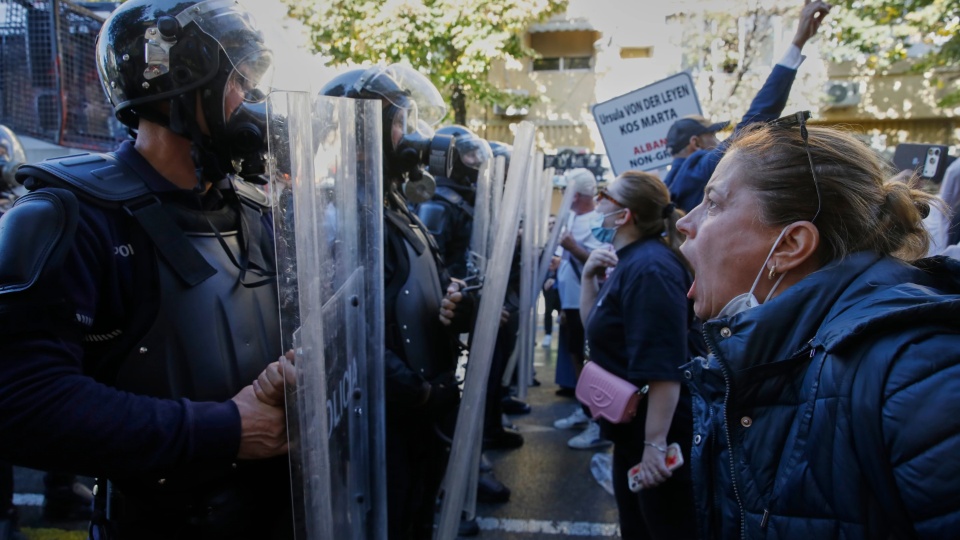
What began as a student protest in first France’s poorest and most ill-financed high schools has now spread—first to even elite high schools, then to universities, then to those workers and retirees on the periphery of the major cities and in the rural areas, and finally now to a combined call of five leading unions for a general strike.
The repression has been fierce but so has the fightback, as militant union firefighters from the Communist-aligned CGT in a previous protest answered police water cannons with their own fire truck hoses and were then cheered as stout resisters at the next protest.
The New York Times, in its coverage of the most recent protests, breathed a sigh of relief that far less property was damaged than previously, neglecting for the most part to feature the demands of the demonstrators. That paper’s coverage also mourned the fact that American visitors in town for an NFL pro football game found many of the shops and museums closed.
Instead of, as Karl Marx described it at the time of the Paris Commune in 1871, “a shameless display of gorgeous, meretricious, and debased luxury,” what visitors were confronted with was Paris in revolt, that is “historic” Paris, as Marx wrote, as opposed to “the Paris of the sightseer.”
There are essentially three reasons the entire country and indeed the continent (massive protests also in Belgium, Italy, Spain, Portugal, and Albania) is rising up: the bitter aftermath of a decade of neoliberal austerity budgets and tax breaks for the rich; the sapping of Europe’s energy supply and the subsequent solution of war; and the (continuing) end of the colonial enterprise.
From Gen Z to Gen Zero
President Emanuel Macron’s neoliberal “reforms” have included tax breaks for the wealthiest individuals and corporations, making it easier to fire employees, and an attack on unions by undercutting their worth so that now only about 10% of the country is unionized.
Add to this attempts to privitize France’s extensive rail system and airport concessions, budgets passed without the consent of the legislature, underfunding of the health system, and, the straw that broke the camel’s back, depleting the education system while making access to elite universities more difficult and even cutting funds for crafts and trade schools, thus consigning Gen Z to what amounts to Generation Zero.
This move to the right has been aided and abetted by Macron’s own centrist parties, which in order to stay in power have swung even more to the right, accommodating not only the right-wing Republican Party but also the Marine Le Pen’s far right National Rally party, particularly on the issue of restriction of immigration.
When an alliance of four left parties won a majority of seats in the last election, Macron refused to name one of their members prime minister. The Socialist Party, as its old guard reasserted itself, then deserted the left coalition.
Macron is aided also by not only a hard-right media with C-News, owned by one of France’s richest men, Vincent Bolloré, the equivalent of Murdoch-owned Fox News in the U.S., but also by the state-owned news channel, which one study reported in its coverage of the current protests devoted “75% of its time to the violence and material damages and only 8% to the demands (of the protesters).”
In education, the protesters have already forced the government to at least tacitly support the ending of its unfair digital system for apportioning students to universities, a recruitment of 500 teachers rather than the formerly proposed cancellation of 836, and additional funds to support the poorest schools, as well as one billion euros in the next three years for higher education. This money, though, is dependent on the overall budget and without increased pressure could easily be withdrawn.
Energy and The Phantom Menace
Josep Borrell, former European Foreign Minister, claimed that Europe’s prosperity in the beginning of the current century was the result of two factors: cheap oil from Russia and cheap goods from China. Ever since that claim, European elites, beholden to the U.S., have been doing everything they can to divest Europe of both.
The blowing up of the NordStream pipeline—which most credibly was attributed by investigative journalist Sy Hersh to the U.S. and Norway, the two main benefactors from the cutting off of Russian oil—has, because of the increase in the price of energy, now further increased by Trump’s War of Choice on Iran, seen Europe’s factories depleted and the continent de-industrialized.
Industries have fled, with that bulwark of European industrial might, Germany’s Volkswagen, closing and moving plants out of Germany, and with one of the largest of these being converted into a weapons factory.
The unpopular European leaders, whose poll numbers begin in the low teens (Macron in France) and fall to single digits (Merz in Germany) as their economies sink, can propose nothing but war with Russia, The Phantom Menace.
Russia, meanwhile, though not wanting to be attacked on its Western flank, looks eastward to China, Iran, and Asia. Europe, instead of importing cheap oil from Russia, is now importing at four times the price and double the ecological damage fracked liquid natural gas from the U.S. or Indian oil, which is largely the same old Russian oil treated in India, at 10 to 20% more than Europe paid previously.
The protests involve cost of living increases in energy and food hastened by these decisions as well as a dawning consciousness that the continent is being led toward war and that its social program spending is being depleted by this conversion to a war economy.
The Russophobic frenzy is most intense in the Nordic and Baltic states and those to the east, as Poland now claims to have underground shelters that can accommodate 25 million of its population of 38 million. Sweden, where a pamphlet has been distributed titled “If Crisis or War Comes,” claims now to be able to house in underground bunkers seven of its 10 million people.
Europe is also slowly attempting to cut off its supply of cheap goods from China, including highly affordable battery-powered cars which aid the continent in its former goal of carbon neutrality by 2050.
The colonizers’ fading ventures
What Borrell did not point out was that part of Europe’s wealth comes from 500 years of plundering both its colonies and each other and that moment is everyday coming to an end.
France in particular, which relies more on nuclear energy than oil, has seen its cheap supply of uranium to power those plants diminished as a revolution in Niger, accompanied by ones in Burkina Faso and Mali, has resulted in Niger selling its uranium on the global market for an increased price rather than having it pilfered for a fraction of its value by the French.
The traces of this stolen wealth are everywhere, as a current exhibition of the Viennese painter Tintoretto featured many of the works owned by the French stolen by Napoleon in his partial conquest of Italy in the 19th century.
As an example of how this age of plunder is coming back to haunt the old continent, the current high-school rebellion did not start in France. It began in a high school in Mayotte, a French colony, and then spread to a high school in the poorest region in France, Saint Denis, filled with immigrants or sons and daughters of immigrants wanting to be part of the life they see around them in the Parisian center.
It should be noted also that the day the protests spread and engulfed all areas of French life, Oct.17, was the 65th anniversary of the day in 1961 when 109 peaceful Algerian peaceful protesters were murdered by the police and their bodies thrown into the Seine as they fought to support their country’s battle for independence.
All these factors underlie the current rebellion both in France and Europe as a whole, a rebellion which shows no sign of abating.
No paywalls at People’s World
We hope you appreciated this article. At People’s World, we believe news and information should be free and accessible to all, but we need your help. Our journalism is free of corporate influence and paywalls because we are totally reader-supported. Only you, our readers and supporters, make this possible. If you enjoy reading People’s World and the stories we bring you, please support our work by donating or becoming a monthly sustainer today. Thank you!
CONTRIBUTOR