
WASHINGTON—President Trump declared today that he bears “no responsibility whatsoever” for the crash of the airline system that shut down traffic across the country for five hours and triggered days of subsequent delays.
The union representing the workers of the air traffic control system, meanwhile, has come out with a list of reasons for the nationwide grounding of planes, warning that refusal to address those reasons will surely cause shutdowns and possibly much worse to happen again. If Trump refuses to implement the corrective measures called for by the workers, he will be fully responsible, they say, for whatever does happen.
The nation’s antiquated and underfunded air traffic control system crashed for more than five hours on the afternoon and evening of November 13 because administrations and Congresses of both parties refused for years to upgrade it and hire enough controllers to run it, the head of the controllers’ union says.
In one of several interviews after the system went down, National Air Traffic Controllers Association (NATCA) President Nick Daniels said lawmakers finally got around in 2025 to appropriating $12.5 billion to start massive modernization of the nation’s extensive system of airport traffic control towers, intermediate routing towers called tracons, and buying and installing new radar equipment.
But the problem goes beyond the mechanics that took the system down, Daniels added. He said U.S. air traffic controllers are underpaid, overworked, and understaffed and wrestling with an antique computer and radar system—a system the FAA is trying to modernize at the very same time it demands the controllers handle record numbers of flights and passengers every day.
Two small electronics failures, one each at tracons in Arkansas and Texas, set off a cascade of multitudes of erroneous messages to planes on the ground and in the air. The Federal Aviation Administration had no choice but to ground every flight—at least 7,000— in the continental U.S., Puerto Rico, and the Virgin Islands for more than five hours. Alaska and Hawaii have their own separate systems, which were unaffected.
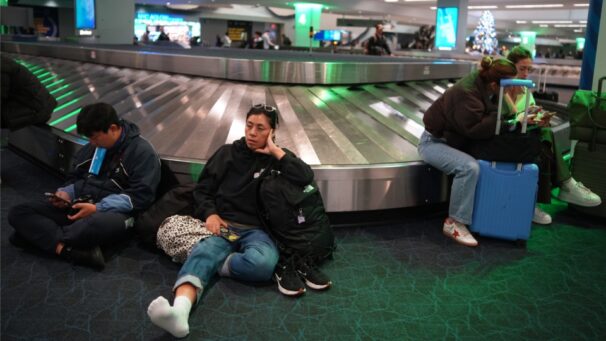
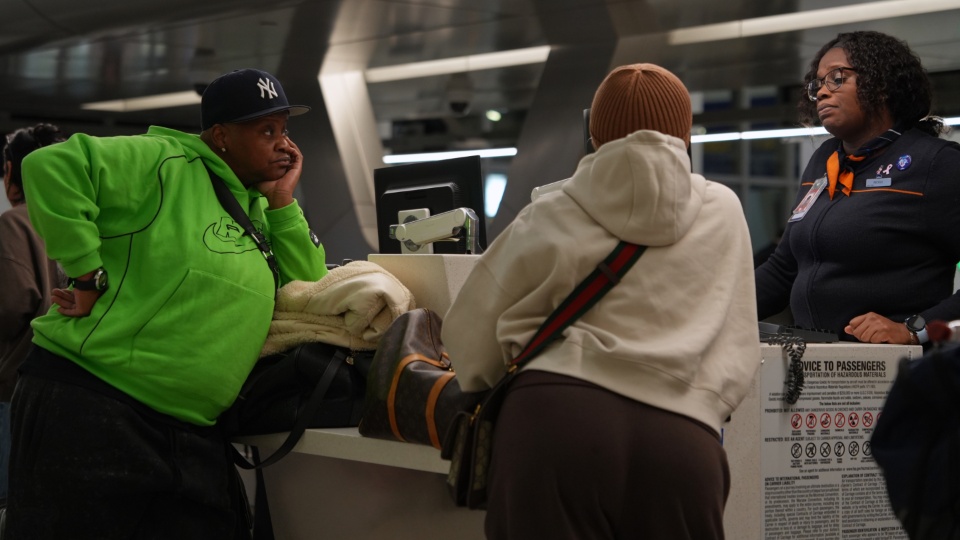
The computer crash left hundreds of thousands of passengers stranded at airports from coast to coast, wondering when—or if—their planes would ever take off or land. Lines were interminable, people camped out in lobbies and aisles; confusion was rampant. Recovery was supposed to occur by November 16.
And all because the air traffic control system is working with 40-year-old computers, routers and radar which buckled under the load, Daniels said.
“There’s no playbook for this,” Daniels told the British Broadcasting Corporation interviewer, live, during the system crash. “When you start having frequencies go intermittent, when you start having radars go down, air traffic controllers are scrambling to ensure the safety of the American flying public.
“And there isn’t a way to say. ‘It’s just one issue over here.’ It’s a set of cascading issues. When it’s this complex system, they don’t know what’s wrong with it yet. The way we mitigate risk is to spread aircraft out, keep them on the ground, and find alternate measures.”
That left the nation’s air traffic controllers with the “primary responsibility to keep the aircraft upon the ground, diagnose the situation and then work from there.”
But there’s a human problem, too: The nation’s air traffic controller force is short of several thousand highly trained and skilled people. That puts an enormous burden and huge nerve-racking responsibility on individual controllers, especially at major hub airports such as Atlanta, Chicago, the Twin Cities, Los Angeles and Dallas-Fort Worth.
Training new controllers takes months, and many initial candidates wash out before passing the basic coursework, reports show. The remaining ones then start their careers at smaller, less-congested airports, getting more training and experience before moving up to the hub airports.
As a result, those airports are short-staffed. And an air traffic controller’s job is so nerve-wracking and pressure-packed that controllers are one of the few groups of federal workers who can retire at full pensions at age 55. Those who want to keep working must seek government permission to do so.
Daniels reported there have been smaller groundings in the last several years, notably in the New York-New Jersey area, Minneapolis-St. Paul and Dallas-Fort Worth. The last nationwide grounding was after the al-Qaeda attacks on New York and Washington, 25 years ago.
Amid partisan finger-pointing, the only agreement was with Daniels’s description that the system’s electronics, computers and radars are so antique that the U.S., considered the “gold standard” worldwide for aviation safety, is falling behind.
The top problem now is “the lack of investment in the system that’s occurred over the last decade,” Daniels said. “That’s why we’ve had to go out and advocate for $12.5 billion to initially start handling some of these issues, and then an additional $40 billion to then bring it up to a standard.
“This is what air traffic controllers who have been going to work for over a decade are saying and have been saying for over a decade: ‘Somebody has to invest in the system or this is another showing of a system, which is supposed to be gold standard, crumbling and being a broken system and somebody has to fix it.’
“It’s like trying to go out and work on the very first laptop ever made” and then see that it “can’t keep up” with computing power and “running Excel spreadsheets” to keep track of the planes.
“We work around this equipment rather than having the equipment work for us.”
Though Daniels did not say so in the TV interview, the shortage of controllers dates back to an infamous event in labor history.
Terrible working conditions and safety hazards, to controllers as well as airline passengers, forced NATCA’s predecessor, the Professional Air Traffic Controllers Organization (PATCO) to call a strike in 1981 over safety issues.
GOP President Ronald Reagan responded by firing all 11,359 PATCO controllers and barring the government from ever rehiring any of them. The entire controller workforce has never completely recovered, much less grown to accommodate the increased traffic of the last 45 years.
And Reagan’s action—against a union that endorsed him in the 1980 election—not only broke PATCO, but the lack of a mass movement for the controllers opened the door for open season by corporate honchos against all unions.
“The other part of this argument that is not talked about is the men and women who” manage the air traffic system, “day in and day out, understaffed, overworked, underpaid,” Daniels said.
“It’s a story that has not been told of the heroics –running the system with the most air traffic in the history of the United States of America and then say, ‘By the way, do it while the system is being upgraded.’ It’s a story that’s going to be told for quite some time.”
It even could occur again next month. Daniels raised the question of what would happen if there’s another government shutdown. Funding for many civilian agencies, including the Federal Aviation Administration, the controllers’ employer, is due to expire at midnight on December 11.
The controllers, like transportation security officers—the airport screeners—are classified as “essential” workers. That means they must come to work even if the money to pay them isn’t there. “
“We’ll do everything we can to get this system working properly, but we’re not going to do it if the radars and radios aren’t working properly.”
Daniels also did not point out, as other print news reports did, that Congress authorized—but did not appropriate, i.e., actually dole out—the $12.5 billion in Democratic President Joe Biden’s infrastructure law. It finally got around to approving disbursement of the funds last year.
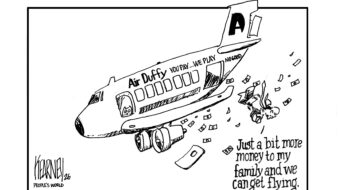
The political reaction does not split on the issue of more money to upgrade and replace the mechanics of the air traffic control system. Trump Transportation Secretary Sean Duffy, for example, says the upgrade and replacement needs $50 billion more.
It does split, along partisan lines, on who’s responsible for denying the funding to upgrade and replace the antiquated equipment and to hire more controllers.
The incoming Democratic majority is considering starting an investigation of who’s responsible for the breakdown, including the private contractor, which is responsible both for the present system and the replacement. Retiring House Speaker Mike Johnson, R-La., a devoted Trump supporter, opposes an investigation.
No paywalls at People’s World
At People’s World, we believe news and information should be free and accessible to all, but we need your help. Our journalism is free of corporate influence and paywalls because we are totally reader-supported. Only you, our readers and supporters, make this possible. If you enjoy reading People’s World and the stories we bring you, please support our work by donating or becoming a monthly sustainer today. Thank you!
CONTRIBUTOR