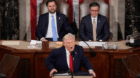
While the capitalist class continues to line their pockets, millions of working-class Americans are skipping medical care, falling behind on rent, and choosing between groceries and utilities just to survive. A new policy report released by May Day Strong, on the heels of President Donald Trump’s 2026 “State of the Union” address, says that the cost-of-living crisis crushing working families is a distinct feature of an economic system rigged by and for the billionaires. But, they argued, there’s a clear path to unrig it.
The numbers are, by now, sickeningly familiar: three out of five people don’t have $2,000 saved for an emergency. CEO pay has skyrocketed by over 1,000% since the 1970s, while worker pay has barely increased, if at all. The top 0.1% now control the overwhelming share of the country’s wealth.
“Across the country, an affordability crisis is accelerating at kitchen tables and in checkout lines,” their report says. “Families are making daily tradeoffs, skipping care, buying less food, falling behind on bills, just to get through the month.
“The basics of a good life—an affordable home, quality healthcare, nutritious food, a dignified job—are increasingly out of reach for millions of Americans. At the same time, big corporations and the superrich are posting record profits.”
The report lays out that this economic crisis has hit African-American and Latino communities the hardest and is the direct result of a system that “has prioritized private profit over public well-being.” But unlike the capitalist class’s think-tank papers, The Real Affordability Agenda is designed as a working-class battle plan for city halls and statehouses in the upcoming midterms.
May Day Strong’s agenda is built on three core pillars meant to guarantee a dignified life for everyone: Affordable Housing, Good Jobs, and what they call “Affordable Universal Needs.”
Housing as a public good
The report takes direct aim at the architects of the housing crisis, pointing the finger at corporate rent gouging, real estate wealth concentration, and private equity landlords. The solution to the housing crisis isn’t just to build more housing, they said in response to the neoliberal supply-side economic argument, but to build the right kind of housing.
Their platform calls for strict limits on rent increases to prevent families from being displaced by corporate landlords seeking limitless profits. To fund truly affordable homes, they advocate for dedicated taxes on luxury property sales—“transfer taxes” on high-end transactions over $1 million—with the revenue funneled directly into affordable housing production and preservation.
The agenda also champions the expansion of “social housing models”—permanently affordable homes, owned by the public or non-profits, where residents have a democratic say in how things are run. In fact, they argue, it’s a winnable alternative to the financialized model we have now, where financiers and private-equity buy up homes, sometimes entire neighborhoods, as assets to be flipped while they rake in profits from rent in the meantime.
A $25 minimum wage and a jobs guarantee
While corporate profits continue to surge, working-class power has been systematically dismantled since the 1970s. In response, May Day Strong’s agenda is demanding a federal minimum wage of at least $25 an hour, indexed to the actual cost of living, and an end to all subminimum wages—including for tipped workers, workers with disabilities, and incarcerated workers.
But they go further. To counter the coming “tsunami of layoffs” as capitalists seek to replace workers with AI or chase short-term profits, the report calls for a federal jobs guarantee.
“Rather than letting unemployment soar,” they said, “a public jobs program will put people to work rebuilding our communities, strengthening local economies, and restoring dignity to work instead of letting corporate greed decide who gets left behind.”
This is paired with calls to repeal anti-union “right-to-work” laws, establishing universal paid leave, strong worker organizing protections, curbing employer misclassification tactics, strengthening unemployment protections, and cracking down on wage theft.
Universal needs, from childcare to transit
Importantly, their agenda reframes basic necessities as public goods rather than as “free market” commodities. That means fully funded universal childcare with fair wages for providers, free school meals, debt-free public college, and fare-free, reliable public transit.
“Healthcare,” the report says, “is a basic need for survival, but for too long we have treated it as a product to be sold at a profit.” While reiterating the long-term goal of expanded Medicare for All, they also demand immediate action to stop Big Pharma price gouging and eliminate medical debt.
Even utilities are on the table. They call for publicly owned utilities and progressive rate structures that charge the energy monopolies more while at the same time “keeping the lights on” for working-class families.
“The billionaires will pay for it”
The question from the ruling class punditry is always, “How do we pay for it?” The report’s answer to this is quite simple: make the people who have all the money, yet do no work, pay for it.
“For too long, our tax system has favored the rich, allowing them to amass extraordinary fortunes while public services and safety nets have been starved of resources,” the report explains.
Their tax justice strategy targets extreme wealth (think Jeff Bezos and Elon Musk), forces large monopolies like Amazon and Walmart to “pay what they owe” by closing loopholes, and penalizes predatory practices like CEO-to-worker pay disparities and corporate pollution.
To make their case, they highlight recent victories proving it can be done. As an example, Massachusetts’s millionaire’s tax is generating billions for education and transit. And New Mexico is using corporate revenues to fund free universal childcare. In New Jersey, a new corporate transit fee is pouring over a billion dollars a year into public transportation.
“This is a fight for the soul of our country,” the report concludes. “We can choose to build an America where everyone has an affordable home, access to healthcare, and a job that pays a living wage.”
For the growing pro-labor, pro-democracy movement looking for a roadmap to channel working-class anger into tangible wins in the upcoming 2026 Midterms, The Real Affordability Agenda offers a program of what can be fought for and won.
We hope you appreciated this article. At People’s World, we believe news and information should be free and accessible to all, but we need your help. Our journalism is free of corporate influence and paywalls because we are totally reader-supported. Only you, our readers and supporters, make this possible. If you enjoy reading People’s World and the stories we bring you, please support our work by donating or becoming a monthly sustainer today. Thank you!
CONTRIBUTOR