JERSEY CITY, N.J.—A few weeks after Zohran Mamdani’s election in New York, Jersey City, a city with a population of over 300,000 people, elected an almost entirely brand-new government on Dec. 2. Those elected were backed by a progressive coalition of unions, immigrant rights organizations, and environmental groups.
Echoing what took place across the water, Jersey City’s progressive candidate for mayor, current Councilmember James Solomon, defeated Jim McGreevey, a former disgraced governor with ties to real estate developers and a long history of corruption.
The result followed the Nov. 4 defeat of Trump’s pick for New Jersey governor and the Republicans losing four seats in the state assembly. Jersey City also sent Working Families Party candidate Katie Brennan to the statehouse in Trenton.
Only two of the 52 candidates running for the city’s 10 non-partisan mayor and council seats got more than 50% of the vote on Nov. 4, triggering the Dec. 2 runoff. Jersey City does not have ranked-choice voting, which would allow voters to list their candidates in order of preference, eliminating the need for a runoff.
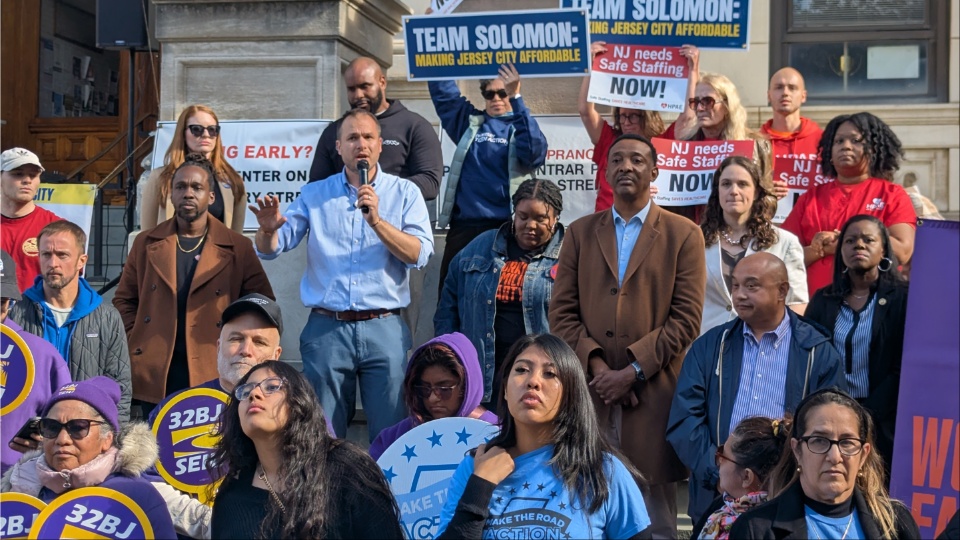
Mayor-elect Solomon and all of the six elected ward candidates were backed by the New Jersey Working Families Party. Two of them are Democratic Socialists, the first open DSA members elected to public office in the state.
In the Nov. 4 election, two of the councilmembers-elect had been part of Hudson County Commissioner Bill O’Dea’s team, another progressive candidate for mayor. Another was independent. The rest, including the three at-large council candidates, had been on Solomon’s team, or had endorsed him. In the Dec. 2 runoff, all of them linked up with Solomon to defeat McGreevey.
Solomon received 68% of the vote. Taken together, the rest of his team won by similarly wide margins. Turnout for the mayoral race was just under 20% on Dec. 2, compared with 36% a month earlier. For at least 20 years, Hudson County has had lower voter turnout than any other county in the state. Many residents have become deeply disillusioned with the county’s machine politics, corruption, and backroom dealing.

Still, the election result marked a major victory for progressive forces overall, though independent at-large candidate Tina Nalls did not win a seat. Nalls is a former childcare worker and a community leader on Jersey City’s south side, which is predominantly African American. Her presence on the council would have strengthened struggles for accountable policing, mental health care, jobs, housing, and youth programs.
Solomon’s opponent, McGreevey, was supported by the Hudson County Democratic Organization. His campaign spent twice as much as Solomon’s and was flooded with dollars from real-estate and anti-labor construction firms, MAGA donors, and charter school funds. McGreevey refused to criticize Trump and promised no protections for immigrants. He and his whole team were soundly rejected at the polls.
Solomon’s campaign was primarily focused on affordable housing and making real estate developers pay their fair share. He refused to accept any developer donations.
His platform also included strong enforcement and expansion of rent control, fair workweek and heat protection laws for Jersey City workers, fighting for a $20 minimum wage and full school funding from the state, pairing mental health professionals with police and fighting for a Civilian Complaint Review Board with real power to hold police accountable (the latter also requires state action), 1,000 new summer youth jobs, bringing more investment into Jersey City’s south side, awarding more city contracts to minority-owned businesses, fighting for expanded public transit, and defending and strengthening the city’s sanctuary law, alongside other protections from ICE. Not all of these points, however, were strongly highlighted on the campaign trail.
The Democratic Socialists elected to council, Joel Brooks and Jake Ephros, added the need for free universal childcare and universal rent control. They also championed some ideas from Mamdani’s campaign in New York, like municipally-owned supermarkets to provide low-cost groceries for residents.
Healthcare access was another important issue. Christ Hospital is facing shutdown by its new owner, Hudson Regional Health, which appears to have bought the property with the goal of turning it into luxury apartments. As of now, only the emergency department remains open. The city’s lone remaining hospital, Jersey City Medical Center, is now unable to provide beds for all its patients. The nurses’ union, HPAE, had endorsed Solomon because of his work in helping the fight to keep Christ Hospital open. On Dec. 10, the council passed an ordinance co-sponsored by Solomon to ensure the site will primarily be used for medical care.

Solomon was first elected as a councilmember representing Ward E by the city’s waterfront in 2017 and was backed by Bernie Sanders’ OUR Revolution organization. Together with Ward F Councilmember Frank Gilmore, who has been re-elected, he regularly challenged Mayor Steven Fulop’s handouts for real estate developers.
Solomon could have earlier strengthened his campaign’s presence within Jersey City’s south side and put a bigger focus on basic equality questions affecting all the issues. This weakness made him vulnerable to attacks from McGreevey, who played into existing grievances against Fulop, painting Solomon as a downtown gentrifier.
Nonetheless, Solomon won a majority of the vote in most south side districts. But he will need to strengthen his relationship with the African American community to build unity around his progressive program and overcome big business opposition.
Affordable housing
The new administration will be challenged to address the problem of rising rents and property taxes and the closely connected problem of funding a working class and people’s budget.
Solomon’s program includes requiring 20% of the housing units in all big developments to be affordable. Newark’s experience under Mayor Ras Baraka’s leadership shows developers will build with a 20% affordability requirement. Newark’s law also requires a quarter of that 20% to cost no more than $1,150 per month.
The combined negotiating power of progressive mayors in New York City, Jersey City, and Newark can give each of them more leverage, if they work together, to push for more and deeper affordability while reducing or eliminating tax cuts for developers.
In the current political moment, cities have limited options for creating affordable housing—built and maintained by union workers—that do not rely on negotiating the best deal they can get from private developers. Those developers exist to make profits and will refuse to build anything unless they get more than they give. For a more fundamental solution to the housing crisis, a mass state and national housing movement must be built to win federal funding for public housing or a similar state-run program.
Jersey City will have to resolve a deepening budget crisis largely resulting from decades of tax cuts for developers in the form of abatements and “payments in lieu of taxes” (PILOTs). Sometimes these have been given in exchange for including affordable housing and guaranteed union contracts, and other community benefits.
The 30-year PILOT for a 360-unit development at 701 Newark Ave., for example, required 25% affordable housing and union jobs. Outgoing Mayor Fulop has handed out many of these tax breaks without requiring much or anything in return. His allies on the council gave the Kushner family’s KRE Group a 30-year, $150 million tax break to build the Centre Pompidou, without requiring any affordable housing or union jobs.
To make up for the lost revenue, the city and Board of Education have raised property taxes on homeowners and slashed the budget at the same time. Meanwhile, large luxury towers have driven up rents and property values. Higher property taxes and the influx of higher income residents also spur businesses to raise prices. Homeowners and renters alike are getting squeezed or priced out.
Jersey City schools are especially affected. Money from PILOTs have not gone to the schools, and the concentration of wealth on the waterfront has skewed the city’s average income upward. This, alongside other state aid cuts, has triggered a reduction in state funds for Jersey City schools.
Big business has also evaded the city’s employer payroll tax, which goes toward schools. At the same time, state laws limit the city’s ability to redistribute its own wealth. It cannot create its own progressive income tax, for example, or a tax on business profits, and all properties must be taxed at the same rate.
Solomon’s plan is to raise funds from fees on developers, impose maximum penalties on landlords for legal violations, and enforce the payroll tax. He wants to review all existing PILOTs, terminating those where developers haven’t kept up their end of the bargain, and audit all PILOTs each year. He has also promised to use available state laws to require all new developments pay their fair share toward the city’s schools and infrastructure.
These would be important steps forward. To fulfill the people’s needs, it will also be necessary to struggle for legislation at the state level. Local elected officials can play a big role in helping to mobilize and broaden that fight, and the defeat of the GOP and progressive victories across the state on Nov. 4 have laid the basis for working people to win real victories.
We hope you appreciated this article. At People’s World, we believe news and information should be free and accessible to all, but we need your help. Our journalism is free of corporate influence and paywalls because we are totally reader-supported. Only you, our readers and supporters, make this possible. If you enjoy reading People’s World and the stories we bring you, please support our work by donating or becoming a monthly sustainer today. Thank you!
CONTRIBUTOR