

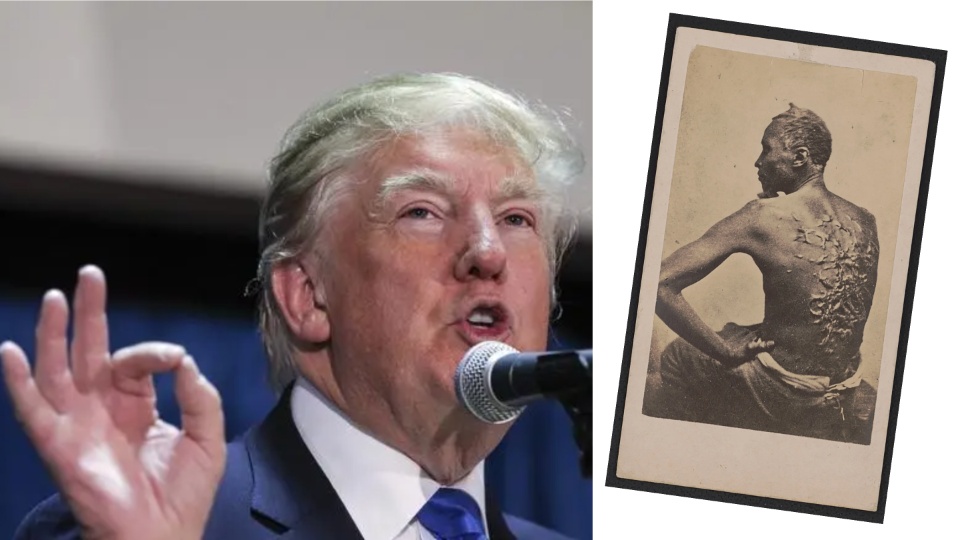
The white supremacist MAGA administration headed by Donald Trump has ordered the removal of information and depictions of the era of slavery in the United States from materials posted at several national parks and historic sites.
One of the most emblematic images of enslavement is the graphic and soul-shocking photograph titled “The Scourged Back,” which depicts a man, an escaped slave who was known by both names Peter and Gordon, taken circa 1863 in Louisiana. The photo graphically shows his healed but keloid-scarred back.
The image vividly presents the horrors and brutality of enslavement, as the wounds on his back were inflicted by the whip of his former so-called “owner.” Trump has ordered its removal from a monument in Georgia.
Erasing the histories and experiences of Black people in the U.S. is part of the educational pogrom being enacted by the administration to “whitewash” America’s real history. It is a political project to change the narrative of U.S. society’s development in a way that centers the blessings and triumphs of white people while ignoring the blemishes, scars, and struggles that are as great a part of America’s history as any other nation.
The institution of slavery in North America’s British colonies commenced in 1619 in Jamestown, Va., and it did not legally end until 1865. A Civil War had to be fought to settle the question and end the legal institution of slavery. And even when it had legally ended, new systems and schemes were developed, particularly in the southern U.S., to re-institute de facto slaver.
This system, called Jim Crow, would continue through until it was painstakingly dismantlement by courageous individuals and movements who exposed it and bought about its demise.
Formal enslavement lasted for 246 years, and then the era of Jim Crow dragged on for at least another 100 years. The effects of both still persist for many people today—they aren’t just past history.
In 2026, the United States of America will celebrate its 250th birthday. If you survey those two-and-a-half centuries of existence and add in the period before U.S. independence, there were 246 years of enslavement and another century of apartheid.
So, there is no way that the U.S. could have been born, continued to exist, nor have its story told without also telling the story of Black people—and that includes our full saga, from enslavement to liberation, along with all the hardships to struggles overcome along the way.
To remove the histories and narratives of Black people in North America is akin to removing the heart from a living body, and along with its heart, that body would also lose its soul. The body and its story without its Black history component is really a dead and empty narrative and will remain so until America has the courage to tell the whole story.
The official U.S. narrative is encapsulated in the image of the Statue of Liberty, which welcomes the world arriving at Ellis Island with a bronze plaque invitation: “Give me your tired, your poor, your huddled masses yearning to breathe free, The wretched refuse of your teeming shore.” In the statue’s left hand, on a tablet, is the date July 4, 1776.
Knowing the full history of most Black people is an effort plagued by limitations; we weren’t welcomed upon arrival as Lady Liberty’s image portrays. We were treated as property and given names for inventory, not people. We were bought, sold, raped, and worked to death. Black families doing genealogical research usually encounter a brick wall at a certain point because of this.
Much of what we do know of ourselves exists through oral traditions that attempt to teach and convey to us experiences and history in a world where we live and work but never existed.
My story, for instance, starts before Ellis Island. My family arrived on Sullivan’s Island, South Carolina. This was a major marketplace and auction block for the precious and enriching cargo of Black people stolen from Africa. When talking to my family, it seems from the narrative, that they and their descendants were bound to the same plantation in South Carolina for at least 200 years—46 years, more or less, shy of the total period of slavery’s existence on this continent.
There have been ludicrous reasons presented for erasing the images and memories of slavery from our public spaces. One is that it makes white people feel guilty. The Trump / MAGA / white supremacist administration says that posting information about slavery (or the genocide of Native Americans) spreads “corrosive ideology,” which means that a new ideology is being fomented to replace it.
Evidently, the current historical narrative that includes slavery and overcoming that ordeal somehow eats away and corrodes the so-called “pro-American” narrative. But in reality, those being bothered and feeling corroded are those who want to sanitize and de-color the real history of America.
It is not that they are embarrassed by the brutal history of enslavement. Rather, they embrace a politically racialized framework that essentially proffers the notion that the history, experiences, and existence of Black people don’t matter.
This administration has already proven on multiple occasions how racialized it is. Its efforts through DOGE cost 350,000 Black women their jobs. Mobs called law enforcement, some in masks and with no identification, roam the streets removing brown and Black immigrants.
Among some segments of the population, they have succeeded in implanting a criminalized view of immigrants as part of their agenda of removing non-whites from the population. Not recognizing the presence and history of Black people is a further step in that direction. It renders in perception, in popular historical understanding, and in official narrative the pronouncement and indoctrination that the United States is a white Christian nation without blemish or scar.
A scripture says that, “These commandments that I give you today shall be upon your hearts. You shall teach them diligently to your children, and shall talk to them when you sit in your house, and when you walk by the way, and when you lie down, and when you rise up.”
Our story will be told despite this racist agenda of erasure. We will talk about the good, the bad, and the ugly. We will tell the story into the generations, and we will become loud about who we are, what we have experienced, how we have overcome the impossible with possibilities, and declare, no matter how hard we have been pressed down and ignored, in the spirit of Maya Angelou, “Still I rise!” And so will the history of our experiences rise to the heavens and invade all of American history, and we will not be erased.
As with all op-eds published by People’s World, the views expressed here are those of the author.
We hope you appreciated this article. At People’s World, we believe news and information should be free and accessible to all, but we need your help. Our journalism is free of corporate influence and paywalls because we are totally reader-supported. Only you, our readers and supporters, make this possible. If you enjoy reading People’s World and the stories we bring you, please support our work by donating or becoming a monthly sustainer today. Thank you!
CONTRIBUTOR



MOST POPULAR TODAY

Europe refuses war script: Spain’s rebuke exposes limits of U.S.–Israeli escalation in Iran

Trump’s Postmaster General says USPS may shut down in a year

Trump refuses to pay screeners unless Congress approves his voter repression

Praising Trump’s war, monarchist forces hijack Iranian diaspora

Strategic retreat or strategic pivot? The state of the Target boycott