While tourism seems to be booming around the world, the United States is bleeding visitors and with them, jobs. The numbers, released in a new report by UNITE HERE, tell a damning story of a once-thriving hospitality industry in crisis that should alarm every worker in the country.
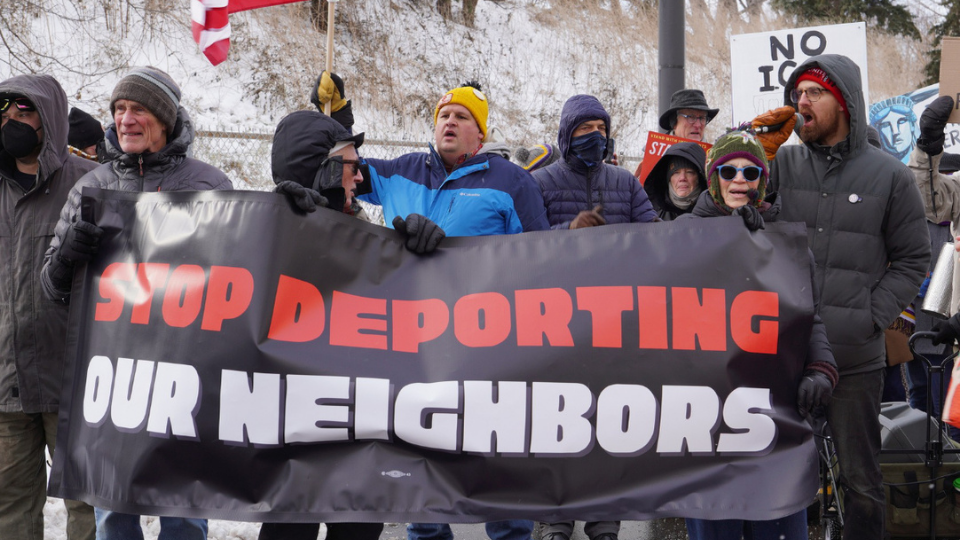
The hospitality industry is suffering from something entirely preventable. The Trump administration’s terroristic immigration policies and militarily occupying U.S. cities “are making the U.S. inhospitable,” the union’s report said.
The impact on jobs is being felt all over the country, with nearly 100,000 less people working in hospitality in December 2025 than the year before. The jobless rate in hospitality climbed to 6.1 percent, up from 5.4 percent. And for those still working, conditions have become increasingly brutal.
Take Filene Julien, a driver for airline caterer LSG Sky Chefs at Miami International. She’s been there seven years, making sure flights are stocked and ready. But when the Trump administration stripped Temporary Protected Status (TPS) away from immigrant workers, her team started thinning out—not because the work was gone, but because her coworkers were.
“Before this happened, we would only be assigned to work two flights per day, but now we have to do three, sometimes four flights,” Julien said. “It used to be an eight-hour shift, but now it can be 12 hours or more. There are times I’ve arrived at four in the morning and still haven’t gone home by ten at night.”
Julien has six kids to support. She keeps working these punishing hours because she has no choice.
“It’s time for my co-workers with TPS to have a pathway to citizenship. No one should have to live in fear, not knowing what is going to happen to them,” she said.
In South Florida, where 42% of the people are immigrants, the revocation of TPS for over a million people is like pulling the rug out from under an entire economy. UNITE HERE Local 355 estimates that 90% of its 7,000 members are immigrants. Already, 10% of the airport’s concession and catering staff have lost their right to work.
Fewer tourists, smaller paychecks
Even luxury hotels are feeling the squeeze. For example, in Miami, where over 65 percent of hotel workers are foreign-born—the highest percentage in the country—employers are struggling to maintain the staff-to-guest ratios that luxury properties require. Meanwhile, “economy” hotels are taking a huge hit as working-class travelers continue to cut back on discretionary spending due to the rising cost of living.
Coupled with that, the hospitality industry operates on razor-thin margins already. So when workers “disappear” or customers stay home, everyone feels the economic pain.
In Las Vegas, for example, the total number of visitors declined by 7.5 percent in 2025, dropping below 40 million for the first time since 2021. Hotel occupancy on the Strip fell from 86.4 percent to 83.2 percent, and revenue per available room dropped 8.2 percent.
Shaleah Taylor, a guest room attendant in Las Vegas for 13 years, sees the slowdown every day on the job.
“You can feel that business has slowed down. People are spending less, and some of my coworkers who depend on tips are seeing a real drop,” she said. “Even a 10 percent decrease makes a difference when you are living paycheck to paycheck. For working people, that affects how we pay bills, how we buy groceries, and how we take care of our families.”
Rhodora Barry has worked as a master cook at the Flamingo Hotel in Las Vegas for 25 years. She still has her job because of seniority, but she watches her coworkers struggle with reduced hours and lost income. Even her own children are being crushed by housing costs—one daughter pays $2,200 a month to rent a two-bedroom apartment, another has a mortgage of over $3,000 a month for a small home.
“We need policies that help working families, lower grocery costs, and support local businesses,” Barry said. “We need an economy that works for regular people, not just corporations or politicians.”
UNITE HERE notes that the decline in tourism is a direct result of the Trump administration’s policies that have made the U.S. feel hostile and dangerous to visitors.
By July 2025, over a dozen countries issued updated travel advisories for the U.S., including Australia, Belgium, Canada, China, Denmark, Finland, France, Germany, Ireland, the Netherlands, New Zealand, Portugal, and the United Kingdom. A Skift Research survey found that around 46 percent of international travelers are less likely to visit the U.S. “due to its current leadership.”
In the month of September last year, international spending didn’t just dip—it cratered by $1.2 billion. The U.S. saw 2.5 million fewer international trips compared to the previous year. For the first time since the 2020 pandemic, the needle is moving in the wrong direction.
In Seattle, for example, Canadians make up 73 percent of international visitors. In October 2025, Canadian air travel to the U.S. declined 24 percent compared to the previous year, while car travel dropped 30 percent. Tourism Economics projects a 26.9 percent decline in international overnight visitation to Seattle in 2025—the steepest drop among major U.S. destinations.
As a result, Emilio, a housekeeper at Seattle’s Edgewater Hotel, has seen his working hours evaporate.
“At first, I was working four or five days. They started cutting my hours in October,” he said. “I never expected my hours to get cut like this. My coworkers say it has never been this slow before. There was one month I didn’t get any work at all, not even one day.”
With two young children and a wife who isn’t working, Emilio is the sole provider for his family. He found a second job at an industrial bakery, but they don’t give him enough hours either. Now he’s looking for a third job. His rent is over $2,000.
“I’m so worried, because I don’t want us to lose our apartment. Food is one thing; I can go without food, but we need to have a roof over our heads. I have to ask my friends to loan me money,” he said.
People simply too scared to go out
In Washington, D.C., the Trump administration’s deployment of National Guard troops and federal agents to occupy the city devastated local businesses. Restaurant reservations dropped 30 percent in the days following the announcement. Hotels in some neighborhoods saw travel decline by as much as 20 percent.
One hotel developer requested a two-year extension on a planned project, citing the “visible presence of the National Guard” and policies that have “negatively impacted international travel to the U.S. overall and Washington, D.C. specifically.”
Rhonda Steward, who has worked in housekeeping at D.C. hotels for 14 years, was laid off for two weeks over Christmas—something she’s never experienced before.
“I’ve had to use so much more leave last year, probably three or four extra weeks, just to make up for the lost hours and pay my bills,” she said. “The problem is, I’m burning through my leave just to survive financially, which means I don’t have any left when I’m actually sick or need time off to rest.”
Greg Varney, a line cook in Washington, D.C., has watched his restaurant go from 500 covers a night to barely 250. Between mass federal layoffs and the sight of masked federal agents on street corners, people are simply too scared to go out.
“A year ago, our weekends would have 450 to 500 covers per night; now, at best, we do around 250,” Varney said. Mass layoffs of federal workers and fear of federal agents have discouraged diners from eating out. But it’s the atmosphere in the kitchen that truly captures what’s happening.
“During the occupation, there was an intense and palpable fear in the kitchen. People had family members who were taken,” Varney explained. “We all now jerk our heads up whenever we hear sirens, even in a city like D.C., where it’s common. I’ve had to come in when I wasn’t scheduled because of the increase of call-outs among staff. We are all trying to watch out for each other, but it feels like we’ve basically taken on a second shift due to this occupation and raids in D.C. streets.”
Two Americas, one broken industry
The data provided by UNITE HERE in their report paints a picture of a hospitality industry in severe crisis. CoStar Group reports year-to-date U.S. RevPAR growth through August at just 0.2 percent, the lowest level on record outside of recessionary periods and 2020. Average daily rate growth of 1 percent is lagging inflation. As one industry analyst put it, the U.S. could be entering a “hotel recession.”
According to even the Wall Street Journal, “There are two economies in the U.S. right now, and they are moving in different directions. For high earners and many older Americans, the economy looks robust… For many others, momentum has stalled or reversed.”
The hospitality industry is just one example where those “two economies” collide. Luxury hotels are serving fewer guests at higher prices while “economy” hotels increasingly sit empty. The immigrant workers who help keep the industry running are being pushed out of the workforce. And the U.S.-born workers are being forced to work longer, harder shifts.
For the union workers who were interviewed for this report, they are fighting to keep doing the jobs they’ve done for years, sometimes decades. They’re also fighting for their co-workers to be able to work without fear, with equal rights on the job and in society. And they’re asking for an economy that benefits working people, not just the billionaires and the well-connected.
Until those things change, the “inhospitable” conditions in America’s hospitality industry will only get worse.
We hope you appreciated this article. At People’s World, we believe news and information should be free and accessible to all, but we need your help. Our journalism is free of corporate influence and paywalls because we are totally reader-supported. Only you, our readers and supporters, make this possible. If you enjoy reading People’s World and the stories we bring you, please support our work by donating or becoming a monthly sustainer today. Thank you!
CONTRIBUTOR