ATLANTA—Atlanta residents seeking improved public services and living conditions often find themselves up against what so many around the country have dealt with before: Funding mechanisms that can end up favoring wealthy neighborhoods over working-class areas.
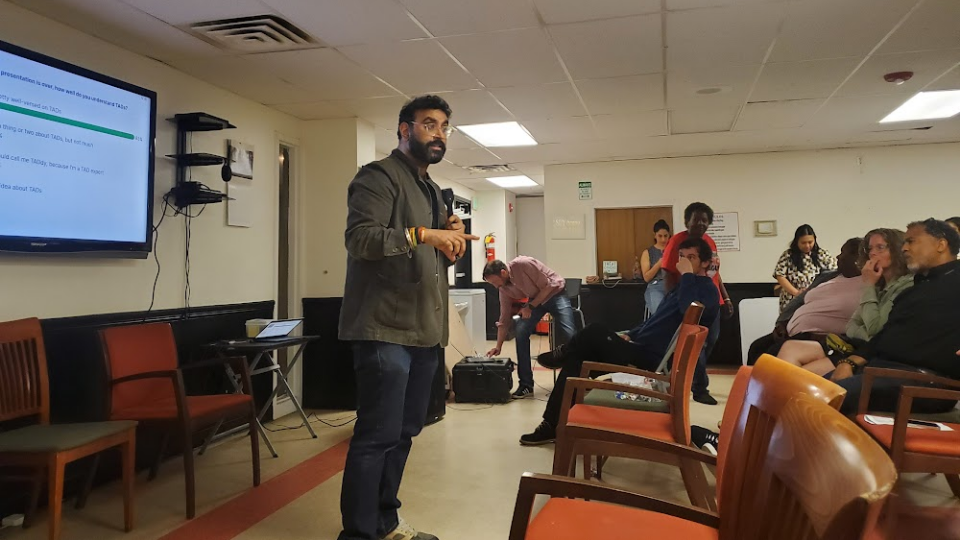
Residents of Atlanta gathered in the Rick McDevitt Youth Center on Tuesday evening for an educational event put together by the Center for Civic Innovation (CCI) to discuss the City of Atlanta’s Tax allocation districts, also known as TADs. TADs are a financial tool that allows Atlanta to use tax property increases to fund public infrastructure in certain neighborhoods
Tax allocation districts (TADs) are zones in which a base property tax value is frozen at creation, and any increases in property tax above that base are used for development in that specific area rather than funding public schools or government services available to a broader community.
Base property tax revenue still goes to public services as usual. Essentially, as property values rise, the city takes the extra tax dollars raised and invests them directly into the TAD, rather than putting the extra collections towards general tax funds. Collections from the base property taxes continue to go towards general city and county funds.
TADs are a hot-button issue in Atlanta at the moment, given that Mayor Andre Dickens’ office recently announced plans to extend the eight current TAD district expiration dates until 2055. Some TADs are currently set to close in 2030, such as the Beltline TAD, while others have expiration dates of 2050.
When a TAD expires, all property taxes collected in the various neighborhoods go back towards their regular funding targets, such as Atlanta Public Schools. The promise of a TAD relies on the idea that once a TAD expires, property value will be higher because of the TAD investment, and city and county services will earn back what they lost from the reallocation of funds during the TAD period.
While the city proposes TADs as a tool in the fight against inequality, some activist organizations say that they do not achieve their stated goals. According to a 2023 study by Partnership for Southern Equity (PSE), rather than eliminate inequality, TADs force “poor communities to subsidize their own displacement.”
Analyzing TADs between 2016-2021, PSE found that TADs “are both ineffective at meeting their intended technical purpose of driving commercial activity to raise property values, and are, at worst, a driver of displacement of legacy residents and low-wealth communities of color”. The study points out that TADs don’t always raise property values as promised, and if they do, there is no safety net in place to ensure that legacy residents can afford to pay the higher property costs.
Through the inquisitive looks and raised eyebrows, Atlanta residents did their best to absorb every bit of information put forward in the outdated rec center in South Atlanta. In order to bring some humanity into the conversation, Alison Johnson of the Housing Justice League and Ashley Buzzy, a small business owner, sat on a panel hosted by Chauncey Alcorn of Capital B to explain the on-the-ground impacts of TADs. The two panelists spoke on how they have seen TADs impact their local communities and why they have mixed feelings on the Mayor’s announcement to extend their deadlines.
Johnson started her remarks by calling out the City of Atlanta for a “never-ending cycle of broken promises”. Even though the City touts TADs as a solution to poverty and inequality, Johnson made it clear that, as a lifelong resident of Atlanta, she cannot trust the city outright on the policy. The housing equality organizer was adamant that she and her community “are not anti-development, [they] want development that works for and with [them].”
Some in the audience shared a similar sentiment to Johnson: TADs can work, but the City has not shown enough to fully convince residents they will achieve their goal. One of those residents was Columbus Ward of Peoplestown, the neighborhood hosting the CCI event. Before coming to the event, Ward was fairly familiar with TADs. He has served as president of his Neighborhood Planning Unit and served as an advisor to Invest Atlanta. Invest Atlanta is a committee chaired by the mayor that decides where funds collected through TADs will go.
After the panel, Ward felt that TADs “could help”, but “it depends where [Invest Atlanta] puts the money.” Ward was worried that they would simply use TAD funds to fund developer projects that don’t prioritize low-income residents. In his opinion, the funding should not be given to real estate developers who do not ensure that residents earning the average income can afford to stay in their properties.
Ward cited the rec center in which the discussion took place as an example of where the money could go. He pointed out that the youth center had not seen “significant improvement for over 30 years”. The stained ceiling panels and 90s decor served as evidence of his claim.
While children yelled and played basketball outside the small brick building, the attendees left the event with a little more information in their pockets on what a TAD is and what purpose it serves. There was anger in the room over the rampant inequality in the city, but attached to it all was a sense of determination. A determination to ensure Atlanta is an equitable city. As Johnson closed out the panel, she told the audience, “It is not incumbent on the city to do the right thing; it is incumbent on us to make the city do the right thing.”
Atlanta residents hoping to learn more about TADs and their impact can attend the next TAD Talk on Thursday, May 7th, at 6 PM, located at the Ke’nekt Cooperative.
People’s World is in the midst of its annual fund drive, trying to raise $140,000 by May Day. To support working-class journalism, please consider make a donation or become a monthly sustainer. Thank you.
CONTRIBUTOR