SELMA, Ala.—On Sunday, thousands from all over the country made their way here to participate in the commemoration of the 1965 Bloody Sunday attack. They assembled around the historic Brown Chapel AME Church within Selma’s George Washington Carver housing projects.
Marchers said the event, which was both a remembrance and a launching of renewed struggle, is necessary to preserve the voting rights and economic gains that have been won since the 1960s. A leading role in organizing the weekend gathering was played by the Southern Christian Leadership Conference (SCLC), the organization co-founded by the Rev. Martin Luther King, Jr., himself.
At the peak of the Civil Rights Movement, Selma became the epicenter of the struggle against Black disenfranchisement. While the 15th Amendment to the Constitution granted voting rights to Black men on paper in 1870, Jim Crow state governments across the South spent decades utilizing a plethora of legal loopholes and reactionary tricks to make it nearly impossible for Black people to register to vote.

The registrar’s office within the Dallas County Courthouse became notorious for its extreme voter suppression of Selma’s Black community, while the organized resistance to these practices became legendary.
In 1965, the struggle in Selma came to a crescendo when unarmed civil rights marchers, led by Hosea Williams and the then-young late Democratic Rep. John Lewis, were brutally attacked by a gang of Alabama State Troopers while crossing the Edmund Pettus Bridge. They had intended to march all the way to the state capital, Montgomery.
The attack became a watershed moment for the Civil Rights Movement as footage of the violence was broadcast on television across the nation, garnering support for its goals among millions of Americans.
Now, 61 years later, Selma commemorated the legacy of the attack with a week-long jubilee, culminating in Sunday’s memorial march across the Edmund Pettus Bridge. The march was preceded by a rally in Foot Soldier Park, where Jeremy Ponds, the field director of the SCLC, acted as the master of ceremonies.
Bullhorn in hand, Mr. Ponds called on the crowd to march non-violently and in an orderly fashion.
“We’re not going to bum-rush the bridge. We’re gonna bum-rush the ballot box,” he said to the crowd before introducing the first speaker, Armani Eady of the American Civil Liberties Association (ACLU).

In her speech, Eady drew comparisons between the Civil Rights struggle of the ’60s and the current struggle to resist the agenda of the Trump administration.
“How much more do we have to go? And are we going to get there?” she asked the audience. “These are the questions my foremothers and forefathers had while they were sitting at lunch counters and marching across bridges.”
Following Eady, the bullhorn was passed to formerly incarcerated community organizer Kenneth Glasgow, who opened his speech by yelling “Mustard!” as a sort of battle cry, a reference to rapper Kendrick Lamar’s hit record “TV Off.”
Following that, Glasgow’s wife and executive director of The Ordinary People Society, Rodreisha Russaw-Glasgow, as well as former SCLC President and current member of the New National Christian Leadership Conference, Rev. Dr. Byron Clay, delivered their own speeches.
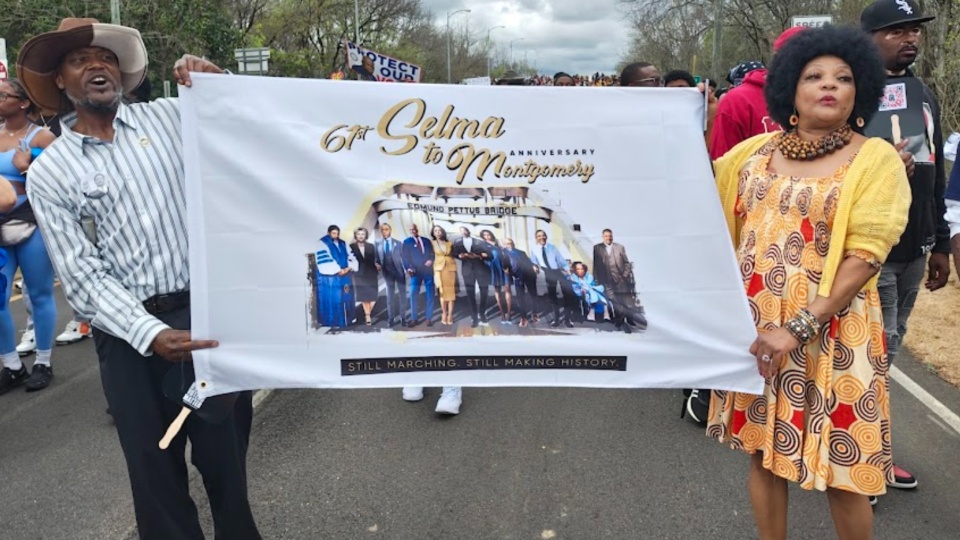
After a short call to prayer, Ponds took back the bullhorn and announced that the march was beginning. The paraders moved down Martin Luther King Street before turning onto Alabama Avenue and then Broad Street, the road that terminates at the Edmund Pettus Bridge. SCLC members were in the vanguard of the march bearing a banner and a U.S. flag, leading the crowd with contemporary chants originating within the 21st-century Black Lives Matter movement.

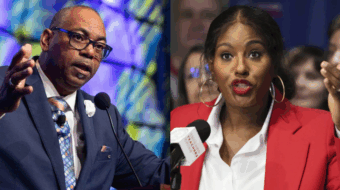
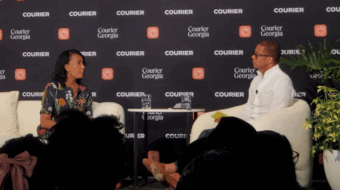
Once the march reached the foot of the bridge, it stopped in front of another rally organized by the Black Voters Matter organization alongside a handful of other groups. Speakers there included BVM co-founders LaTosha Brown and Cliff Albright, the Rev. Al Sharpton, Illinois Gov. J.B. Pritzker, Illinois Attorney General Kwame Raul, former Department of Transportation Secretary Pete Buttigieg, and Selma Mayor Johnny “Skip” Moss III, among others.
While the speakers touched on a variety of topics, the legacy of the recently deceased Rev. Jesse Jackson was a consistent and dominating theme. This was the first edition of the annual commemoration for which Jackson was not present.
Martin Luther King III, son of Dr. King, concluded the list of speakers. Following his remarks, the sea of marchers slowly climbed the uphill portion of the arch-shaped bridge under the Alabama sun, as segments of the crowd broke out into impromptu renditions of Black spirituals and African American hymns. Once the peak of the arch was reached, the crowd was able to look out and see the other side of the Alabama River.
In 1965, this was the spot in which Lewis and Williams would have first seen the army of gas mask-clad state troopers waiting for them on the other side. Instead, Sunday’s crowd gazed out onto a collection of food trucks, souvenir vendors, and informational booths set up by a variety of organizations. While Alabama State Police were present, they did not engage in any acts of violence against the marchers.

At the southern foot of the bridge, the march-goers mingled amongst themselves, taking photos in front of the many plaques honoring the original victims of the infamous attack. People from all over the country had made the journey for Selma to engage in this very moment.

“I’m down here in Selma with college students from the Bridgewater State University up in Massachusetts,” said educator Jazzmyn Red. “They have elected to take an alternative spring break to learn about different social justice issues across the nation.” Red was one of many educators in attendance with their students, providing an example of hands-on history education.
An elderly couple, dressed in their Sunday best, drove all the way down from their home in New Jersey. Selma is their original hometown, and both of their respective sets of parents were on the bridge in 1965. The couple comes to Selma every year to honor the legacy of their parents.

Memphis resident Terryl Buford, armed with a sign bearing the iconic Civil Rights-era slogan “I Am a Man,” felt the need to attend “to celebrate the lives that came before us.”
“Martin Luther King Jr. died in Memphis,” he pointed out, calling attention to the connection his city has with the history of the movement. Buford is a member of Call 2 Men, a Tennessee-based organization that focuses on “re-establishing the foundation of African-American men…to show love and unity to our communities, to build our community, and to support all other organizations that are fighting for the rights of mankind.”
Also in attendance was a sizable contingent from Alabama’s Democratic Socialists of America, hailing from both the Birmingham and Mobile chapters, who hoped to offer their anti-capitalist message to the people.
Sunday’s march reflected the determination of those there and millions not there to ensure that both the memories and lessons of the Civil Rights movement will not be lost to time. The struggles for Black liberation, voting rights, and economic justice in this country saw many of their biggest successes during the ’60s, but those struggles, people here said, are far from over.
Selma’s jubilee march was thus not simply an exercise in historical recollection but a call to action, urging the new generation of not just Black Americans but the entire multi-racial, multi-national working class and its allies to keep the flame of struggle alive as people resist the fascist agenda of President Donald Trump’s administration.
We hope you appreciated this article. At People’s World, we believe news and information should be free and accessible to all, but we need your help. Our journalism is free of corporate influence and paywalls because we are totally reader-supported. Only you, our readers and supporters, make this possible. If you enjoy reading People’s World and the stories we bring you, please support our work by donating or becoming a monthly sustainer today. Thank you!
CONTRIBUTOR