SANTA RITA, Calif.—In Alabama and Louisiana, the state prisons “sell” their convicts to private companies, many of them fast food firms, to go out and work, for a dollar or two a day. Unions call that, literally, slavery. But Santa Rita, Calif., beats the Southern states
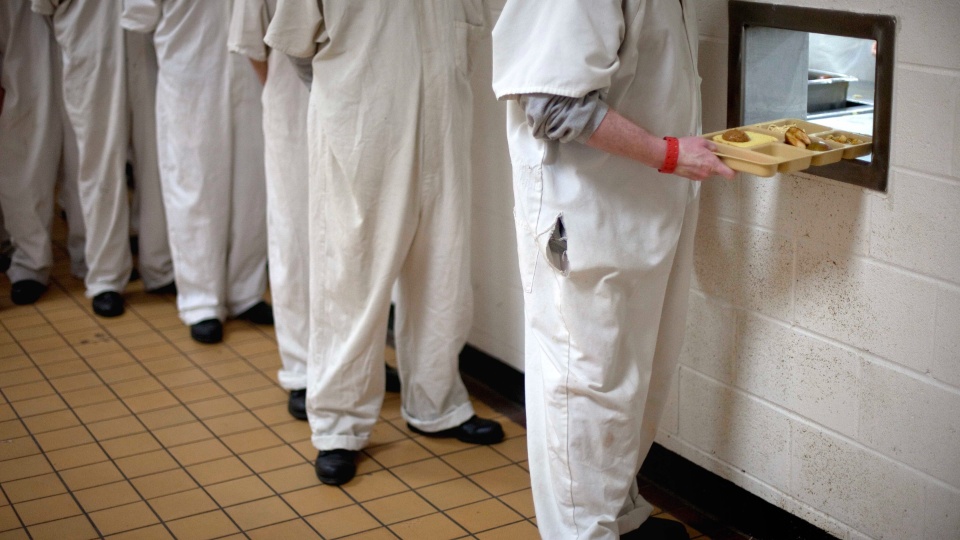
There, legal papers show that eight pre-trial detainees—people not convicted of the crime for which they are charged—who can’t make bail sit in their cells, exiting only to swab the jail cafeteria’s floors and prepare jail meals for the private for-profit company Aramark.
They toil eight hours or more a day, six days a week, and they get paid nothing at all. If they refuse to work, they’re punished by their jailers, and the punishments are dire. And, the case records show, at least one has been toiling for at five and a half years.
In Alabama, the convicts—not pre-trial detainees—got “rented” out by the state, which made a lot of money off the deal, too, as corporate greed for ultra-cheap jail labor led firms to fork over hundreds of thousands of dollars. The same was happening in Louisiana, where agribusiness giants and food corporations rely on prison-raised meat and crops.
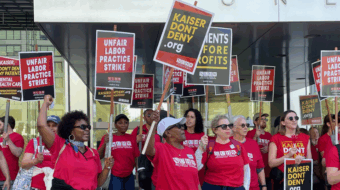
The Retail, Wholesale, and Department Store Union, which has publicized some of this prior exploitation, flat-out called it “modern-day slavery.” RWDSU and the AFL-CIO sued to stop it.
Back in Santa Rita, meanwhile, if you get pulled over for driving without a license, for example, and you can’t make bail, and you’re jailed, and your trial is weeks away, you’re put to work for Aramark, earning zero dollars an hour. The suit doesn’t say how much Aramark paid Alameda County for the detainees’ work. One estimate: $95 million over the last six years.
So, eight of the detainees went to federal court in a class action suit against both Aramark and Alameda County, which includes Santa Rita, to try to get paid and to put an end to the exploitation.
They demanded to be paid the state minimum wage of $16.50 an hour. When they worked more than eight hours a day, they wanted overtime, just like all other workers the federal Fair Labor Standards Act covers. They also sought an injunction to stop the exploitation by Alameda County and Aramark.
First the eight—Armida Ruelas, De’Andre Eugene Cox, Bert Davis, Katrish Jones, Joseph Mehbratu, Dahryl Reynolds, Monica Mason, and Luis Nunez-Romero—went to U.S. District Court in San Francisco with their class action case. They explained they all were poor, detained awaiting trial, and several, though they didn’t say who, face deportation.
They also detailed punishments and working conditions in the Santa Rita jail, which can hold 3,489 inmates. Aramark employees supervised them, and Alameda County sheriff’s deputies guarded both the detainees and convicted prisoners. The difference? Prisoners who worked got paid—$2 an hour.
The detainees “and other prisoner-employees of Aramark are coerced to work,” the detainees’ papers told the federal district court which first heard the case. “Sheriff’s deputies threaten plaintiffs and other prisoner-employees of Aramark that if they refuse to work, they will receive lengthier jail sentences or be sent to solitary confinement, where they would be confined to a small cell for 22-24 hours a day.
“Sheriff’s deputies also threaten to terminate prisoners’ employment if they need to take a sick day or are injured. Such threats cause prisoners to work through illness and injury, sometimes caused by the unsafe conditions in the industrial kitchen.”
When the detainees lost in the lower court, suing for themselves and the class of “all other pre-trial detainees similarly situated,” they tried the U.S. Court of Appeals in San Francisco. In a move common in California, that court’s justices “certified” the case back down to the state Supreme Court for a decision.
Remember, these eight aren’t convicted of a crime. They’re in jail awaiting trial. In lay terms, they’re still innocent until proven guilty.
The state Supreme Court’s justices, 7-0, turned the detainees down in July, in a ruling written by the court’s junior justice, Kelli Evans.
“The United States Court of Appeals for the Ninth Circuit asked us to decide whether non-convicted incarcerated individuals working in a county jail for a private company have a claim for minimum wage and overtime under California law. We conclude the answer is no,” the court said.
The irony in all of this is that if the inmates were in Santa Rita jail as prisoners for a crime, a California law—part of the initiative opening the way to their exploitation—mandates they would get paid $2 a day to work, either for the state by fighting wildfires, for example, or for Aramark.
Innocent and yet to face trial, they get zip.
It wasn’t always this way, the detainees told the courts. Until 1990, the state had a flat all-encompassing ban on prison labor. But then a voter initiative changed the state constitution. Now it allows state prison labor on public works projects—for two bucks a day—but leaves pay for local prison labor for other work, including work for private contractors, up to local county boards.
The California Supreme Court pointed out, however, that changes in the 1990 law cover only convicts. It was silent on pre-trial detainees, such as the eight detainees in the Santa Rita jail case. That left the Alameda County Board and Aramark free to pay them zero, the state court said.
Then Justice Evans explained Aramark’s relationship with the county. Alameda County’s contract with Aramark Correctional Services gives the firm “the responsibility for operating the food service program and delivery of meals for inmates and staff at all Alameda County sheriff’s office facilities and satellite facilities. Satellite facilities include county jails located elsewhere in the state.”
Aramark is actually widely known as a food-service company for big venues. If you go to a baseball game, a football game, or a basketball game, chances are most of the food service stands are supplied by Aramark. It runs many of them, too.
“Aramark, a private, for-profit company, provides the contracted-for food services using the industrial kitchen at the Santa Rita Jail. Jail inmates “prepare and package the food in the industrial kitchen each day and clean and sanitize the kitchen after the conclusion of the day’s food preparation.”
Ruelas, Jones, Mason, and Nunez-Romero “performed sanitation services” in the Santa Rita jail kitchen. The other four prepared the food not just for the Santa Rita jail but for all the jails in Alameda County and elsewhere. Alameda’s county seat is the often-progressive city of Oakland.
The eight workers “are or were pre-trial or other non-convicted detainees confined at Santa Rita Jail who either prepared and packaged food or cleaned and sanitized the kitchen for Aramark.” What the eight awaited trial for does not matter, the justices said. The point is they were detained before trial. In other words, they were innocent.
“Sometimes plaintiffs work in excess of eight hours a day or 40 hours a week, six or seven days a week. Nonetheless, plaintiffs are not paid any wages for their work on Aramark’s behalf.” They sued the sheriff, the county, and Aramark for their pay and overtime.
In 1990, the California legislature enacted the prisoner work law, “to equalize the wage credits for inmates working in jail with those…for individuals working at industrial farms or road camps,” the state Supreme Court explained. Democrats controlled the legislature at the time. Republican George Deukmejian signed the law.
“The underlying purpose is ‘to make possible the substitution of constructive labor for profitless prison confinement in order that those who are charged with or convicted of public offenses and deprived of their liberty may become better citizens because of their disciplinary experience,’” the state Supreme Court justices wrote.
But the lawmakers—and the jurists–have left the pre-trial detainees in the county jails, such as the eight who sued, out in the cold and hungry for justice. The detainees aren’t working even for the peanuts of two bucks a day. They’re toiling for nothing at all, and Aramark is profiting.
We hope you appreciated this article. At People’s World, we believe news and information should be free and accessible to all, but we need your help. Our journalism is free of corporate influence and paywalls because we are totally reader-supported. Only you, our readers and supporters, make this possible. If you enjoy reading People’s World and the stories we bring you, please support our work by donating or becoming a monthly sustainer today. Thank you!
CONTRIBUTOR