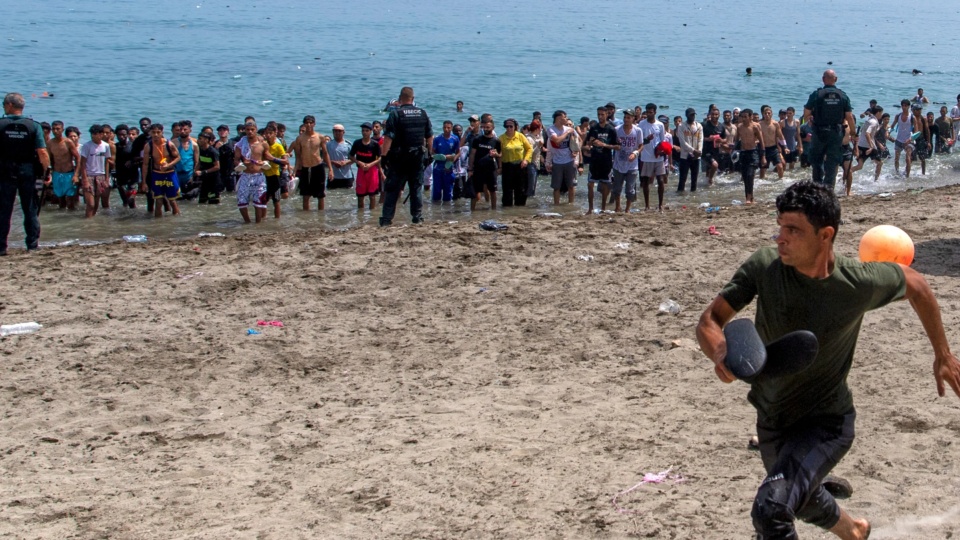
Over 50,000 people crossed from Morocco into the Spanish colonial exclave of Ceuta on July 30, only to face a series of mass deportations and military deployments by the Spanish government. The number of lives lost so far—mostly to drowning or crushing during crossing—could be as high as 90.
Racist reactions and diplomatic retaliation from far-right politicians and governments around the world, meanwhile, have spiraled into a continental crisis.
Italian Prime Minister Giorgia Meloni temporarily ordered the closure of Italy and Spain’s air and sea borders and called for the suspension of free movement rights for Spanish citizens guaranteed under the European Union’s Schengen agreement. Santiago Abascal, leader of the Spanish extreme-right Vox party, repeatedly described the immigrants as “an invasion.”
Spain’s center-left Socialist government, led by Pedro Sánchez, characterized the crossings as a “violation of sovereignty,” directing blame at Morocco’s government for engineering or allowing the incident. Sánchez faces growing diplomatic pressure for its opposition to the Iran war and genocide in Gaza—stances which could have factored in the mass border crossings.
Court distortions
At a surface level, a June 29 ruling by Spain’s Supreme Court is at the center of the crisis. Its decision found that migrants intercepted at sea while trying to reach Ceuta or Melilla, another Spanish-controlled exclave on the north African coast, cannot be summarily deported under the country’s “hot return” procedure, since they do not cross the physical border infrastructure the law refers to.
The ruling requires Spain to process such migrants through ordinary immigration channels instead—a stronger due-process protection, but a narrow one, since it says nothing about migrants’ eventual right to remain.
Sánchez’s government has said human trafficking networks in Morocco seized on the ruling, telling prospective migrants that reaching Ceuta by water now guaranteed a legal process and an effective path to stay in Spain. Whether that message reflects a genuine misreading of the decision or a deliberate exaggeration by smugglers—and whether Moroccan authorities eased their own border enforcement in response—remains disputed.
In the ruling’s wake, Madrid has moved to install floating barriers in the water off Ceuta, which it argues will let it intercept and return migrants before they reach shore, satisfying the court while preserving fast deportations.
A deadly border, and a leverage point
Ceuta and Melilla, each with a population of around 80,000, are the two major cities among a set of Spanish exclaves along the northern coast of Morocco. Together, the exclaves are the European Union’s only land border with Africa, and are often sought as a point of entry by immigrants and refugees in west Asia and north Africa. The hostile geography regularly compels undocumented people and asylum seekers to swim for several kilometers around the border fence.
The border’s militarization owes in large part to a set of agreements between the European Union and Morocco, which annually commit hundreds of millions of euros to Moroccan immigration enforcement. The agreements compose one part of “Fortress Europe,” the EU’s system of border controls. Migrant support groups say it has cost tens of thousands of migrants and refugees their lives since 2014.
Morocco wields its authority over the exclave borders as a form of political leverage against Spain and the EU generally, and the ongoing Ceuta crisis is the latest in a series of mass migration events facilitated by the Moroccan government.
In February 2014, Moroccan and Spanish authorities shot rubber bullets at migrants attempting to swim across the border, killing 17. Two people were killed in a similar incident in 2021, when Morocco facilitated the entry of over 8,000 immigrants into Ceuta in response to Spain hosting Brahim Ghali, president of the Sahrawi Arab Democratic Republic (SADR), for medical treatment.
The SADR’s territory, situated in Western Sahara, is partially occupied by Morocco, which combats any international recognition given to the republic. In 2022, 23 people were killed by Moroccan forces at the Melilla border, when more than 2,000 attempted to break through the fence.
The Moroccan government is not alone in treating refugees, asylum seekers, and economically precarious people as a political weapon. Donald Trump, Sen. Ted Cruz, R-Texas, and other ideologues of the MAGA movement have sought to turn Spain’s border policies into a talking point for November’s midterm elections in the U.S.
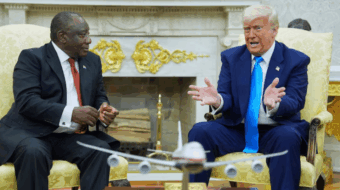
Joining with Abascal, Trump told a cabinet meeting that the crisis “looks like an invasion.” Attempting to divert domestic fears away from ICE’s terrorism and toward racist caricatures of immigrants, Cruz accused Sánchez of granting amnesty to “millions” of men from Africa, claiming that the Socialist government “hates the West.”
Geopolitical maneuvers
Sánchez met with Abdelmadjid Tebboune, the recently re-elected prime minister of Algeria, on July 20. The meeting was the first of its kind since 2022, when the previous Sánchez government ended nearly 50 years of formal neutrality to endorse Morocco’s occupation plan for Western Sahara. Algeria, a long-time supporter of the Sahrawi independence struggle, largely froze diplomatic relations in response.
However, the deepening energy crisis in Europe, exacerbated by U.S.-Israeli attacks on Iran and closure of the Strait of Hormuz, brought the two governments back into negotiations. Seeking expanded access to Algerian natural gas exports, Sánchez and representatives of Spanish industrial monopolies promised stronger bilateral ties and greater Spanish investment in other sectors of the Algerian economy.
Given long-standing tensions between Algeria and Morocco over the former’s support for the SADR, the meeting was taken as a provocation by the Moroccan government.
The U.S. and Israeli governments, now closely aligned with the Moroccan monarchy and right-wing European administrations, have sought to isolate Spain and Algeria alike. In addition to diplomatically recognizing the state of Palestine, Spain has refused to participate in the Iran war, banning American use of jointly-operated military bases for military actions that it deems illegal under international law. In response, the Trump administration has threatened the suspension of bilateral trade and ratcheted up diplomatic pressure through its reactionary allies across the region.
All these factors are widely seen as relevant context for the mass crossing at Ceuta on July 30.
Left reaction
Communist and workers’ parties across the region responded quickly and forcefully to the unfolding events.
The French Communist Party (PCF) stated that “no dispute concerning Algeria, Western Sahara, or Ceuta can justify using people as geopolitical weapons.” The Communist Party of the Workers of Spain (PCTE) condemned “military deployment, repression, summary expulsions without legal guarantees, and the further militarization of borders,” while situating mass migration in the context of displacement by imperialist war, divestment, and resource theft.
The parties will continue to confront anti-immigrant violence as they confront far-right movements in the lead-up to elections next year.
We hope you appreciated this article. At People’s World, we believe news and information should be free and accessible to all, but we need your help. Our journalism is free of corporate influence and paywalls because we are totally reader-supported. Only you, our readers and supporters, make this possible. If you enjoy reading People’s World and the stories we bring you, please support our work by donating or becoming a monthly sustainer today. Thank you!
CONTRIBUTOR