There’s an angle to the Iran War that the cable news anchors, retired generals-turned-commentators, and corporate-owned newspapers are barely talking about, if at all. They report on the shifting justifications proffered by Pete Hegseth, Marco Rubio, or Donald Trump, but few in the press are doing anything to illuminate the bigger picture.
The United States isn’t attacking Iran simply because of Tehran’s nuclear program, or out of concern for the welfare of the Iranian people, or even purely for Israel’s security. The Trump administration’s decision to launch its war was motivated by a goal that goes well beyond nuclear non-proliferation. Nor is the war a case of Tel Aviv telling Washington what to do, regardless of what some of Netanyahu’s most intense critics want to believe.
It has fallen to the far-right, anti-communist outlet The Epoch Times—the newspaper associated with the Falun Gong cult—to offer the truth about what the U.S. is up to. “A key strategic dimension of the Iran conflict,” wrote James Gorrie, a regular columnist for the pro-Trump paper in its March 13 issue, “involves Washington’s efforts to control and even restrict Iranian oil flows to China.”
Finally, an admission: Iran is a critical link in China’s energy supply chain—and breaking that link is part of a long game to put U.S. capitalism’s biggest competitor in a very uncomfortable position. The attack on Venezuela in January and the subsequent takeover of that country’s oil sales was another piece in this same puzzle of U.S. foreign policy.

Call it the “China Chokehold.” The Trump administration doesn’t give its strategy such a catchy name, but the logic isn’t hard to see, especially when you take a look at some of the numbers.
Last year, Iranian oil accounted for 13.4% of China’s seaborne energy imports. Venezuelan oil added another 4.5% of the total. That’s nearly a fifth of the 11.6 million barrels that arrived daily in Chinese ports. The centrality of these trade relationships for the exporters can’t be exaggerated, either; Iran sold 87% of its oil to China, Venezuela 55%.
Now, add in another Chinese economic partner, Russia. Combining its oil sales to China together with those of Iran and Venezuela makes up 33% of China’s crude import mix in 2024—one third of the fuel powering the world’s second-largest economy, all sourced from countries under U.S. sanctions. Brazil, a country not yet sanctioned by the U.S. but whose progressive government is also under pressure from Washington, chips in another 6%.
So, that’s now 40% of China’s energy imports—all being targeted in one way or another by the U.S.
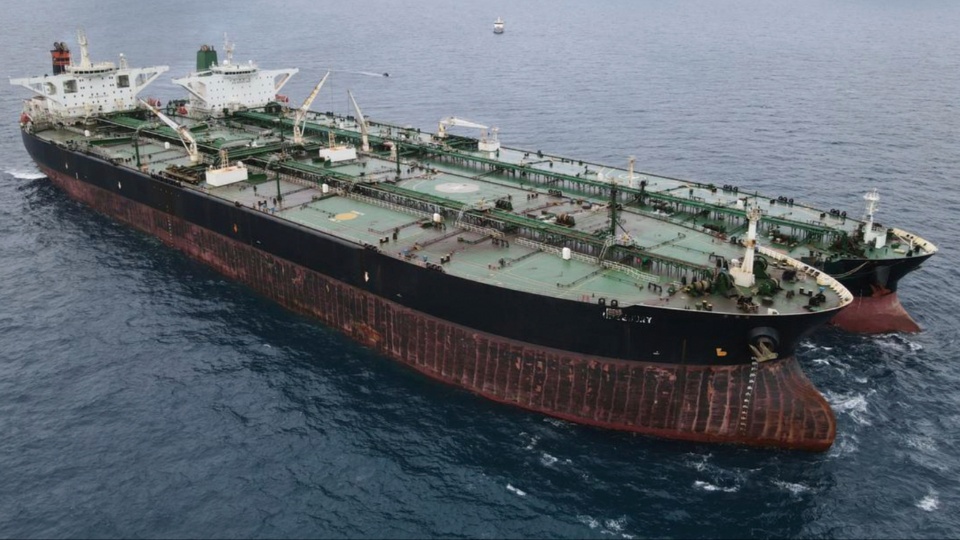
China, of course, knows what’s up. As Epoch Times commentator Gorrie puts it: “Beijing is quite aware that U.S. foreign policy is designed to influence and reduce energy flows to China.” That means the country has had to be creative about how it sources and records Iranian and Venezuelan oil purchases, relying on a system that operated parallel to but separate from the regular international oil markets.
It involves ship-to-ship transfers at sea, intermediary sales arrangements, the bypassing of U.S.-controlled banking institutions, infrastructure-in-exchange-for-oil partnerships, and more. It’s a sanctions-busting transaction system that provided China discounted oil and gave an economic lifeline outside of the dollar-dominated financial system for countries on the U.S.’ blacklist.
But the Trump administration has decided the arrangement must now come to an end, not because it’s illegal under international law, but rather because it’s inconvenient for the shifting strategy of U.S. imperialism. Increasingly, the latter is premised on consolidating a U.S.-dominated economic bloc in the Western Hemisphere and limiting China’s resource and market access around the globe.
Despite the incoherence that spews forth from the White House press office on a daily basis, the administration has actually been very consistent in pursuing this agenda. First, Venezuela: The U.S. moved to redirect Venezuelan exports after kidnapping Nicolás Maduro, cutting into the roughly 389,000 barrels per day China had been importing from that country in 2025.
Then came the escalating pressure campaign against Iran. The sequence isn’t coincidental. Venezuela and Iran are a matched set—two sanctioned producers who together made up a substantial chunk of China’s affordable energy supply. Knock out or restrict their relationship with China, and the U.S. begins to have a real source of economic leverage.
That’s because the real prize is the Strait of Hormuz.
The Strait handles roughly 20% of global petroleum trade, with nearly 90% of those flows headed to Asian economies. China alone purchases 37.7% of total crude flows through the Strait—more than any other country. The United States, with its own domestic production, receives a negligible 2.5%. A serious disruption in the Strait is, at least initially, primarily somebody else’s problem—specifically China’s, India’s, South Korea’s, Thailand’s, and Japan’s.
Iran sits alongside that chokepoint and, as recent days have made abundantly clear, is capable of threatening access to it. It is the one independent actor in the region that can seriously complicate shipping through the whole corridor. That’s a power the U.S. government would prefer to have in its own hands.
Neutralizing Iran—not just sanctioning it, but genuinely subordinating it, whether through regime change or forced compliance—would remove the only hand on that particular valve that U.S. imperialism doesn’t already control. From a Cold War 2.0 strategic standpoint, that’s enormously valuable.
Israel, meanwhile, is hoping to get from this war what its current government has long sought: a region with no state-level adversary capable of projecting meaningful force. The Gulf monarchies have cut their deals. Egypt is, for the most part, managed. Jordan is quiet, and Syria has been fragmented. Lebanese sovereignty is effectively meaningless, as the Israeli military operates there at will.
With Iran’s government either overthrown or brought into subservience in a manner akin to what’s been done to Venezuela, the map of the Middle East looks remarkably more manageable from the perspective of the ruling class in Tel Aviv and Washington.
The ideological packaging for the Iran War changes depending on the audience. For the national security establishment, the rationale is nuclear weapons. For the MAGA base, it’s biblical prophecy. For the D.C. think-tank bubble, it’s democracy promotion. For the defense industry, it’s a revenue opportunity. But underneath the packaging is a coherent strategic vision: Build the capability to complicate China’s access to energy and secure for U.S. capitalism the ability to hold real leverage over its competitor’s economic future.
China has been stockpiling oil at a notable pace in anticipation—averaging 430,000 barrels per day in reserve-building in 2025, compared to just 84,000 the prior year. And it’s not for environmental concerns alone that energy alternatives like wind, solar, hydrogen, and nuclear are major components of the government’s planning. China’s leaders see what’s coming, and they’re making preparations.

Unlike the bombs raining down on the people of Iran, this isn’t traditional warfare. There are no direct sanctions on China, no formal embargo or blockade as in the case of Cuba. There are just rising costs, narrowing discounts, and fewer suppliers. It is the assertion of U.S. military and economic power against China but without open confrontation.
So, this war is not just about—or even primarily about—Iran’s nuclear ambitions. It is a blatant attempt to inflict damage on the Chinese economy in the immediate period and position U.S. imperialism to place China in a chokehold in the long term. This war is a campaign in which Israel has its local goals, but the U.S. has regional and global objectives.
What gets lost in all this strategic maneuvering, almost entirely, is any serious reckoning with who’s actually bearing the costs: Iranian workers and families who are losing loved ones while absorbing the economic fallout, soldiers on multiple sides filling the body bags, the U.S. working class watching desperately-needed public money wasted on weapons, and Global South populations suffering from oil price shocks.
The China Chokehold doctrine is logical when viewed from the boardrooms of American tech firms fearing Chinese competition. And the destruction of Iran makes sense if one is a U.S. oil or defense executive eyeing a profit bonanza or an ideologue dreaming of a “Greater Israel.”
The question the rest of us ought to be asking, though, is whose interests this logic actually serves, because it certainly isn’t ours.
We hope you appreciated this article. At People’s World, we believe news and information should be free and accessible to all, but we need your help. Our journalism is free of corporate influence and paywalls because we are totally reader-supported. Only you, our readers and supporters, make this possible. If you enjoy reading People’s World and the stories we bring you, please support our work by donating or becoming a monthly sustainer today. Thank you!
CONTRIBUTOR