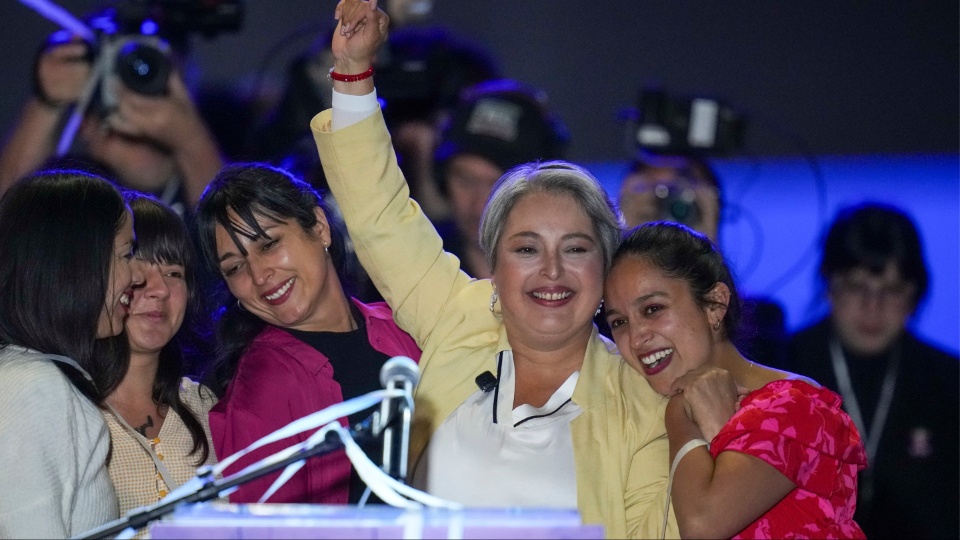
Chilean voters cast their ballots for president on Sunday, putting Communist Jeannette Jara in first place with 27% in a multi-candidate race. She beat out the country’s most infamous fascist son, José Antonio Kast, who captured 24%. The two will now advance to a Dec. 14 run-off, setting up a true class struggle for the presidency.
Jara is a rare working-class candidate in a country where for many decades political leaders only hailed from the wealthy European-descended elite. She grew up in northern Santiago’s El Cortijo neighborhood in a house without running water. The daughter of a mechanic and a homemaker, she is the eldest of five children.
Variously a farm worker, street food vendor, and product promoter in her younger days, Jara studied hard and eventually earned her law degree and a master’s in public policy. Joining the Communist Youth of Chile at the age of 14, she made a name for herself as a leader in the fights to democratize the country after dictator Augusto Pinochet’s fall in the 1990s and eventually rose to become a government minister.
Kast, her opponent, is part of the right-wing royalty of the Chilean ruling class. His parents were German immigrants who arrived in the early 1950s. His father, Michael Kast Shindele, was a member of Hitler’s Nazi Party and a lieutenant in the military of the Third Reich.
He escaped from U.S. custody and then fled the de-Nazification campaign in Germany after World War II. He settled in Chile, where, together with other relatives, he set up a sausage factory that made the family one of the richest in the country.
The fascist politics brought over from Europe were passed down through the generations. One of Kast’s brothers, Miguel, was a “Chicago Boy” economist and labor minister for Pinochet. He helped impose neoliberal policies that crushed the Chilean working class, with an emphasis on privatization, deregulation, and attacks on unions.
Uphill battle ahead for Jara
While progressives and labor are celebrating Jara’s first-place finish, apprehensions are high for the second round. That’s because Kast is likely to pick up most of the votes that went to other right-wing candidates, a combination that makes him the favorite in a head-to-head match-up with Jara.
In her closing speech of the campaign, Jara called for “unity without disqualifications, with respect and democratic conviction.” She said, “While others sow hatred, we work for a country that advances together.” It was an echo of her plea back in June—when she won the left’s presidential primary—for the “broadest possible front” of Chilean workers, democrats, and progressives.
Those forces—which came together in the Unity for Chile (Unidad por Chile) coalition—are going to have to work overtime in the next four weeks if they hope to beat Kast. When his votes in the first round are added to those of the other right-wing candidates, they come to nearly 70%.

An editorial in the Monday morning edition of El Siglo (The Century), magazine of the Communist Party of Chile (PCCh), was blunt in its assessment of the task ahead:
“These will be weeks of enormous challenge, where, moreover, a profound responsibility falls upon the democratic, progressive, and left-wing forces, who must once and for all set aside their squabbles and self-interest, put an end to ‘friendly fire’ and distracting, confusing agendas, and work resolutely, without ambiguity or pettiness, for the victory of our joint candidate, which is the people’s candidate. This is a decisive moment for unity.”
While acknowledging Jara faces difficult odds, the PCCh urged its allies to remember that “nothing is automatic.” It said that a crucial role will be played by “grassroots organizing, work within families, workplaces, and neighborhoods, social media outreach, and advocacy efforts through friendly media outlets across various social and sectoral spheres.
“No one’s contribution is superfluous, and nothing is superfluous.”
Class struggle election
The platform of Jara’s Unity for Chile coalition has put the issues clearly on the table for voters. It declares: “Chile must decide where to go in the coming years: Deepen the path of change or enter an authoritarian drift.”
Jara and the coalition make the case that the far-right is seeking to “roll back our rights” and promotes an “exhausted free market model that makes life precarious.” The alternative, they argue, is a coalition of “those who have historically fought for profound social change: the communities, unions, feminists, youth, indigenous peoples, socio-environmental movements, and cultural figures.”
It recalls the Popular Unity coalition that elected socialist Salvador Allende to the presidency in 1970, who was killed during the 1973 U.S.-backed coup led by Pinochet, but the left’s program seeks to go beyond the past to build an even stronger progressive front to address the economic challenges of today.
While that message was a winning one four years ago when Gabriel Boric was elected president, the political atmosphere has shifted sharply since then. Protests demanding improved living standards and a rejection of free market-dominated policies propelled Boric to victory then, but worries about crime now top surveys about public priorities. Violent crime was the number-one issue for 63% of Chileans in one recent poll.
While Chile remains one of the safest countries in Latin America and boasts a homicide rate comparable to that of the United States, upticks in police complaints and evidence of growing organized crime activity suggest public worries about crime are not simply a perception-reality mismatch.
Regardless, the stark change of focus represents a success for the right-wing propaganda machine and the corporate media that aligns with it in Chile. “Social rights, diversities, cultural diversities, the relationship with Indigenous people, all of this disappeared,” Patricio Fernández, a prominent Chilean journalist, told the New York Times this week. “It is like we are in another world.”
Ally of Trump
This has benefitted Kast, who models himself on Donald Trump and leverages fears about crime to push a “law and order” agenda along with far-right social and economic policies.
As a long-time politician and repeat presidential candidate, Kast has consistently pushed a reactionary platform premised on giving free rein to big business and handing over control of social policy to ultra-conservative forces. He advocates major tax cuts on the wealthy, a rollback of labor and other progressive legislation, a halt to immigration, and bans on abortion and same-sex marriage.

His frequent praise for the Pinochet dictatorship has generated controversy but also endeared him to leading capitalists, the military, and the religious base of voters who all fondly remember the years of tyranny that saw tens of thousands of trade unionists, students, Communists, socialists, democracy activists, and indigenous people murdered.
Attendees at his rallies often sport red MAGA hats, and Kast boasts of his admiration for the U.S. president’s policies. Running on an anti-immigrant platform, he promises to build his own version of Trump’s wall—what he calls a “border shield”—to keep out immigrants, whom he blames for crime.
In 2021, campaigning against Boric, Kast framed the election as “a choice between freedom and communism.” With an actual Communist as his opponent this time, the red-baiting has reached new extremes, especially on immigration. Undocumented migration from Venezuela, for instance, has soared in recent years, a reality Kast has latched onto as he attempts to paint Jara as a partner of Venezuelan President Nicolás Maduro.
Left promises real security
Jara, the Communist Party, and their allies are pushing back strongly against Kast, jumping into the fight with a program that they believe the Chilean people will support. It centers on real security for the country—not just when it comes to crime, but social and economic security, as well.
“Public safety will be a priority from day one,” Jara says, but just as important, she vowed, is guaranteeing “every Chilean family can easily make it to the end of the month.”
Tackling the immediate issue of safety, Jara says she will pursue public security with a social focus, combatting crime by returning control of neighborhoods to communities and empowering prosecutors to go after the economic elites in high finance who abet organized crime.
“Some people say every day that they want to fight organized crime, but in reality, their proposals precisely evade the central issue, which is why organized crime came to Chile,” Jara said in a speech on Friday.

“Organized crime came to launder money, as the Public Prosecutor’s Office has stated, as have various lawyers and experts, but the economic and political right wing in our country opposes [the prosecutor]. What are they afraid of? I ask you, what are they afraid of?”
On the economic front, Jara pledges to build upon the achievements of the Boric government but carry them even further. As labor minister, she spearheaded successful efforts to boost Chile’s minimum wage by nearly 50%, raise pensions for retirees by forcing employers to finally make contributions, and cut the workweek from 45 hours to 40.
As president, she said that she would pursue a guaranteed monthly “living income” of $800 USD for every Chilean, funded through minimum wage hikes and tax revenue. Major investments in job-creating infrastructure projects and affordable housing are other central planks in her platform.
Chile is the world’s largest copper producer and one of the largest producers of lithium, a metal vital in computing, electric vehicles, and the AI industry. Looking to secure the country’s economic future, the Jara government would invest in what she calls “a national public company” to compete with the private sector in the lithium industry, increasing production while prioritizing environmental standards.
A publicly-owned company, Codelco, already exists in the copper sector. Jara promises to increase investment in it by 25%, creating up to 50,000 new jobs and increasing exports by $5 billion USD.
Achieving any of these goals hinges, of course, on beating Kast and the far-right on Dec. 14. He’s well-financed and armed with an agenda he hopes will add Chile to a string of recent right-wing victories in the region, including in Argentina, El Salvador, and other countries.
As Kast’s platform and campaign make clear, the legacy of the fascist Pinochet dictatorship continues to haunt modern-day Chile. That’s why Jara warns that the country stands at the precipice. When election results were announced Sunday night, she told Chileans: “Democracy in our country must be taken care of and valued. Once lost, it costs us a lot to recover it, and today, it is once again at risk.”
We hope you appreciated this article. At People’s World, we believe news and information should be free and accessible to all, but we need your help. Our journalism is free of corporate influence and paywalls because we are totally reader-supported. Only you, our readers and supporters, make this possible. If you enjoy reading People’s World and the stories we bring you, please support our work by donating or becoming a monthly sustainer today. Thank you!
CONTRIBUTOR