

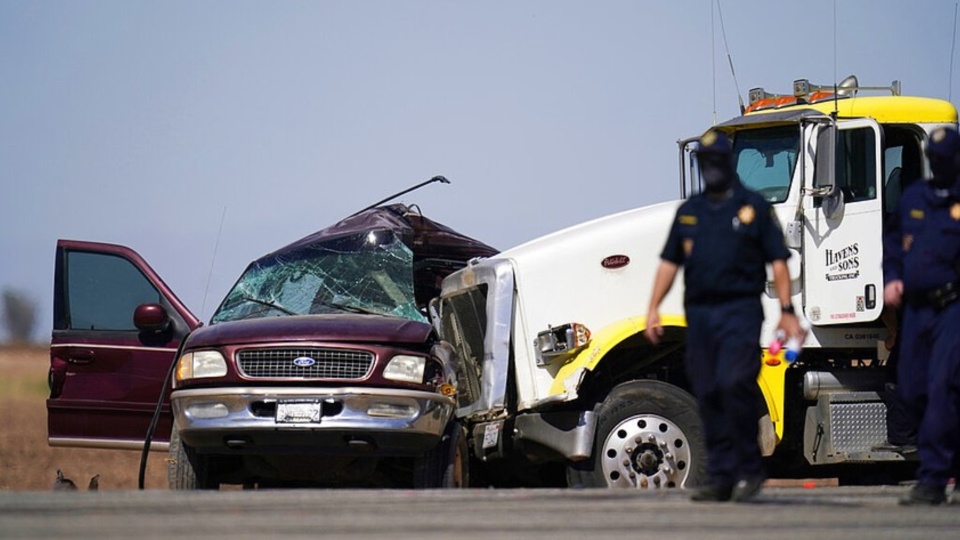
WASHINGTON—In a rerun of a 40-year-old battle over safety on the nation’s roads, the National Consumers League, the Teamsters, and their allies are again trying to throttle the truck companies’ push for longer and heavier trucks traversing U.S. highways.
As it has since 1983, the battle is being waged on Capitol Hill, but the outcome is vital to everyone in the U.S. After all, everyone uses the roads, whether they’re drivers, passengers, truckers, pedestrians, or cyclists.
On July 22, it played out before the Senate Commerce Committee at a hearing on bus and truck safety. Teamsters President Sean O’Brien testified. His union was already on the record—at a House hearing ten weeks before—against the bigger rigs.
As usual, the motive of the corporations, in this case the American Trucking Association, is profit. The more weight one trucker can haul behind his/her cab/tractor per trip, the more money ATA’s member firms make. Both ATA and the independent truckers’ lobby chief will testify.
The lobbies want to raise the maximum weight of the two trailers from the current 88,000 pounds to 91,000 pounds. Studies show the heightened safety risk is obvious.
“In some states that allowed the higher weight, the death rate has gone up,” says Daniel Greene, lead researcher on the issue for the National Consumers League.
Forty years ago, the lead lawmaker arguing against the bigger trucks was the late Rep. William Ratchford, D-Conn., an inside player whose western Connecticut district is traversed by Interstate 84. He wanted them off the road.
This year, and for the last decade, the lead foe of the big rigs has been Sen. Roger Wicker, R-Miss., the former Senate Commerce Committee chair. When she was still alive, Sen. Dianne Feinstein, D-Calif., joined him. So has Sen. Richard Blumenthal, D-Conn.
In 1984, the issue was whether one trailer, weighing 44,000 pounds, or two, weighing double that, would be allowed on interstate highways. Ratchford had sought a ban on the double tractor-trailers; the lobbies didn’t. The compromise let states seek waivers of a federal rule allowing two trailers.
Reams of studies show the bigger the rig, the bigger the risk. Big heavy trucks are more difficult to maneuver, need more stopping distance, are easier to jackknife, and are so high off the road that if they smash into a car, are more likely to pancake it.
“Regardless of whether the administration is going for” the heavier trucks, “we’re going to oppose” the weight hike, says Daniel Greene, lead researcher on the issue for the National Consumers League.
The trucking lobby also argues against other safety features, such as automatic emergency brakes, testimony to the federal Transportation Department shows.
“Their consistent theme is reducing the cost of labor,” Greene adds of the trucking firms’ lobby, the ATA. “The more you eliminate the driver” by making trucks heavier and longer, “the more profit you get,” he said in a telephone interview.
Crash more often
But the result is that heavy trucks crash more often and proportionately kill more people, given that cars are the overwhelming majority of vehicles on U.S. roads. Truck-auto crashes “regrettably have been one of the leading causes of deaths on the roads, and it’s been a persistent issue.
“The notion that increasing the size and weight” of the trucks “will have no effect” is incorrect, Greene says. “In states that allow the longer trucks, the death rates have gone up.”
The National Highway Traffic Safety Administration reports that in 2023, more than 5,500 people died on U.S. roads from truck-car crashes. That’s 70% more than in 2009, NHTSA said. And 97% of the dead were occupants of cars. Another 153,000 people were injured in 2023.
Teamsters senior legislative rep Cole Scandaglia, a specialist in trucking issues, stressed safety, too, at a March 26 Commerce Committee hearing.
“The Teamsters adamantly oppose efforts to raise maximum allowable gross vehicle weight,” he testified. “Simply put, these proposals threaten safety, increase wear and tear on our nation’s roads, and add unnecessary operational difficulties for drivers.”
Scandaglia pointed out that during the first Trump administration, the Transportation Department’s comprehensive study of truck sizes and weight limits and their impacts showed “heavier trucks had a 47%-400% higher crash rate than 80,000-pound trucks and that heavier trucks had out-of-service and brake violation rates that substantially outpaced 80,000-pound trucks.”
DOT’s study noted the trucks don’t just travel on interstates, but roll on local roads. The study “recommended against a nation-wide increase in maximum truck weights,” Scandaglia said. DOT added another threat to the heavy-trucks’ ledger: More unsafe bridges. Quoting DOT again, he testified that raising the truck weight to 91,000 pounds would put “65,157-82,457 local bridges at risk.
“The cost of replacing these local bridges to accommodate trucks operating under a new 91K maximum ranges from an estimated $70.5 billion to $98.5 billion,” Scandaglia said.
The unknown in all of this is the position of the Republican Trump regime. Its campaign platform, Project 2025, is silent on the truck weight issue. In 1983-84, the Republican Reagan administration sided with consumers and car drivers and against the bigger rigs.
Congress should “consider the perspective not of industry advocates who view increased truck weight as an on-paper cost-cutting efficiency measure devoid of real world implications, but of the individuals who would be directly impacted by the changes at their workplaces, Scandaglia said. “The actual truck drivers we represent have been clear: Heavier vehicles present operational difficulties such as controlling braking distance and maneuvering in congested traffic.
“Heavier trucks are more likely to overturn. Putting our members behind the wheel of heavier vehicles, when all safety analysis agrees with our professional experiences, is simply putting our members and the members of the public they share the roads with in harm’s way,” he concluded.
CONTRIBUTOR



MOST POPULAR TODAY

Europe refuses war script: Spain’s rebuke exposes limits of U.S.–Israeli escalation in Iran

Israeli military attempts to kill war correspondent Steve Sweeney

Trump’s Postmaster General says USPS may shut down in a year

Praising Trump’s war, monarchist forces hijack Iranian diaspora

Strategic retreat or strategic pivot? The state of the Target boycott