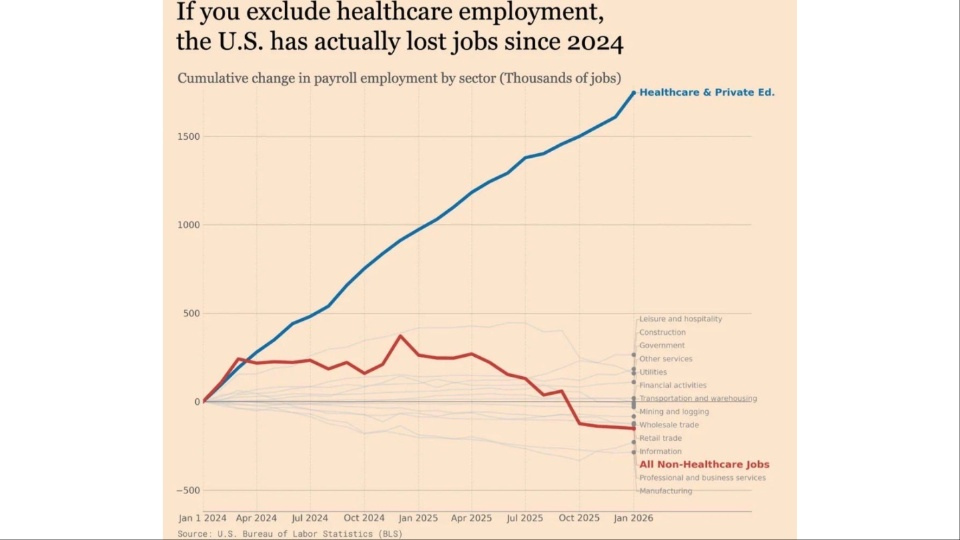
WASHINGTON—Federal data show private-sector job creation sharply slumped during the first year of the second reign of Republican President Donald Trump. The data, contrary to glowing reports from top administration officials, also showed that Black workers were particularly hard hit with high jobless rates.
The official U.S. unemployment rate was 4.3% in January, 0.1% lower than the year-end figure for 2025, the Bureau of Labor Statistics said. The number of unemployed declined by 141,000, to 7.36 million. But that’s, by far, not the whole story at the end of Trump’s first year.
Because in January 2025, just before Trump took over the Oval Office from Democratic President Joseph Biden, U.S. joblessness was officially 4%, and 6.87 million people were unemployed.
The job numbers in Trump’s 12 months have been particularly bleak for Black workers, reported the Joint Center for Political and Economic Studies, a noted think-tank covering that community. In 2025, the average jobless rate for all Black workers was 6.9%, compared to 6% for Black people and 3.7% for whites in 2024, Biden’s final year.
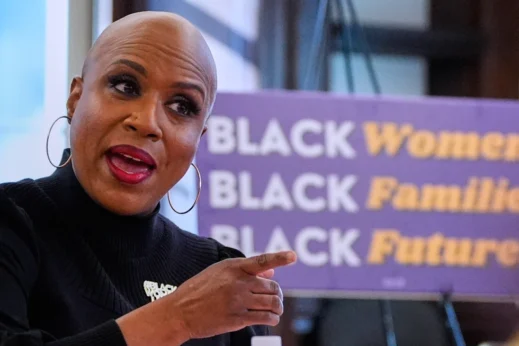
And in 2025, Black women suffered an official average 6.7% jobless rate, up from 5.6%, officially, the year before. The rise in Black joblessness reflects that a disproportionate share of the Black workforce toils for the federal government. It was less discriminatory until his reign. Trump fired 175,000 U.S. workers.
Doing some easy math helps clarify the overall jobless situation affecting workers as a whole: The official figures show the number of unemployed rose by 490,000 last year, the first year of Trump’s second term. And the jobless rate–which does not include people who dropped out of the labor force or those toiling part-time but really wanting full-time work or those seeking work who never had a job—rose 0.3%.
Of course, the news could have been worse. Trump’s mismanagement of the coronavirus pandemic started in late 2019, and its impact continued beyond the end of his prior term. His denial, then bungling, tanked much of the economy. He bequeathed double-digit joblessness—at its worst, more than 20 million people received unemployment checks—to Biden. The number receiving those checks was, of course, below the number of actual unemployed people.
Trump thus became the first president since Herbert Hoover to lose jobs, net, during his first four-year term. It was left to Biden to “prime the pump” with federal spending to quickly pull the country out of the unemployment hole, which was done, at the cost of a temporary spike in inflation.
It’s since come back down, under both Biden and Trump, though not that you can tell at the grocery store.
Companies reported creating a net of 172,000 new jobs in January, the Bureau of Labor Statistics said. Wall Street had expected 68,000. The big gains in construction (+33,000 jobs) and the health care and social assistance figures (+123,500) were offset by Trump’s continued firings of federal workers (-33,000 jobs).
Factories ended nine months of job losses, but created only 5,000 jobs, net. And the January job creation numbers, reported by firms, may turn out to be inflated.
That’s because the BLS, using updated and completed data for all of 2025, reported the economy produced only a net of 181,000 new jobs in all of last year. The agency’s preliminary figure was more than three times as much (584,000). For many years, pro-labor think tanks like the Economic Policy Institute and others said that some 235,000 jobs need to be created monthly in order to incorporate into the job market the people newly eligible to be part of the workforce.
We hope you appreciated this article. At People’s World, we believe news and information should be free and accessible to all, but we need your help. Our journalism is free of corporate influence and paywalls because we are totally reader-supported. Only you, our readers and supporters, make this possible. If you enjoy reading People’s World and the stories we bring you, please support our work by donating or becoming a monthly sustainer today. Thank you!
CONTRIBUTOR