WASHINGTON—Pundits are saying President Donald Trump is likely to lose his appeal to the Supreme Court in a case over his executive order taking away the right of automatic birthright citizenship spelled out in the U.S. Constitution. The Department of Justice is pursuing the case anyway, though, because the administration sees political benefits even if it loses.
By grandstanding before the Supreme Court Trump lawyers, observers note, Trump aims to strengthen the support Republicans get from right-wing xenophobes and racists, parallel to how the GOP seeks votes in those same circles by campaigning against diversity programs and backing ICE roundups.
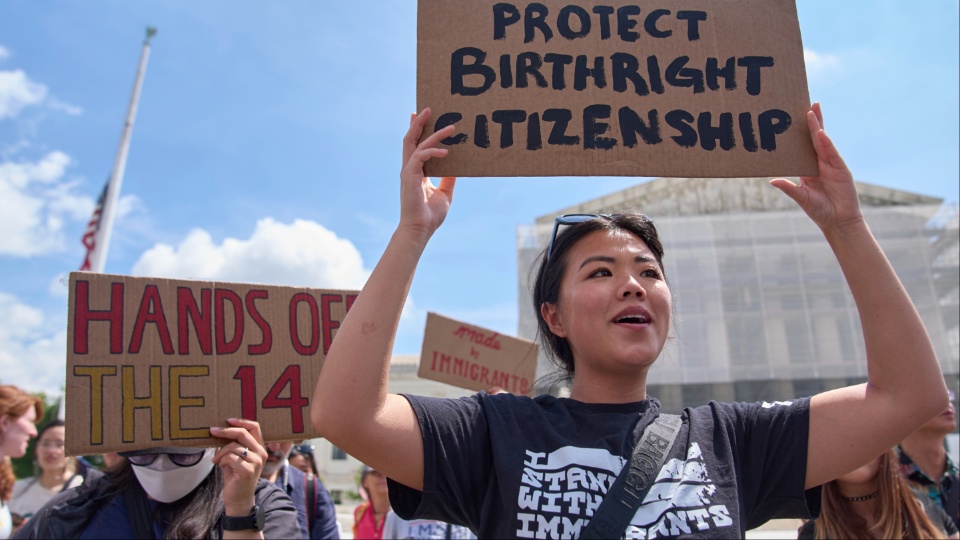
At the Supreme Court Wednesday, led by the AFL-CIO, the nation’s unions are siding with the Constitution and against the Trump regime in the controversial “birthright citizenship” case. The labor movement is backing the case challenging Trump’s order, which is being argued by the American Civil Liberties Union (ACLU).
The official White House schedule for the day says the president himself will be in the court room to observe as the nine Supreme Court justices—seven of them descendants of immigrants and two African-American descendants of enslaved people—hear oral arguments on his attempt to repress the rights of anyone his administration deems to be not a citizen.
Trump’s move, by an executive order on the first day of his second term, Jan. 20, 2025, says the U.S. Constitution’s 14th Amendment, adopted in 1868, does not mean what it bluntly says: “All persons born or naturalized in the United States, and subject to the jurisdiction thereof, are citizens of the United States and the states in which they reside.
“No state shall make or enforce any law which shall abridge the privileges or immunities of citizens of the United States, nor shall any state deprive any person of life, liberty, or property without due process of law, nor deny any person within its jurisdiction equal protection of the laws,” the amendment adds.
There are limited exceptions: children born to foreign diplomats in the U.S. or to occupying enemy armed forces and, formerly, the children of Native American tribes. The latter were legally granted U.S. citizenship in 1924, and other than the remaining exceptions, the amendment is all-encompassing, the AFL-CIO says.
“Birthright citizenship is enshrined in the Constitution, codified in federal law, and has been repeatedly affirmed” by the Supreme Court, the AFL-CIO and its allied unions say in their friend-of-the-court brief. “Nonetheless, the president sought unilaterally to nullify the basis for citizenship by executive decree.”
His order “declares children born in the United States are not U.S. citizens if, at the time of birth, their mother is either ‘unlawfully present in the United States’ or present ‘lawfully but temporarily,’ and their father is not a U.S. citizen or lawful permanent resident.”
The federation declares: “For more than 150 years, the 14th Amendment has guaranteed a child’s birth in the United States confers the privilege of U.S. citizenship regardless of the immigration status of the parents.”
Creating a permanent underclass
Trump and America First Legal—the organization founded by Stephen Miller, architect of the administration’s anti-immigrant policies—argue otherwise. They claim that a person “naturally born in the U.S. is only considered a citizen if their parents have allegiance to the nation.”
By entering the country undocumented, which is a misdemeanor, America First Legal Vice President Daniel Epstein says the parents commit a crime and therefore do not “meet the traditional notion of allegiance.”
Besides disagreeing with the legal acrobatics of Trump’s lawyers, the labor movement points out the immediate tangible effects that would be involved if Trump’s order is upheld. Depriving people of their citizenship not only opens the door for massive political repression, but it throws the victims wide open to economic repression, too. Think the “underground economy” writ large.
“Elimination of birthright citizenship would transform promising future generations into a permanent underclass,” the AFL-CIO and its allies warn.
“Denial of citizenship is a deprivation of ‘property and life and all that makes life worth living.’” Trump’s order means “countless children born on U.S. soil would be rendered undocumented and subject to removal from the United States. An untold number would become effectively stateless.
“U.S.-born children would be forced to live at constant risk of exploitation or deportation to a country they have never known,” the brief declares.
Such a situation would be a massive downward pressure on not just wages of the working-class majority but on all of their living conditions.
The nation’s largest labor federation listed powerful examples. Its first involved two medical specialists in the U.S. after training at the University of Illinois-Chicago and overseas in transplantation surgery. Both used initials to preserve their privacy. Both are in the U.S. on special visas. The husband is a member of the Committee of Interns and Residents, a Service Employees International Union sector. Their first child, born in the U.S., turns a year old in April.
The couple “hope to establish meaningful careers, raise a family, and contribute to the United States,” the brief says. The wife, Dr. G., says they want to settle here both to help low- and moderate-income people receive outstanding medical care and because “the United States is the world’s leading country in the field of medical innovation and research.”
But under Trump’s order, which is what the justices are debating Wednesday, “Their child would not be a U.S. citizen. Their child would be denied the educational and career opportunities only available to U.S. citizens through federal student loans and grants.
“Because their child would be unable to obtain a Social Security card, passport, or other forms of U.S. identification, Drs. G. and E. worry their child would have difficulty registering for school, obtaining medical insurance, and eventually pursuing a career.”
Will hurt all workers
Underlining the realization by labor of the importance of this issue to all workers, unions on the friend-of-the-court brief include the Communications Workers, the Laborers, AFSCME, the American Federation of Teachers, the National Education Association, the Retail, Wholesale, and Department Store Workers, the United Food and Commercial Workers, the United Farm Workers, Actors Equity, the Bricklayers, the Professional and Technical Engineers, SEIU, Unite HERE, the Painters, the United Auto Workers, and the Writers Guild of America East.
All unite around the basic proposition that eliminating birthright citizenship is against the interests of the entire working class.
The Teachers/AFT and the National Education Association both represent teachers and other school workers who are naturalized citizens and teach kids who are citizens but whose parents are not. The Laborers and the Painters, both part of the building trades, have high proportions of migrant worker-members, both naturalized and not.
Actors Equity includes among its historic roster of members performers such as Gene Kelly, who were naturalized. The Communications Workers include a variety of professions with high shares of naturalized and foreign-born citizens. So do the Professional and Technical Engineers. Some 40%+ of the Farm Workers are Spanish-speakers, many of them naturalized. The proportion in Unite HERE is even higher.
The constitutional “hallmark of freedom and opportunity assures that every child born on U.S. soil is entitled to participate equally in all aspects of public and private life,” the unions’ brief says. That, it notes, includes joining unions and running for office up to and including the presidency.
“The guarantee of citizenship has opened the doors of opportunity for millions, paid lasting dividends for our country, and allowed these citizens to contribute as doctors, educators, in-home health aides, family childcare providers, and other workers who are essential to our communities and our national economy,” the AFL-CIO brief states.
The justices are expected to decide the case by the end of June or early July, though their responses to arguments in the courtroom Wednesday could provide clues about how they might rule.
We hope you appreciated this article. At People’s World, we believe news and information should be free and accessible to all, but we need your help. Our journalism is free of corporate influence and paywalls because we are totally reader-supported. Only you, our readers and supporters, make this possible. If you enjoy reading People’s World and the stories we bring you, please support our work by donating or becoming a monthly sustainer today. Thank you!
CONTRIBUTOR