
JOHNSON COUNTY, Iowa—On Nov. 3, the voters of Johnson County, Iowa, made their voice heard when a new county jail bond failed, 46% to 54%. The measure needed a 60% supermajority to pass. If passed, it would have granted the Johnson County Sheriff’s Department a Christmas list of toys for violence costing $94.5 million in general obligation bonds.
The stated purpose for the jail bond funds would be “acquiring land and constructing, equipping, and furnishing a new sheriff’s office and jail facility.” Not disclosed on the ballot—and not entirely determined by the county at the time of writing—the bond interest would be set between $25 million and $55 million. For clarification’s sake, this would mean the $94.5 million bond plus another $25 million (minimum) in interest, putting taxpayers on the hook for roughly $120 million to $150 million.
The justification made by the sheriff’s department was that the current jail is at end-of-life and needs to be totally replaced. When this was revealed to the county following a closed-door committee meeting that crafted the department’s wish list, voters began raising a number of questions.
What public safety problems is the county trying to solve? What outcomes is it trying to achieve? What actions led to the condition of the current jail? Does the sheriff plan to rent out the extra jail space, and if so, to whom? How much will this facility cost to operate? Why wasn’t there public engagement until now?
When it came time to justify the price tag or explain how expanding the jail from 92 to 140 beds will address safety concerns, the sheriff’s department could only rely on generalities, painting a picture of violent individuals overflowing the current facility. In reality, local experts pointed out that the county’s jail population has trended downwards and nearly 90% of occupants are there on nonviolent charges.
The 2026 election now marks the sixth time since 1976, by the coalition’s count, that county residents have voted against a new jail, rejecting the need for spending tax dollars on an expensive incarceration facility.
Shaky justification
Knowing that past record of voter rejection, county leaders decided the best course was to set up a closed-door planning committee, initially including Sheriff Brad Kunkel, the Sheriff’s Department command staff, Johnson County’s facilities manager, and County Attorney Rachel Zimmermann Smith.
The bond request they came up with was even higher than what county-hired consultants had proposed in a recent Structural Condition Assessment.
In 2024, Axiom Consultants estimated fully rebuilding the existing jail would cost between $10.5 and $15 million. In the same assessment, Axiom “would not state, at this time, that the building is in danger of imminent structural failures of any sort.” They also added a note stating that, due to the building’s original construction methods, it would be “resistant to age-related damage.”
The sheriff, however, claimed the building is worn out but repeatedly ignored questions from the community as to why his department has a history and pattern of deferred maintenance. The same 2024 Axiom assessment found that critical repairs to the jail would total roughly $2.3 million to $4.4 million, a fraction of the bond.
The sheriff’s department also claimed that spending tens of millions for a new jail would actually save taxpayers money by eliminating the need to transport people to other jails due to overflow. The county’s own data, though, revealed that over a 25-year period, taxpayers only spent $650,000 annually on average for such circumstances. At that rate, it would take taxpayers nearly 150 years to spend an amount equal to the cost of the new jail.
The same data also shows that the jail population, at its current level, does not even come to half of the 240 beds the new facility’s core systems were designed to accommodate. The average daily population in September 2026 was 106.67, according to the county’s website. In the same month, most of the seven listed reasons for booking are nonviolent crimes, typically involving alcohol consumption, which speaks to a different issue possibly requiring solutions beyond incarceration.
Of all the concerns and questions brought up by the community, the one with the most resonance was that of how the county would prevent the federal government, and namely ICE, from using all those extra unused beds in a new larger facility.
Johnson County has been subject to overreach by higher levels of government previously, and many residents pointed out that the county would be defenseless if ICE demanded access to its jail. The Johnson County Sheriff’s Department has a history of claiming it does not work with the federal government or hold people on ICE detainers, but internal data and actions suggest otherwise.
It’s important to note, regardless of the department’s claims, that Republican state lawmakers already made it illegal for local officials to refuse to collaborate with ICE.
Community response
The defeat of the jail bond on Election Day was not a spontaneous outcome.
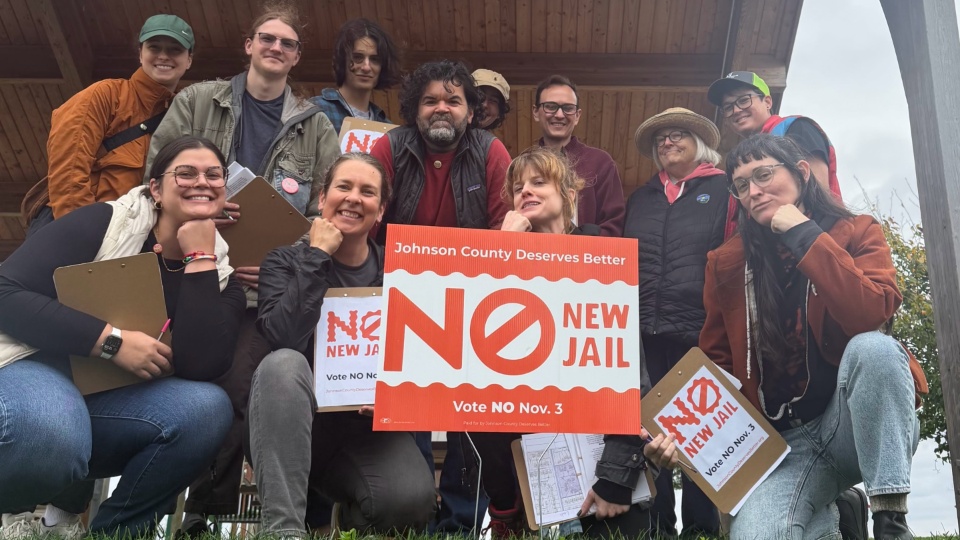
On July 5, a coalition of volunteers announced their intention to launch an awareness campaign named “Johnson County Deserves Better.” But it wasn’t until August that the county Board of Supervisors voted 3-2 to put the jail on the ballot.
The coalition was built by many of the same voters who started questioning the sheriff’s department’s intentions when it brought this proposal to the county in 2024.
Johnson County Deserves Better emphasized three main points in its campaign: 1.) fiscal responsibility, 2.) good governance, 3.) a humanitarian approach, focusing on the main aspects that would concern any voter within the county.
The group did not have an easy fight. There was a massive disparity in funding in favor of jail advocates, namely from Shive-Hattery, the Cedar Rapids-based architecture firm the county contracted for the jail project, which was in position to gain if the ballot measure passed. It donated $15,000 to Johnson County’s pro-jail PAC in October 2026, which at the time doubled the total funding of the coalition.
But the coalition focused on real community needs and sought to maintain unity throughout, focusing on facts and the need to defeat monied interests. Creating signs, tabling at community events, building a social media presence, and setting the goal of knocking every door were some of the main tactics used in their struggle against mass incarceration at the local level.
Despite the victory, organizers are urging people to look ahead, reminding them that the fight isn’t over and that the demand continues for better governance, fiscal responsibility, and a humane approach to preventing harm and building a safer community.
“We understand the need to plan for the long term, which is why we know we deserve a plan that includes investments in the systems and infrastructure that prevent harm — meaning fewer victims — rather than those that react to it,” coalition activist and attorney Ingrid Gronstal said after the vote. “A long-term solution means more care, not more cages.”
No paywalls at People’s World
At People’s World, we believe news and information should be free and accessible to all, but we need your help. Our journalism is free of corporate influence and paywalls because we are totally reader-supported. Only you, our readers and supporters, make this possible. If you enjoy reading People’s World and the stories we bring you, please support our work by donating or becoming a monthly sustainer today. Thank you!
CONTRIBUTOR