The following opinion article is in response to the article “The ‘Lost Cause’ loses its tax subsidy with Virginia’s anti-Confederacy law,” published by People’s World on April 22, 2026.
I am struck by the irony of People’s World printing an op-ed that seems to wholeheartedly support a recent Virginia law that removes tax-exempt status from the United Daughters of the Confederacy (UDC) and other pro-Confederate historical associations.
As much as I agree with author Aloysius Wolf’s analysis of the reactionary nature of the UDC and the very negative role it has played in promoting the “lost cause” version of history of the Civil War, I have to agree with the legal team of the UDC that cites this as a case of viewpoint discrimination.
I have always been an outspoken opponent of the dozens of Confederate statues and the naming of streets and highways after Confederate generals in the state of Virginia. Although efforts have been made recently to change this situation, there still exist nearly 100 statues and hundreds of streets that honor Confederates.
I could never understand how any jurisdiction could honor men who were traitors to their country. Wolf’s article does an excellent job summarizing the particular role of the UDC in the process of erecting these statues and naming these streets and highways.
I have no problem with Wolf’s reporting the new law that would remove the UDC’s tax-exempt status. After all, Virginia did pass this legislation. People’s World should report the news. And, I have no problem with Wolf’s excellent analysis of the role of the UDC in Virginia and the entire southern United States.
However, the irony comes in Wolf’s support for this measure, for the predecessor of People’s World, the Daily Worker, was subjected to the exact same type of governmental pressure that Wolf now applauds in Virginia. In both cases, the power of the state’s fiscal code is used to penalize an organization that the government deems contrary to established public policy.
The new Virginia law specifically names the UDC and strips it of tax-exempt status because the organization stands against the public values of equality. This is just like how the Communist Control Act of 1954 stripped the Communist Party of all the rights and privileges of being a legal political party in the United States.
As the Communist Party was no longer considered a legal political party, it was considered a business. Dues and contributions made to the party now became taxable. The law prohibited the party from having financial accounts, entering into leases, or obtaining judicial enforcement of contracts. It prevented people from taking tax deductions to communist-led organizations. It prevented party employees from contributing to and thus ever receiving Social Security.
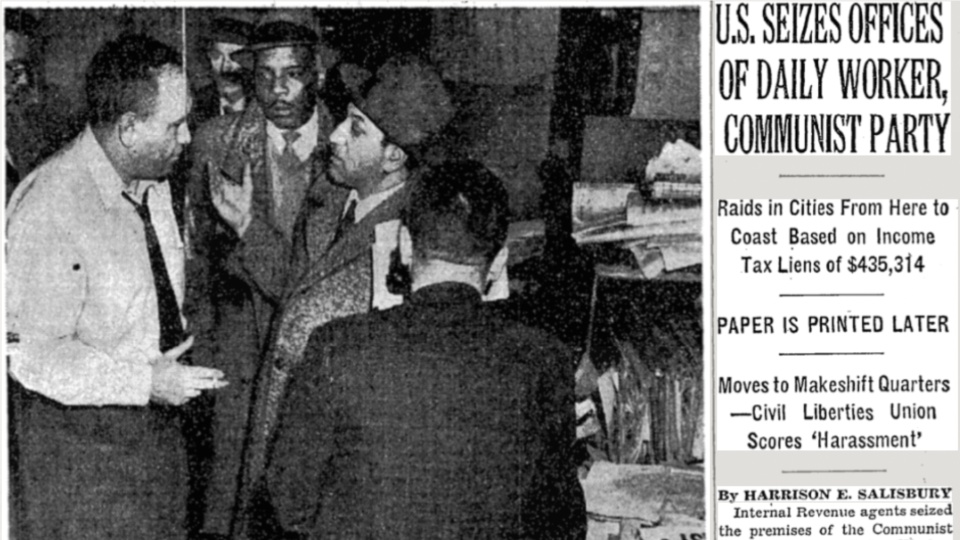
And, in 1956, the IRS began to seize assets of the Communist Party, including the offices of the Daily Worker. The office was padlocked, and all the furniture was sold off, most importantly including the addressing machine with the names and addresses of all the subscribers.
Unquestionably, Virginia’s treatment of the UDC is much milder than the treatment the U.S. Government meted out to the Communist Party. But the legal precedent is the same: A government is using selected taxation as a punishment for views that the government deems contrary to public policy.
Virginia has used the case of Bob Jones University vs. the United States as their legal basis for passing this law. Bob Jones University prohibited interracial dating among its students. The IRS stripped them of their tax-exempt status because of this prohibition. The Supreme Court ruled 8 to 1 that the government has the right to revoke tax-exempt status from non-profit organizations whose practices are contrary to a compelling government public policy.
For me, and I’m not a lawyer, the distinction is that Bob Jones University took discriminatory actions while UDC has lost its tax-exempt status due only to discriminatory viewpoints, viewpoints which I think are protected under the First Amendment. If UDC practiced actual discrimination, say, in hiring, or in deciding who could enter their public museum, then Virginia’s new law would be completely justified.
Why is this important? Why would I be defending the rights of an organization whose viewpoint on history I reject as false, an organization who promoted this false version of history in order to ideologically justify racial discrimination?
First, because, just as in the past, this very same tactic can be used against the Communist Party. Secondly, Georgi Dimitrov, in his famous speech to the Seventh World Congress of the Communist International, now published as Against Fascism and War, by International Publishers, argued that it was up to Communists to fight against government policies that suppress democratic liberties.
Failing to protect liberty, even the limited version of liberty we have under capitalism, directly facilitates the victory of fascism. Under a clearly fascist-leaning Trump government, we can’t afford for even our ideological enemies to lose their right to express their viewpoints.
As with all op-eds published by People’s World, the views reflected here are those of the author.
People’s World is in the midst of its annual fund drive, trying to raise $140,000 by May Day. To support working-class journalism, please consider make a donation or become a monthly sustainer. Thank you
CONTRIBUTOR