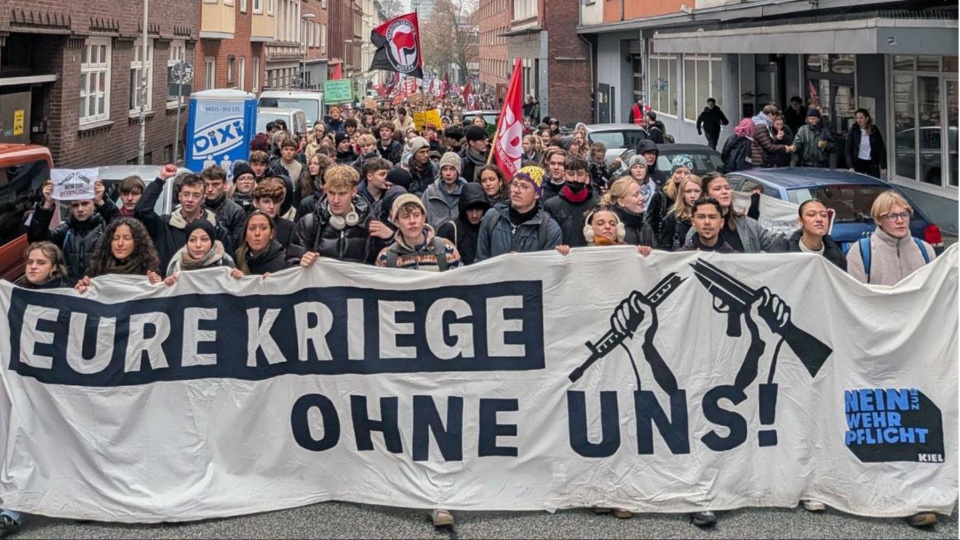
BERLIN—More than 55,000 students in over 80 cities across Germany went on strike this Friday against the “Military Service Modernization Act,” which was passed by the federal parliament, the Bundestag, that same day.
According to the new law, starting this January, all 18-year-olds will receive a questionnaire that will test their willingness and interest in military service. Completing the form will be mandatory for men and voluntary for women. From July 2027, men will also be required to undergo medical examinations.
The move is seen as a major step toward the return of conscription and marks a significant escalation in conservative Chancellor Friedrich Merz’s campaign to turn Germany into the largest conventional military power on the continent.
The law passed 323 to 272, despite determined opposition from left-wing members of parliament from the “Die Linke” party. The approved draft is nominally committed to a system of voluntary military service, but as written, it leaves room for compulsory conscription if recruitment targets are not met.
The goal is to significantly increase the ranks of the German army, which currently numbers about 183,000 regular soldiers and only 49,000 reservists. According to NATO targets, Germany is supposed to reach a strength of 460,000 soldiers—260,000 regulars and 200,000 reservists. That would mark a near-return to troop levels common during the Cold War, when West Germany maintained an army of more than half-a-million men before downsizing its ranks in the 1990s.
The students’ “School Strike Against Conscription” initiative mobilized youth opposition nationwide and demonstrated the extent of the resistance against the law. Students formed strike committees and already spent the past few weeks preparing demonstrations, writing speeches, designing posters, conducting surveys, and mobilizing their classmates.
From Kiel to Munich, from Göttingen to Potsdam, many classrooms remained empty all day Friday.
“We are impressed by how many students went on strike today. This shows that students are not only speaking out against conscription in surveys but are also prepared to take action against it. They demonstrated courage today. Because they don’t want to spend six months learning how to kill. They don’t want to die in war,” explained Hannes Kramer, press spokesman for the initiative.
The participants went on strike despite repression and threats from state ministries of education, school principals, and assembly authorities. “They threatened us with absences and tried to intimidate us with discussions. I experienced this myself, but I decided to strike anyway,” said Golo Busche from Kiel, because: “What’s a conversation with the principal or unexcused absences compared to half-a-year in the barracks?”
The young people weren’t demonstrating alone. “In many places, the students were supported by parents and teachers, for example, by the GEW (Education and Science Workers’ Union),” Kramer said happily.
More than 2,000 students demonstrated against conscription in Munich. In Berlin, over 10,000 young people took to the streets, 5,000 in Hamburg, and 3,000 in Dresden. In major cities like Munich, Kiel, Stuttgart, and Cologne, thousands of young people also protested. Even in smaller towns like Marburg, Landau, and Friedberg, hundreds took to the streets.
The German Communist Party (DKP) had also called for the strikes. In many places, party members supported the demonstrations. Many other organizations expressed their solidarity, such as the German Peace Society-United War Resisters (DFG-VK) and individual trade union branches.
In numerous speeches and at open mics, it became clear why the students preferred to strike rather than go to school. “We’re supposed to become fit for war for Germany—but what about our right to live in peace?” explained Phil Werring from Münster, justifying his participation in the strike. Instead of military drill and war, the students want a life without coercion, with good education and training, and future opportunities.
In several cities, participants were subjected to sometimes severe repression. In Halberstadt, high school students were locked in by the school administration and deprived of their freedom. The school administration decreed that recess would take place indoors.
In Leipzig, police removed two students from a demonstration because of a banner calling on Chancellor Merz to join the German Armed Forces himself. The officers claimed this was illegal but could not cite any law that had actually been violated.
In Hamburg, police banned a feeder demonstration and prohibited a spontaneously registered demonstration. In Rostock, the assembly authority unilaterally postponed a registered demonstration until 1 p.m., after school had ended.
The protest will not end with Friday’s strikes, emphasized the “School Strike Against Conscription” initiative. “We will remain vocal until conscription is off the table. We will oppose every step towards its introduction,” announced Ronja Ruh from Berlin.
The initiative is calling for a second round of school strikes on March 5, 2026. Until then, they are preparing for the next strike and campaigning against Bundeswehr recruitment in schools.
This article features reporting by Unsere Zeit and People’s World.
We hope you appreciated this article. At People’s World, we believe news and information should be free and accessible to all, but we need your help. Our journalism is free of corporate influence and paywalls because we are totally reader-supported. Only you, our readers and supporters, make this possible. If you enjoy reading People’s World and the stories we bring you, please support our work by donating or becoming a monthly sustainer today.
CONTRIBUTOR