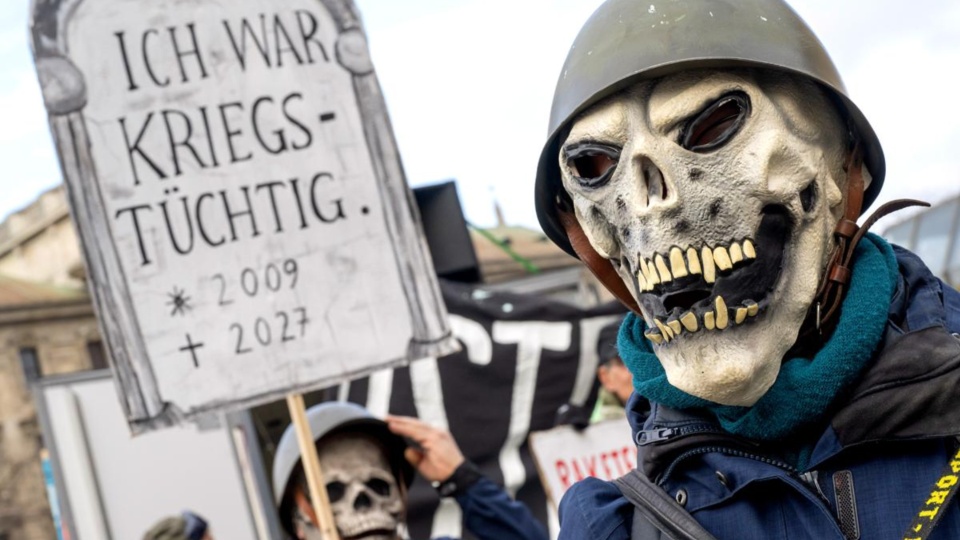
MUNICH—These days, the Bavarian capital resembles a fortress. Dozens of heads of government and foreign ministers from around the world have arrived for the Munich Security Conference, which will be opened by Germany’s conservative Chancellor Friedrich Merz on Friday, Feb. 13.
The private event has grown so large that the luxury Hotel Bayerischer Hof has become too small as a venue. Therefore, additional buildings have been rented for the “Siko,” a nickname shortened from the German sicherheitskonferenz, or Security Conference. The entire area surrounding the hotel has been designated a restricted zone, with protesters kept at a distance.
Conference Director Wolfgang Ischinger, a long-time representative of German imperialism in Washington, has transformed the war conference from its origins as a meeting to discuss military science into a transatlantic think tank highly regarded in capitals on both sides of the ocean.
Always striving for good relations with the U.S. since his days as ambassador in D.C., Ischinger was able to announce this year that the U.S. government delegation would be led by Secretary of State Marco Rubio. He will be accompanied by Trump confidants Steve Witkoff and Jared Kushner, both of whom sit on the president’s “Board of Peace,” which is overseeing the “rebuilding” of Gaza. These U.S. representatives stand for an aggressive war policy and have been key backers of recent imperial maneuvers targeting Iran, Venezuela, and Cuba.
A glance at the guest list of the Munich conference reveals that regime change policies like those targeting these countries have long been an integral part of German foreign policy. At past conferences, opposition politicians from Russia were particularly welcome, while no dialogue took place with the government in Moscow.
Similarly, this year, instead of representatives from Tehran, it will be Reza Pahlavi, the son of the deposed Iranian monarch, who will be welcomed. Pahlavi hasn’t set foot in Iran since 1979 but is being treated as if he were that nation’s leader.
All of that is par for the course. The real shift this year is the picture that conference organizers are painting of the system of international alliances and their prescriptions for how Europe should respond.
They are presenting an image of European interests being trampled underfoot. According to their narrative, the superpowers USA and China are wrecking the international order at the expense of democratic governments in Europe. This tale mirrors that of the established parties in the German Bundestag.
“More than 80 years after its establishment, the postwar order, shaped primarily by the USA, is in a process of destruction,” states the Munich Security Report published on Monday. The document, typically unveiled a few days before the conference, sets the tone and agenda of the meeting.
It continues: “The most powerful of those actors taking the axe to existing rules and institutions is U.S. President Donald Trump.” Conference chairman Ischinger therefore wants Munich to send a signal to Europe: Wake up!
The report recalls the Davos “confession” speech of Prime Minister Mark Carney at the World Economic Forum in January. There, the Canadian leader warned that economic integration is now explicitly subordinated to geopolitical rivalry and domestic political calculation by the U.S. With this “rupture,” Carney emphasized how allies are treated as expendable, institutions as disposable, and agreements as binding only so long as they serve immediate U.S. advantage.
“The world has entered a period of wrecking-ball politics,” the Munich Security Report states. “Sweeping destruction—rather than careful reforms and policy corrections—is the order of the day.”
Containing the destruction will require other actors to step up, it says, “by significantly investing in their own power resources and pooling them through closer cooperation.” In other words, Europe—with Germany in the lead—has to arm itself and defend its “interests.”
Eighty years after the military victory of the anti-Hitler coalition over German fascism and the end of the war of annihilation against the peoples of Europe and especially the Soviet Union, this is the answer to the growing competition among the G7 imperialists, at least according to the leading thinkers of German great power ambitions.
In an interview with the Frankfurter Allgemeine Zeitung, Ischinger, Germany’s most prominent diplomat, recently explained the necessity of a “core Europe.” Decisive action must be taken by that “core”—again, meaning Germany—even if unanimity cannot be achieved in the European Union, he said. This especially applies to “foreign policy issues and the development of a European arms industry”—a project that Canada, too, has joined.
“The time that Ukraine, with its fight for freedom against Russia, is buying us must not be wasted,” Ischinger said, referring to the sense and senselessness of the dying on NATO’s “eastern flank,” as the front line running through the heart of Europe is now called.
However, the aspirations of those like Ischinger, who envision a militarized Europe headed by Germany, cannot be certain of the support of those they govern. People who still believe that government policies will improve their future are in the minority in the G7 countries. In Germany, it is only 13%, according to the Munich Security Report. The course toward a war economy within the European alliance will only accelerate this trend.
This article originally appeared in Unsere Zeit. It has been supplemented with further reporting by People’s World.
We hope you appreciated this article. At People’s World, we believe news and information should be free and accessible to all, but we need your help. Our journalism is free of corporate influence and paywalls because we are totally reader-supported. Only you, our readers and supporters, make this possible. If you enjoy reading People’s World and the stories we bring you, please support our work by donating or becoming a monthly sustainer today. Thank you!
CONTRIBUTOR