WASHINGTON—August 6 is Hiroshima Day. Eighty-one years ago, on August 6, 1945, the U.S. dropped the first atomic bomb on Hiroshima, Japan. Scholars have debated ever since why the U.S. used the bomb and then dropped a second one on Nagasaki three days later, on August 9, 1945.
Was it to bring a quicker end to World War II and save a million U.S. casualties, as President Harry S. Truman, who gave the go-ahead, claimed at the time? Or was it to send a warning from the U.S. to the Soviet Union? “We have the bomb; you don’t. So what we say goes,” was the mindset of U.S. imperialism in the early years of the nascent Cold War.
While Hiroshima Day is the subject of a solemn commemoration in Chicago, it is also marked by an ominous portent of potential nuclear proliferation. Saudi Arabia, for example, is joining the list of nations with the technology and material to make a nuclear bomb, courtesy of right-wing—and pro-nuclear—U.S. President Donald Trump.
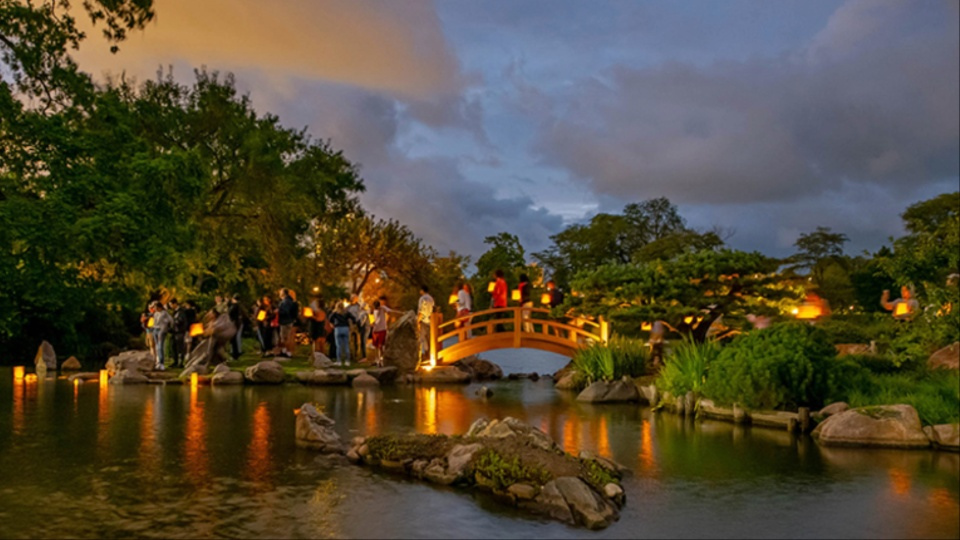
In Chicago, the Toro Nagashi memorial lantern-lighting ceremony will occur in Jackson Park’s Osaka Garden, from 7 p.m.-11 p.m. Central Time on August 6.
The Jackson Park site is just over a mile from the site of the key precursor of the A-bomb, the first controlled nuclear chain reaction, which occurred under the stands of an abandoned University of Chicago football stadium on Dec. 2, 1942.
In a later article written for what was then the U.S. Atomic Energy Commission, the leader of the Chicago scientific team, Dr. Enrico Fermi, admitted they focused on harnessing atomic energy during the war for “the objective of producing an effective weapon.”
“At the same time, we all hoped that with the end of the war, emphasis would be shifted…to the peaceful aspects of atomic energy,” Fermi added. The hope turned out to be naïve. Producing bombs “still is the primary concern” of nations involved with nuclear energy, he admitted.
“The ceremony of Toro Nagashi—literally, “floating lanterns”—is a Buddhist tradition held to celebrate the end of the Obon season,” the Chicago Park District explained. This ceremony is open only to 300 people, and it’s already full.
“Toro Nagashi can be a smaller family affair to remember lost family members or a much bigger event to memorialize those who have been lost to natural disasters, war, and other causes.” The lit lanterns commemorate the spirits of the dead.
“After the atomic bombings of Hiroshima and Nagasaki, the event has become linked with hopes for a more peaceful future,” the Park District’s release says.
The U.S. dropped the second A-bomb on Nagasaki on August 9, 1945. The combined destruction—both cities were obliterated, and hundreds of thousands of people were immediately incinerated, with tens of thousands more to follow in succeeding years—was followed by the formal Japanese surrender.
Key speakers in Chicago will include Alexandra Bell, president and CEO of the Bulletin of the Atomic Scientists, and Dr. Yuki Miyamoto, Director of DePaul University’s Humanities Center and Peace Ambassador to Hiroshima. Members of Chicago’s Daiyuzenji Rinzai Zen Temple will lead the rite.
By contrast, right-wing Trump is unintentionally marking Hiroshima Day by making nuclear proliferation worse. On July 23, he signed a pact to help the Saudi government and its virtual and murderous dictator, Prince Mohammed bin Salman, develop “a civilian nuclear energy program” over the next 30 years. Such programs can be the precursors to developing the bomb, especially without international oversight.
The U.S. has such civilian nuclear energy development pacts with 26 other nations, and Trump has been pushing them, wrote François Diaz-Maurin in the Chicago-based Bulletin of the Atomic Scientists after Trump’s announcement. Westinghouse, part of the U.S. military-industrial complex—though Diaz-Maurin did not mention that—is expected to be the main contractor.
“Previous U.S. administrations resisted concluding” a civilian nuclear energy development program with the Saudis “because the kingdom insisted on developing domestic uranium enrichment,” Diaz-Maurin wrote.
“The U.S.-Saudi agreement comes from an administration that doesn’t seem to worry about the spread of uranium enrichment and spent fuel reprocessing,” Diaz-Maurin explained, citing a May 2025 Trump executive order demanding his administration “aggressively pursue at least 20 new agreements” with other nations for nuclear energy development.
And late last year, Trump and South Korean President Lee Jae Myung signed a similar agreement.
Meanwhile, in Hiroshima, an annual ceremony memorializing the victims of the first A-bomb will occur. The rite will be at the “Atomic Bomb Dome,” the ruin of the city’s former industrial exhibition hall near Ground Zero.
The dome “ended up being the only preserved ‘monument’ to the destruction, serving a focal point for Hiroshima’s peaceful rebirth activities, but its preservation was contentious,” wrote Alex Wallerstein in the Bulletin.
Wallerstein makes one more point: The U.S. dropped two A-bombs on Japan. Surveys show 78% of respondents can name the site of the first one, Hiroshima, but fewer than one third of that number can name the second, Nagasaki.
We hope you appreciated this article. At People’s World, we believe news and information should be free and accessible to all, but we need your help. Our journalism is free of corporate influence and paywalls because we are totally reader-supported. Only you, our readers and supporters, make this possible. If you enjoy reading People’s World and the stories we bring you, please support our work by donating or becoming a monthly sustainer today. Thank you!
CONTRIBUTOR