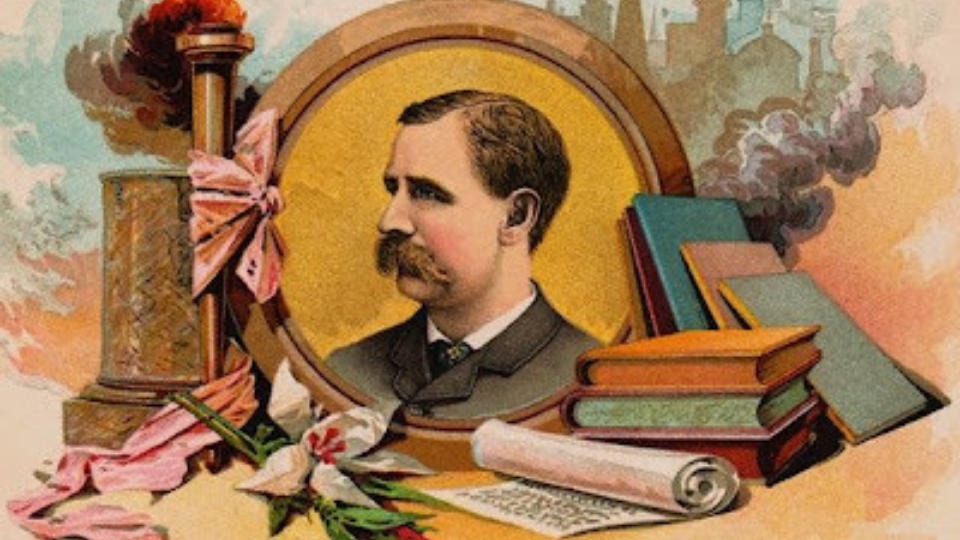
“The folly of men, not their hard-heartedness, was the great cause of the world’s poverty.”― Edward Bellamy
Published in 1888, Looking Backward: 2000-1887 was a best-selling American novel in the early 20th century. Today, Edward Bellamy’s work is all but unknown, and society is poorer for its ignorance.
The futuristic premise of Looking Backward is embodied in the literal and figurative awakening of Julian West, a time traveler who had been slumbering for 113 years. Transported from the crude and unbridled capitalism of his day, Julian finds his eyes opened to a new world of cooperation and equality.
Bellamy anticipated the consolidating trend toward parasitic monopolies and trusts of the Gilded Age, and foretold the dawn of a “golden future.” Avaricious and inherently inefficient capitalism gives way to a single owner of all capital and industry: the state, whose motto is “From all equally, to all equally.”
Sensitive to being labeled a “communist” or “socialist,” the New England-born Bellamy called himself a nationalist who put public interest over private profit at every turn. Applying “the democratic idea to the business system,” he employs easy-to-grasp, yet powerful, allegories to build his case.
For example, he describes a large carriage, pulled by poor, suffering humanity. On top ride the wealthy. The driver is hunger. Despite the strain of drawing the coach, the top passengers never get down, even at the steepest ascents. Well above the dust and toil, these occupants leisurely enjoy the scenery while critically assessing how hard it is to get good help.
In Bellamy’s vision of national unity in Looking Backward, everyone is enlisted in an industrial army. Each citizen is educated, trained, and assigned a job according to their abilities. Even the infirm contribute. There is no such thing as unemployment, and a fully funded retirement comes at age 45. 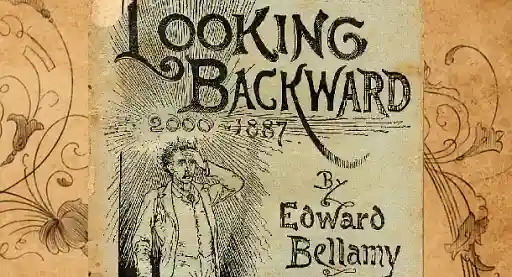
Everyone receives equal pay via a debit card (an innovation that Bellamy presaged), but hours are adjusted based on the physical requirements of the work. As such, manual laborers would have shorter shifts than less strenuous avocations.
By putting all citizens on equal financial footing, private homes are modest, and public places are grand. Because the welfare of people supplants profit—everyone gleans an equal per-capita share of the national GDP (Gross Domestic Product)— wasteful competition becomes obsolete.
Dr. Leete, who conducts Julian West on a tour of this future, observes that by consolidating capital and production under one owner, the nation actually creates more public wealth than capitalism produced. Instead of industries and individuals competing against one another, they now collaborate.
I like to cite television’s incessant, infantilizing commercials (aka organized lying) as prime examples of execrable waste. Imagine how much healthier society would be if those tens of thousands of spokespersons, actors, models, celebrities, shills, and cavorting extras were employed in productive capacities, instead of touting duplicative services and dubious products in a craven scramble to squeeze out an extra dollar over competitors.
“There is no such thing in a civilized society as self-support,” Bellamy writes. “In a state of society so barbarous as not even to know family cooperation, each individual may possibly support himself, though even then, for a part of his life only. … They were in the plight of a man building a house with dynamite for mortar.”
Dr. Leete tells the wide-eyed Julian: “Their misery came, with all your other miseries, from that incapacity for cooperation which followed from the individualism on which your social system was founded, from your inability to perceive that you could make 10 times more profit by uniting with your fellow men than by contending with them.”
When Julian recites shibboleths about “free market” prosperity and “individual rights,” Dr. Leete replies, “The nation is rich, and does not wish the people to deprive themselves of any good thing. In your day, men were bound to lay up goods and money against coming failure of the means of support and for their children. This necessity made parsimony a virtue. But now it would have no such laudable object, and, having lost its utility, it has ceased to be regarded as a virtue.”
Lauding the spirit of unity, the good doctor declares, “There is far less interference of any sort with personal liberty nowadays than you were accustomed to. We require, indeed, by law that every man [and woman] shall serve the nation for a fixed period, instead of leaving a choice, as you did, between working, stealing, or starving. With the exception of this fundamental law, which is, indeed, merely a codification of the law of nature by which it is made equal in its pressure on men, our system depends in no particular upon legislation, but is entirely voluntary, the logical outcome of the operation of human nature under rational conditions.”
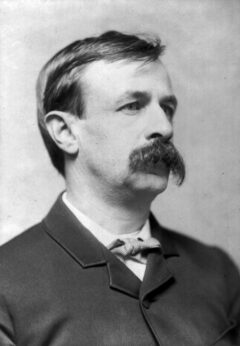
“Work is not valued or devalued as it used to be because the wages were high or low. All work is dignified because it is necessary and contributes to the welfare of the community. It was not until humanity was removed from the swamp of capitalism and transplanted into a healthy environment that people’s true nature could be seen. Unobscured and unhindered by the blight of the old system, humanity is recognized now for its true qualities. People improve not only physically but morally as well. The species is healthier, more honest, and more logical as a whole.”
This brief review barely scratches the surface of Looking Backward’s philosophical depths (or literary value). I encourage all to read it, along with Bellamy’s final work, Equality. There, expanding on his vision of “public capitalism,” Bellamy supplants “old economics [a science of things] with new economics [a science of human beings].”
As the motive force of his society, “equality is the only moral relation between human beings,” Bellamy asserts. He contrasts this with “sham democracies [that] enable worldwide money power and plutocratic despotism.”
“No constitutional devices or parliamentary procedures can make government anything but a farce as long as private economic interests are distinct from and opposed to the public interest,” he concludes.
For anyone hungering for something beyond the crumbs of capitalism, Bellamy has a bounty to share.
We hope you appreciated this article. At People’s World, we believe news and information should be free and accessible to all, but we need your help. Our journalism is free of corporate influence and paywalls because we are totally reader-supported. Only you, our readers and supporters, make this possible. If you enjoy reading People’s World and the stories we bring you, please support our work by donating or becoming a monthly sustainer today. Thank you!
CONTRIBUTOR