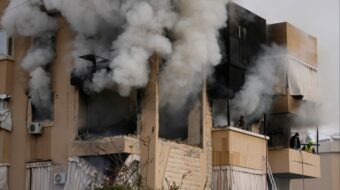
When Israel assassinated Hezbollah’s longtime leader Hassan Nasrallah and killed off much of the group’s leadership in September 2024, it did more than decapitate a movement—it redrew the map of power in southern Lebanon. For the first time in decades, Israel found itself facing a fragmented, leaderless resistance on the other side of its northern border; and it seized that opportunity not through invasion, but through technological innovation.
Southern Lebanon today is not occupied in the conventional sense. There are no columns of tanks, no checkpoints, no Israeli troops marching through border villages. Instead, it is occupied from above and afar—by drones, sensors, and algorithms. This is the new face of control: a remote occupation that governs not through soldiers, but through constant visibility and the threat of instant annihilation.
The IDF has long used the skies over Lebanon for reconnaissance, but since 2024, this surveillance has become total. High-altitude drones now orbit the border almost continuously, monitoring cell signals, tracking vehicles, and transmitting data to Israeli intelligence systems in real time. A report from the Carnegie Endowment for International Peace described this transformation as “a testing ground for remote territorial control”—a laboratory for managing space without soldiers.
Even the air itself is part of the occupation. Residents of southern Lebanon’s major cities of Nabatieh, Tyre, and Bint Jbeil report frequent, if not near constant hums of Israeli drones overhead. They do not see soldiers, yet they live under their gaze. The threat of sudden death—whether by drone strike, guided bomb, or automated targeting algorithm—is permanent.
The killing of Nasrallah and most of Hezbollah’s senior command created a vacuum in southern Lebanon’s political and security structure. The organization’s leadership network, once deeply embedded in every aspect of life in the south, was thrown into disarray. With command channels disrupted, Hezbollah’s local influence receded, leaving villages and border zones effectively exposed.
Israel has capitalized on this moment. With Hezbollah weakened, the IDF no longer needs to physically occupy territory to shape it. Instead, Israel has constructed an “invisible architecture” of domination: a blend of persistent aerial presence, cyberwarfare, and AI-assisted targeting systems that allow it to exert control without crossing the border.
The new model combines multiple layers of coercion. Drones conduct round-the-clock reconnaissance, feeding data into artificial intelligence programs similar to the “Lavender” system that reportedly helped identify tens of thousands of targets in Gaza. These same algorithms, integrated with real-time signals intelligence, can flag “suspicious” movements or communications patterns in Lebanon’s south within seconds.
On the cyber front, Israel has demonstrated its capacity to infiltrate Hezbollah’s logistics chain directly. In one notorious case, a wave of pager and radio explosions killed and injured Hezbollah operatives—an attack that combined digital espionage with kinetic force. Reuters reported that in the aftermath, Hezbollah reverted to landlines and in-person couriers, a regression that underlines Israel’s dominance in the electronic sphere.
Even psychological control has gone digital. In recent operations, Israel has relied on text messages and social media alerts to warn civilians in southern Lebanon of incoming airstrikes. Residents in Tyre, Nabatieh, and the southern suburbs of Beirut have reported receiving evacuation notices on their phones—sometimes only a short time before explosions occurred. These automated warnings, while presented as humanitarian measures, have also become a means of demonstrating total technological reach: Israel can not only strike anywhere, but communicate directly with those it targets.
All of this represents a profound shift in Israel’s approach to warfare. By projecting power remotely, Israel reduces the political costs of occupation—no Israeli military casualties, no soldiers captured, no domestic backlash. The coercive effect, however, remains intact. Lebanon’s airspace, communication networks, and southern terrain are now extensions of Israel’s surveillance regime.
Human rights organizations warn that this model blurs the line between military and civilian targets. Human rights organizations have documented patterns of indiscriminate strikes and civilian displacement resulting from automated targeting and mass surveillance. UNIFIL reports near-daily airspace violations, with drones flying over Lebanese villages, UN compounds, and even hospitals.
The most striking aspect of this new occupation is its invisibility. Control has become infrastructural rather than territorial. Israel no longer needs to plant a flag to dominate a region; it only needs to see everything that moves within it.
This invisibility also makes resistance more difficult. There is no army to confront, no checkpoint to tear down, only an omnipresent sky and a network of unseen servers humming in Tel Aviv or Haifa. It is an occupation designed not to be seen, but to be felt.
What is unfolding in southern Lebanon is not just a regional experiment. As analysts at the Middle East Report have noted, militaries around the world are watching closely. The model being refined here—a system of remote, AI-driven, data-based domination—could easily be adapted for future conflicts. It promises control without the burdens of occupation, precision without accountability, and domination without visibility.
For Lebanon, this means a new kind of sovereignty crisis: one in which the state’s borders are intact on paper, but penetrated by machines. For the world, it signals the normalization of “automated occupation,” a system that replaces soldiers with code and turns entire populations into datasets.
In the skies over southern Lebanon, a new form of imperial power is being perfected. The drones may fly home each night, but their gaze remains. The pagers that explode, the phones that warn of incoming bombs, the algorithms that decide who lives and dies, are all part of a single architecture of control.
The methods first used in Palestine are being upgraded and used in Lebanon. If the world does not reckon with what is happening here, this model of domination—silent, technological, and endless—may soon appear in warzones around the globe.
We hope you appreciated this article. At People’s World, we believe news and information should be free and accessible to all, but we need your help. Our journalism is free of corporate influence and paywalls because we are totally reader-supported. Only you, our readers and supporters, make this possible. If you enjoy reading People’s World and the stories we bring you, please support our work by donating or becoming a monthly sustainer today.
CONTRIBUTOR