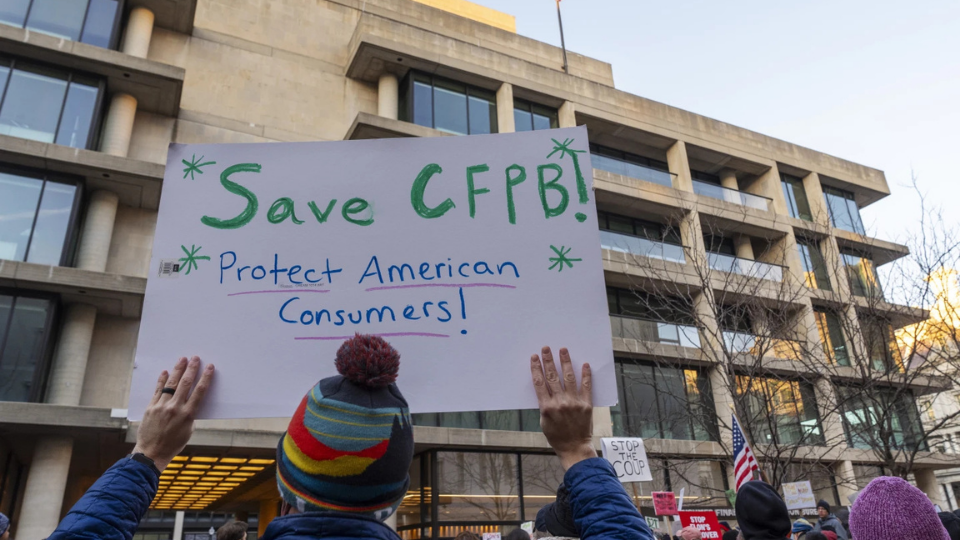
NEW YORK—Shortly before the new year, Judge Amy Berman Jackson ruled that the Trump administration could not stop funding the Consumer Financial Protection Bureau (CFPB). The agency, established in 2011, was formed to oversee consumer protection in the financial sector, with a priority on mortgages, credit cards, and student loans. Since the beginning of his second term, President Donald Trump has made several moves to eliminate the agency and fire the people who work there, who are all federal employees.
In response to the 2008 financial crisis, Congress enacted the Dodd–Frank Wall Street Reform and Consumer Protection Act in 2010, establishing the CFPB. According to the United States Treasury Department, the bureau’s top priority is to “promote fairness and transparency for mortgages, credit cards, and other consumer financial products and services.” It is an independent bureau within the Federal Reserve.
The agency has touted several accomplishments in protecting consumers, as detailed on its website’s blog. Those include an estimated $17.5 billion being put back in Americans’ pockets through monetary compensation, principal reductions, and canceled debts; taking action against Bank of America for “double-dipping” on non-sufficient fund fees and misleading statements regarding credit card rewards; and ordering Wells Fargo to return $2 billion to consumers and pay $1.7 billion in fines for violating laws regarding auto loans and mortgages.
The CFPB has also made numerous proposals to protect the wallets of many Americans—such as curbing excessive credit card late fees, overdraft fees, and a proposal to ban the use of medical debt in credit reports or loan decisions.
While some may argue that financial protection for consumers against large corporate and banking entities is beneficial, the agency has not been without its detractors. These complaints have usually come from Republicans and conservatives, such as GOP Congressman Dan Meuser, who called the agency “an ideological weapon.”
He claims it was used under former Director Rohit Chopra, who was appointed by President Joe Biden, “not to protect the public, but to pressure businesses into aligning with the CFPB’s goals through aggressive rules, enforcement, and supervision.” North Carolina Republican Congressman Tim Moore called it “a progressive agenda prioritizing aggressive enforcement over clear guidance and balanced oversight.”
After retaking office in 2024, Trump fired Chopra and replaced him with Russell Vought as the agency’s acting director. Vought, who is head of the Office of Management and Budget (OMB), is a co-author of Project 2025, the 900-page policy blueprint that shaped the Trump campaign’s 2024 platform. Destroying the CFPB and other regulatory agencies was one of the document’s key goals.
In October 2025, while appearing on “The Charlie Kirk Show,” Vought revealed his plans for the CFPB, saying: “We don’t have anyone working there [CFPB] except our Republican appointees and a few career [employees] that are doing statutory responsibilities while we close down the agency…. We want to put it out, and we will be successful probably within the next two, three months.”
Vought’s admission prompted backlash from several government officials, who called the attempt to shut down the agency illegal. Sen. Elizabeth Warren, D-Mass., an early supporter and architect of the CFPB, wrote a letter and issued a public statement condemning the comments.
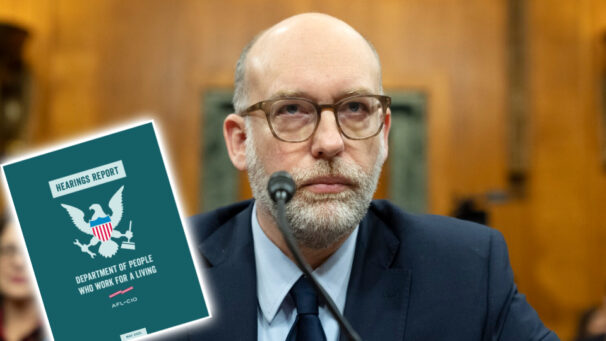
“Your continued attempts to shutter the CFPB are illegal, and American families stand to pay the price,” Warren remarked at the time. “You are making it easier for big banks and giant corporations to cheat and scam families across the country, declaring open season on American consumers.”
Vought and the Trump administration have recently argued that, because the agency receives its funding from the Federal Reserve and the Fed is operating at a loss, there are no “valid funds (combined earnings)” for the CFPB. Judge Jackson rejected the claim, ruling that the CFPB should continue to receive its funding from the Federal Reserve despite the Trump administration’s assertion that no funds are available.
Before citing a lack of funds, Vought sent layoff notices to an estimated 1,400 of the bureau’s workers in April of last year. It was the same Judge Jackson who ordered an injunction halting these firings, seeing the dismantling of the agency through layoffs and data deletion as a “violation of law.” The firings currently remain blocked.
The National Treasury Employees Union (NTEU) continues its legal challenge to Trump’s layoffs of federal workers at the agency. The union’s president, Doreen Greenwald, wrote last year that “It is this lack of respect for the separation of powers that is the heart of our lawsuit to save the CFPB from the White House’s slash-and-burn approach to government.”
In reference to the recent lack of funding claim, Judge Jackson stated that this lapse is manufactured by the Trump administration and that, “It appears that defendants’ new understanding of ‘combined earnings’ is an unsupported and transparent attempt to starve the CPFB of funding and yet another attempt to achieve the very end the Court’s injunction was put in place to prevent.”
The judge’s ruling came days after a coalition of 22 attorneys general, co-led by California AG Rob Bonta, sued the Trump administration and Vought, asserting that the White House’s argument to withhold funds from the consumer protection agency is unconstitutional. The lawsuit—filed in the U.S. District Court for the District of Oregon—challenges the decision by Vought to “refuse to request the necessary funding for the agency from the Federal Reserve, in violation of the Dodd-Frank Wall Street Reform and Consumer Protection Act (Dodd-Frank Act).”
“For 14 years, the CFPB has served as an invaluable partner to state attorneys general and state banking regulators, as an enforcer, regulator, and resource for consumers. Shortly after taking office, the Trump Administration launched a campaign of destruction and systemic shuttering of the CFPB, threatening catastrophic harm to hardworking families and consumer financial markets nationwide,” co-leader of the coalition, California AG Rob Bonta said in a statement on Dec. 22.
“By refusing to fund the CFPB, even when legal and appropriate funding mechanisms are available,” he went on, “the Trump administration has sharpened its message that it does not care about affordability, that it does not care to be on the side of families and working Americans.”
In a written opinion on her ruling, Judge Jackson emphasized the Trump administration’s attempts to dismantle the agency by any means, noting that, “neither the statute [Dodd-Frank], the injunction, nor the Fed’s willingness to pay has changed; the only new circumstance is the administration’s determination to eliminate an agency created by Congress with the stroke of pen.”
We hope you appreciated this article. At People’s World, we believe news and information should be free and accessible to all, but we need your help. Our journalism is free of corporate influence and paywalls because we are totally reader-supported. Only you, our readers and supporters, make this possible. If you enjoy reading People’s World and the stories we bring you, please support our work by donating or becoming a monthly sustainer today. Thank you!
CONTRIBUTOR