WASHINGTON—Progressive lawmakers and allies of labor, including the AFL-CIO and its constituency group for Latino workers, denounced President Trump’s kidnapping and overthrow of Venezuelan President Nicolás Maduro and Trump’s declaration that the U.S. would “run” Venezuela for the benefit of U.S. oil companies.
Many foes of the Trump actions called the kidnapping and overthrow a declaration of war.
The AFL-CIO and its Labor Council for Latin American Advancement (LCLAA) spoke out against the attacks and both cited a statement against the attacks by the International Trade Union Confederation (ITUC).
The AFL-CIO statement was short and to the point. “We join the international labor community in condemning President Trump’s unconstitutional actions in Venezuela,” the federation said. “LCLAA joins the national and international labor movement in condemning unconstitutional actions in Venezuela,” the federation’s constituency group for Spanish-speaking workers, also said.
 In their short online statements, they linked to a more detailed one by the International Trade Union Confederation, of which the AFL-CIO is a member. The ITUC statement condemned Trump’s intervention as “a flagrant violation of” the U.N. charter and of international law. “Use of military force and the incursion into the territory of a sovereign nation constitute an unacceptable act of war that jeopardizes the peace and stability of the entire region.
“We reject any regime change by force or through foreign interference. The fate of Venezuela must be decided exclusively by the Venezuelan people through democratic and peaceful mechanisms, without imperial tutelage,” it added. ITUC also demanded the release of Maduro and his wife, Cilia Flores, “and any other citizens detained in this illegal operation.”
“These acts in no way defend democracy. They are clear acts of aggression as part of a militarized foreign policy agenda motivated by unilateral economic interests,” said ITUC General Secretary Luc Triangle. “Threats of kidnapping and the misuse of the courts to attack a sovereign government undermine the international rule of law and set a precedent of imperial coercion that jeopardizes peace everywhere.”
The other major global labor group, the World Federation of Trade Unions (WFTU), was even stronger in its language, calling the U.S. attack an “imperialist intervention…aiming for the control of the mineral and energy wealth of the country.”
The Unitary National Federation of Construction Industry Workers of Venezuela, one of the country’s largest and most militant unions, is a member of the WFTU and sits on the federation’s presidential council. The WFTU expressed its solidarity with Venezuelan workers and called upon its 100 million members to condemn Trump’s kidnapping of Maduro and “extend their internationalist solidarity.”

Trump made no bones about what he was doing and why he sent a fleet of 150 aircraft to bomb key points in the Venezuelan capital of Caracas and kidnap Maduro in the dead of night on Jan. 3. He said the U.S. intended to “take back” the oil he claimed was stolen from the U.S. many years ago when Venezuela nationalized the oil industry and started using the profits to meet the social needs of its people.
Trump claimed he would be able to “get along with” and obtain cooperation from Venezuelan Vice President Delcy Rodríguez about reconstruction, and especially oil imports and supplies. Rodríguez automatically took over the presidency under the Venezuelan constitution, which was quickly confirmed by a ruling of her country’s Supreme Court.
In her own press conference, Rodríguez at first completely rejected Trump’s claims, saying Maduro was still the president and demanded proof that Maduro and Flores were still alive. Trump then threatened that she could face a fate even worse than Maduro’s if she did not back down. On Sunday, she issued a statement in English declaring her desire for the U.S. and Venezuela to “cooperate” to the benefit of both countries.
U.S. troops flew the Maduro couple to Stewart Air Base in Newburgh, N.Y.—carefully avoiding New York City—with stops on the way, which included the controversial U.S. naval base in Guantanamo Bay, Cuba. New York City Mayor Zohran Mamdani, just three days into his job, personally called Trump to protest. He told the president that the military action was “a violation of federal and international law.”
One of the most outspoken denunciations of Trump’s actions from within the U.S. Congress came from Sen. Bernie Sanders, Ind-Vt., who said it reminded him of U.S. imperialism stretching back for decades. “Trump is failing in his job to ‘run’ the United States; he should not be trying to ‘run’ Venezuela,” Sanders said.
“Trump has, once again, shown his contempt for the Constitution and the rule of law,” the senator said. “The United States does not have the right, as Trump stated, to ‘run’ Venezuela. Congress must immediately pass a War Powers resolution to end this illegal military operation and reassert its constitutional responsibilities.

“Trump and his administration often said they want to revive the Monroe Doctrine, claiming the United States has the right to dominate the affairs of the hemisphere. They have spoken openly about controlling Venezuela’s oil reserves, the largest in the world.
“This is rank imperialism. It recalls the darkest chapters of U.S. interventions in Latin America, which have left a terrible legacy. It will and should be condemned by the democratic world.”
By contrast, Republicans fell in line behind Trump, as usual, abandoning their constitutional responsibilities of both oversight and deciding on war.
Just before the House adjourned for the December holidays, it defeated, by a 211-213 margin, a resolution ordering Trump to “direct removal of United States Armed Forces from hostilities within or against Venezuela…not authorized by Congress.” All but three Republicans voted “no.” Henry Cuellar of Texas was the lone Democrat to join with the Republican majority.
Republican lawmakers representing the heavily Cuban and Venezuelan émigré communities of South Florida were especially vehement in supporting Trump.
The sole Democrat from the area, Rep. Debbie Wasserman-Schultz, objected, too, but was more concerned about Trump carrying out the mission without the consent of Congress than she was about the right to engage in regime change in the first place.
The Congressional Black Caucus and the Congressional Hispanic Caucus opposed the Trump actions. The CBC termed Trump’s abduction and invasion “a grave and illegal use of power.”
The Hispanic Caucus warned Trump “is thrusting the U.S. into a dangerous and uncertain situation” and said his proposed “open-ended takeover of Venezuelan governance” will damage the American people on the home front.
The Hispanic Caucus added: “Trump would rather spend millions of dollars on unauthorized military action” than on domestic programs, particularly aiding millions of people whose insurance premiums skyrocketed starting on Jan. 1 thanks to the Trump-pushed and Republican-passed Big Beautiful Bill and its $4.5 trillion tax cut for corporations and the 1%.”
Nina Turner, a former Ohio state senator and Sanders’ co-campaign manager during his two presidential runs, told more than 500 people attending a Progressive Democrats of America Zoom session that the kidnapping “is a pure political power grab” by Trump.
Joe Sims, co-chair of the Communist Party USA, writing within hours of the kidnapping on Saturday morning, called U.S. actions “unjust, illegal, and yet another act of state terror against not only Venezuela but any country that refuses to submit to the Trump Doctrine.”
The CPUSA leader said that the attack on Venezuela had “nothing to do with alleged drug trafficking but everything to do with oil.” Recalling that Nigeria—another oil-rich nation—was recently bombed by the U.S., Sims warned that other countries could also become targets, including Cuba and Brazil.
He encouraged Americans to call Congress and “protest in every way possible.”

The Cuban government called Trump’s moves “a dangerous escalation of the sustained campaign of war waged for years by the United States…which intensified beginning in September 2025 with the aggressive naval deployment in the Caribbean Sea, under false pretexts and unfounded accusations lacking any evidence.” In a tweet early on Jan. 5, Trump predicted Cuba’s government would soon fall.
“This is a blatant imperialist and fascist aggression with objectives of domination, aimed at reviving U.S. hegemonic ambitions…rooted in the Monroe Doctrine, and at achieving unrestricted access to and control over the natural wealth of Venezuela and the region. It also seeks to intimidate and subjugate the governments of Latin America and the Caribbean,” the Cubans said.
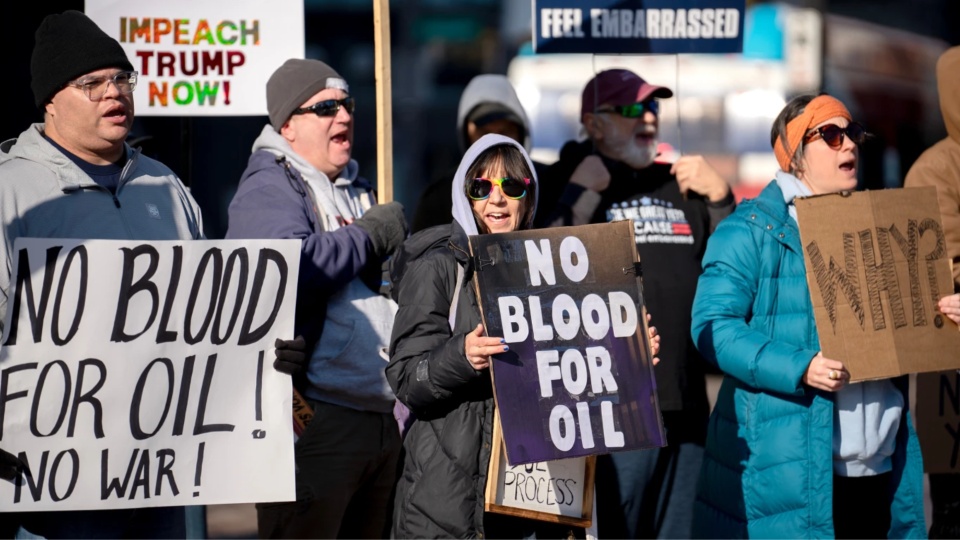
There were marches in Los Angeles, New York, Chicago, Dallas, Columbus, Ohio, and several other U.S. cities against Trump’s actions on Saturday and Sunda, along with demonstrations in India, Canada, Cuba, Turkey, and dozens of other countries.
John Wojcik and C.J. Atkins contributed to this article.
We hope you appreciated this article. At People’s World, we believe news and information should be free and accessible to all, but we need your help. Our journalism is free of corporate influence and paywalls because we are totally reader-supported. Only you, our readers and supporters, make this possible. If you enjoy reading People’s World and the stories we bring you, please support our work by donating or becoming a monthly sustainer today.
CONTRIBUTOR