BETHESDA, Md.—The Bethesda African Cemetery Coalition (BACC) says the struggle to protect Moses African Cemetery is far from over. Even after a landmark ruling from the Maryland Supreme Court, two lawsuits remain active, a developer is still refusing to return remains it removed from the site, and the fight to reclaim land taken from the River Road community continues.
For more than 10 years, BACC, an intergenerational, multi-ethnic coalition of descendants, local residents, and allied members here and abroad, has waged a multi-strategy effort to stop the desecration of Moses Cemetery, the sacred burial ground of the River Road community and its ancestors.
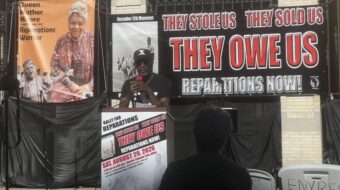
The coalition holds ground and protests to heighten awareness and apply pressure on the organizations, companies and institutions with the power to stop the desecration of Moses. It has also filed three legal actions against the desecration of the cemetery.
In August 2024, the Maryland Supreme Court confirmed and legitimized BACC’s research and scholarship: that Moses African Cemetery exists on River Road, that bodies remain buried there despite decades of desecration, and that the cemetery has been and continues to be desecrated.
Attorneys Kristen Logan of Rothwell & Figg and Aristotle Theresa of Stoop Law recently briefed the community on where BACC’s two lawsuits against Montgomery County and 1784 Holdings—a real estate developer trying to repurpose the land—now stand. They spoke at a Juneteenth celebration hosted by the BACC.
In BACC v. The Housing Opportunities Commission of Montgomery County, Logan said that after securing a momentous victory at the Maryland Supreme Court, BACC is now seeking damages for the desecration of the burial site and recovery of the remains. The developer has refused to return the remains, which are being stored in a warehouse in Virginia, and has conducted tests, including DNA tests, that were not approved by the descendant community. The Maryland Supreme Court decided in favor of BACC and referred to the Housing Opportunity Commission’s activity—the building of a parking lot on the land—as a desecration.
Theresa spoke on BACC v. 1784 Holdings and its associated companies. BACC is seeking a judicial sanction against the corporation for desecrating the ancient African burial ground off River Road, a main thoroughfare in one of the wealthiest communities in the United States. The developer has admitted to approving the destruction, or “consuming,” of 80 to 90 percent of the remains found at the site.
Among the coalition’s central goals: gaining control of the land confiscated from the African community by both Montgomery County and private companies, returning the remains to Africa, and creating a museum to preserve the history of the River Road community.
All the latest information was shared at BACC’s 5th annual Juneteenth celebration, held this year at Glen Echo National Park. For the second year running, the coalition also called on the public and performers to boycott Montgomery County’s official Juneteenth program, citing the county’s ongoing role in the cemetery’s desecration and its history of racism, including lynchings and police brutality.

The choice of Glen Echo was deliberate. The park was segregated until 1961 and barred Black residents from its activities until a civil rights struggle broke the color barrier. The celebration featured Harvey Matthews, who as a child played among the tombstones of Moses African Cemetery because he wasn’t allowed to play in Glen Echo Park. Matthews spoke about growing up during the Jim Crow era and what it meant to him to honor his family and ancestors at the event.
The celebration also included performances by Dr. Karen, Lady G, Uncultured, Sathvik, and Evergreen Productions, along with art from Omar Hafez, whose portraits represent the three children’s remains found in Moses Cemetery, and Sasa Akil, who made coins honoring community leaders who have transitioned.
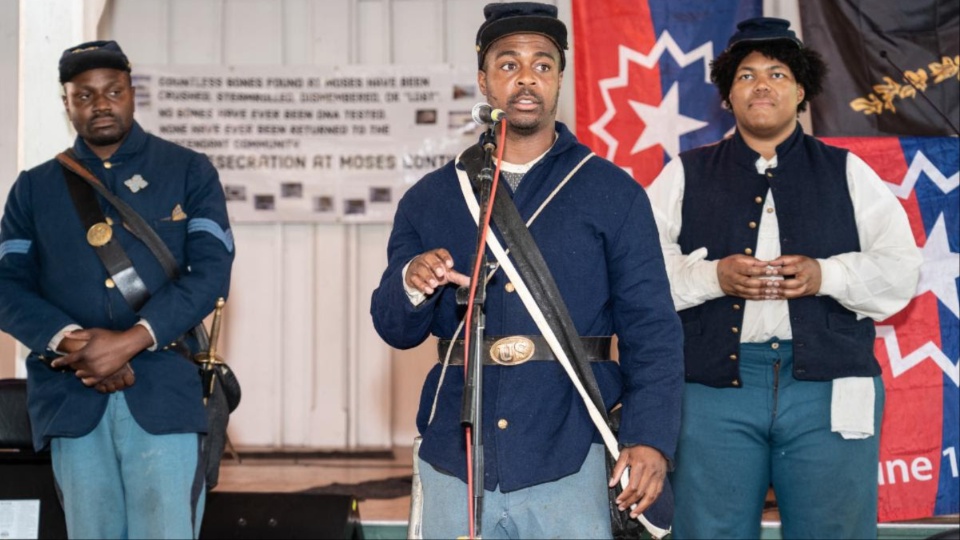
Civil War reenactors gave a history of Juneteenth, the Civil War, and its connection to Moses African Cemetery—a history that includes members of the U.S. Colored Troops buried in the desecrated land, among them Pvt. William H.H. Brown, a Black soldier who fought for the Union and whose remains were dismembered and discarded in Moses Cemetery.
The reenactors spoke on the four million people enslaved at the start of the Civil War and the role Black troops, drawn from a range of ethnic backgrounds, played in saving the Union and liberating the enslaved. They noted the Civil War wasn’t an isolated event; it also inspired other liberation movements and has been called the second Haitian Revolution—evidence, they said, that solidarity is the force that carries struggles like this one through.
That solidarity extends beyond U.S. borders. Yvonne Dede Korletey of the Diaspora African Forum, based in Accra, Ghana, discussed efforts to repatriate remains found at the Warren Family Homestead. As Dr. Marsha Coleman-Adebayo put it: “Once we take possession of our ancestors’ remains, we plan to take our ancestors back home to Africa.”
For BACC, the update was a reminder that the struggle is hard fought but far from finished—and that coming together to face the past, however difficult, is what has kept the campaign moving toward a museum, a return of the land, and a homecoming for the ancestors of River Road.
We hope you appreciated this article. At People’s World, we believe news and information should be free and accessible to all, but we need your help. Our journalism is free of corporate influence and paywalls because we are totally reader-supported. Only you, our readers and supporters, make this possible. If you enjoy reading People’s World and the stories we bring you, please support our work by donating or becoming a monthly sustainer today. Thank you!
CONTRIBUTOR