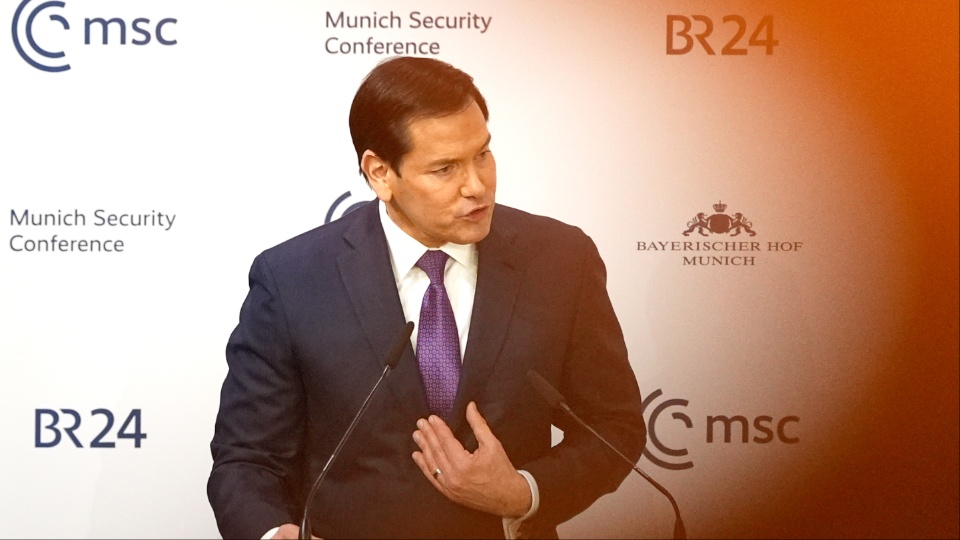
Like an abusive partner asking their spouse to come back home, Secretary of State Marco Rubio spent Valentine’s Day wooing an audience of European leaders and military officials who’ve been repeatedly jilted by the Trump administration lately.
In a switch from the scolding JD Vance gave them last year, attendees of the 2026 Munich Security Conference instead received nothing less than an engraved invitation to join the U.S. as junior partner in a 21st-century mission to re-conquer the world.
Ditching the bellicose style typical of Trump and his deputies, Rubio put a “respectable” veneer on MAGA’s foreign policy messaging, making it palatable for continental elites accustomed to diplomatic pleasantries.
They may have been delivered in a softer tone, but his remarks showed that the Trump administration unapologetically aspires to recreate history’s most brutal and racist forms of imperialism and capitalist exploitation, and it expects Europe to play a part.
The old order is dead, Rubio said, and the future of geopolitics will be America First, with the Global South brought back under colonial control—a reality the Old World must adapt to if it hopes to survive. The instructions for Europe’s ruling class were clear: Adopt Trump’s strategic priorities on the world stage and MAGA-style domestic policies in their own societies or fade into irrelevance.
Sins of globalization
The U.S.’ top diplomat spoke of shared “Christian civilization” and a “renewal” of ties, winning a standing ovation. His speech was a right-wing love letter to the elites of Europe, the good cop to Vance’s bad cop act on the same stage in February 2025.
At that time, the vice president reprimanded the politicians of the continent for supposedly suppressing the free speech of right-wingers and allowing out-of-control migration to ruin their societies. Snubbing the German chancellor, he instead met with the leader of the neo-Nazi Alternative for Germany (AfD) party.
Trashing the transatlantic alliance, he warned “there is nothing America can do for you, nor for that matter is there anything you can do for the American people.”

Rubio, by contrast, sought to bring Europe back into the U.S. fold, buttering up its leaders with slick aspirational language that conference organizer and former German ambassador to Washington Wolfgang Ischinger found “reassuring.” The secretary surely captured conservative colonial hearts when he solemnly declared the U.S. “will always be the child of Europe.”
Rubio started on an anti-communist note, reminding his European listeners of how continental capitalists had saved themselves from the socialist surge after World War II by submitting to U.S. leadership. After the fall of the Soviet Union and the Berlin Wall, however, the triumph of “the West” was squandered by neoliberal delusions about “the end of history.”
From there, Rubio sketched out the familiar points frequently harped on by his boss. Cheating trade regimes, the climate change scam, open borders, and hordes of immigrants trapped the West in a death spiral until Trump arrived on the scene. Rubio rattled off the litany of supposedly shared sins of U.S. and European governments over the last 35 years:
Market mythology was allowed to push the “foolish idea” that commerce could replace nationhood. The West tied itself down with a dogmatic belief that “free and unfettered trade” would unite the world while other countries (read: China) knew better and continued to protect their economies and subsidize their industries. Sovereignty was “outsourced to international institutions.”
Welfare states were built instead of military machines. The “climate cult” inhibited the West from pursuing the fossil fuel future it desperately needs. And an “unprecedented wave of mass migration” was allowed to endanger “the continuity of our culture.”
That’s MAGA’s take on the last 40+ years of global political and economic development, as told in its own language.
A Marxist might characterize it as the ideological perspective of that faction of the capitalist class which rejects neoliberal globalization—a system which was anchored in U.S.-authored free trade agreements like NAFTA, governed by U.S.-led multilateral institutions such as the WTO and IMF, and projected globally by U.S. power alongside its partners through alliances like NATO.
The segment of the ruling class grouped around Trump embraces nationalism and authoritarianism and is more willing to discard the pretense of universal rules. It advances the view that U.S. dominance can only be saved by turning to economic warfare, tariffs, sanctions, and raw force.
Guaranteeing U.S. corporate power wins out against its rivals, they argue, requires a return to an imperial bloc strategy and the carving out of an American-controlled “sphere of influence” as in the days of the Monroe Doctrine.
That’s what the administration’s new National Security Strategy declared in December last year, and it’s the mission Rubio was selling to Europe’s political rulers.
The West versus the rest
Rubio told the security conference that “thousands of years of Western civilization” hung in the balance when “godless communist revolutions and anti-colonial uprisings” sent “the great Western empires…into terminal decline” after 1945.
Without saying the words, he lamented the fact that white supremacy and Euro-American capitalism lost their grip on the world in the postwar decades. For nearly 500 years before the war, he talked of how “the West” expanded, with missionaries, pilgrims, soldiers, and explorers pouring out to “cross oceans, settle new continents, [and] build vast empires extending out across the globe.”

The genocide, plunder, and theft which were the hallmarks of that epoch of empire-building did not figure in Rubio’s remarks. The truth about the racist crimes perpetrated against the peoples of Africa, Asia, and Latin America was erased and replaced with the fiction of the “greatest civilization in human history” enlightening the globe.
Rubio called on Europe to join America in reconstructing that unequal world. The Trump administration, he claimed, doesn’t want allies “shackled by guilt and shame” about their colonial past or who feel compelled to “atone for the purported sins of past generations.” No, it wants partners who are “proud of their culture and heritage.”
A new “Western century” holds so much possibility, according to Rubio. Commercial space travel, cutting-edge AI, industrial automation, creating a Western supply chain for critical minerals, and a “unified effort to compete for market share in the economies of the Global South.”
It’s no coincidence, of course, that in all of these areas U.S. capitalism faces intense competition from a rising China. Nor is it an accident that the nations of the Global South are seen merely as resource suppliers and sales outlets rather than sovereign actors entitled to determine their own futures.
Europe’s rulers are thus presented with a choice. To reinvigorate the alliance with U.S. imperialism that so many of them fear losing, they must once again pledge loyalty to a strategy mapped out in Washington, just as they did in 1945.
For starters, to show they’re serious, they must put their cash on the table.
Many countries are already doing that; military spending across NATO countries has soared over the past few years. Germany even amended its constitution to allow the state to take on more debt in order to rearm. Leaders like German Chancellor Friedrich Merz and EU President Ursula von der Leyen have used Trump’s threat to abandon the continent as the rationale for their spending, but they’re meeting the American president’s demands just the same.
That’s not enough, though, Rubio told them. Governments must adopt other U.S. priorities: re-industrialize their economies (by cutting trade ties with China, though that country’s name went unmentioned); halting the mass migration that threatens the West with “civilizational erasure” (a favorite term of white nationalists); and dump clean energy policies in favor of oil, coal, and natural gas (much of which has to be purchased, conveniently, from U.S. corporations, since the Ukraine war keeps cheaper Russian supplies out of the European market).
Long live the empire
The old-time conservative members of Europe’s ruling class were left, in the words of Ischinger, breathing a “sigh of relief” after the secretary’s speech. They’re desperate to hold onto the U.S. alliance and would be happy, too, to ditch the social democratic welfare state achievements which distinguish their nations from the American model of capitalism.

But they should remember that the Trump administration wants more. Rubio’s speech, like Vance’s and those of other U.S. officials, are aimed at empowering the European far-right. They provide a ready-made list of talking points for parties like AfD in Germany, the National Front in France, and others to pull their electorates down the Trump trail and pressure mainstream parties to move further rightward.
MAGA is looking for reliable allies to help carry out its modern-day colonial crusade, which is a component of the new Cold War and economic struggle against China. The Munich speech was packaged as reassurance and a plea for partnership, but in reality, it was an ultimatum. The U.S. is prepared to go it alone. If Europe wants a seat at the imperial table, it needs to get in the game.
As for the working classes of the U.S., Europe, and the Global South, they need a different vision for international relations—one rooted in solidarity, equitable trade and cooperation, and democratic accountability. Rather than a formula for re-colonizing the world and reaping profits for corporations, they need solutions to the problems of global economic inequality, climate change, and war.
Rubio offered none of that.
We hope you appreciated this article. At People’s World, we believe news and information should be free and accessible to all, but we need your help. Our journalism is free of corporate influence and paywalls because we are totally reader-supported. Only you, our readers and supporters, make this possible. If you enjoy reading People’s World and the stories we bring you, please support our work by donating or becoming a monthly sustainer today. Thank you!
CONTRIBUTOR