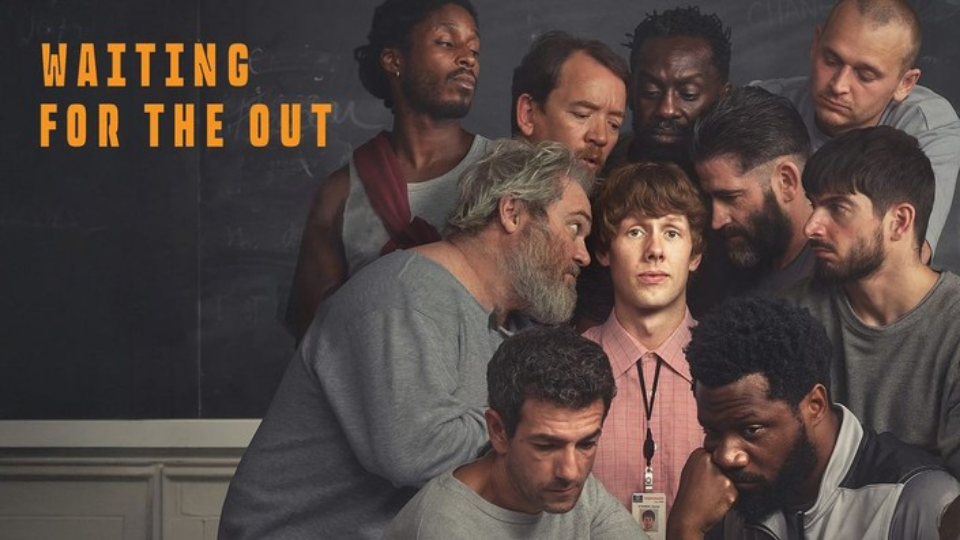
The BBC’s production of its six-part series Waiting for The Out seems to address not only its past failings in terms of prison series (Sean Bean’s Time) but also further the new obsession with working-class life, as evidenced in the Emmy and Golden Globe-winning Adolescence. The series centers around a supposedly solidly working-class young adult, Dan, who, in the opening, is confronted with an abundance of shoe styles in a consumerist nightmare, then visits his brother, who, while languishing with his newborn, also recounts a beating from loan sharks, and finally, begins his day job as a teacher of philosophy at a maximum-security prison.
In between, though, Dan is focused on paternity. Would he make a good father like his brother? Would his girlfriend, who, she reminds him, he barely knows, forego artificial insemination so he could instead be the daddy? And, what is the meaning of the obsession of one of the inmates with his now-grown daughter?
Dan, who walks with a limp, a suggestion of an injury from his own father, whom he has not spoken to in 25 years, then seems himself to be solidly working-class, except that this is part of the deception. When he begins teaching philosophy to the rowdy inmates who (rightfully?) can’t find the use in Dan’s reciting the now neoliberal preachings of John Locke, he turns philosophy into a series of cute conundrums. In response, one of the inmates, who knows more philosophy than he does, calls him out and suggests that the philosophy he instead needs to be espousing is that of materialism. Dan ignores him, having no use for Marx’s dictum that philosophers have thus far only interpreted the world, whereas “the point is to change it.”
In the end, Dan, though his background is working class, reveals himself to be solidly middle-class in his thought and outlook. His gaze on those he would “teach” is solidly that of the BBC itself. He doesn’t recognize the innate knowledge of those victimized by the system, but rather attempts to “civilize” them by making them accommodate to middle-class (safe, genteel) modes of thought and being.
Though the series is based on a prison autobiography, it has none of the actual, grounded toughness of say 1940s prison films like Brute Force, where the prisoners’ inability to accommodate to the system that oppresses them leads to an attempt to take over the prison. Instead, here we have “characters” performing oddball prison rituals (smashing the walls, kicking chairs, trying to run out of the classroom) with the teacher’s goal being to sanitize them. The exception to this rule, and the only honest character in the series, is the Black woman prison guard who, out of genuine working-class affection, though she claims it’s only part of her job, accompanies Dan to the infirmary after his weak foot begins bleeding and there tells him that he has actually reached his students.
The focus on paternity is part of this socializing. Will Dan learn to accept his father’s cruelty, thus making him a candidate for fatherhood himself? His single-minded obsession, at such a young age, with being a parent—besides his girlfriend and his brother, he also stares at the child of an inmate before he goes into the prison—is, though the series wants to see it as a sign of maturity, rather another step at a time in life when rebellion and questioning is key, toward interpolation into the social order with nary and not a wit of protest against it.
What is the BBC, elsewhere in its news, cheering on the Israeli/U.S. attempt to topple Iran and thus induce more suffering on its ordinary population, up to here?
The network tried one prison series, Time, where the focus was not on Sean Bean’s prisoner but on a prison guard, which was hardly effective. The station is also acutely aware of having to match Netflix’s Adolescence, which, in the end, sees working-class men and boys as villains and so was praised by mainstream outlets, but still had a stolid focus on its working-class characters.
So the BBC, as usual, taking the middle ground, has as its focus a middle class character disguised as working class, set amongst caricatured working class reprobates whose rebellion instead of being channeled into actively opposing the system which has exploited them is instead in the form of “our hero” siphoned off into metaphysical questions about “purpose” and “freedom.” This focus makes a mockery of their lack of each instead of addressing the means by which they could both create through struggle a genuine purpose and move toward actual, not delusional freedom. Ultimately, there is, as Hamlet says to Horatio, more in heaven and earth, and in the prison setting he finds himself, than are dreamt of in Dan’s philosophy.
We hope you appreciated this article. At People’s World, we believe news and information should be free and accessible to all, but we need your help. Our journalism is free of corporate influence and paywalls because we are totally reader-supported. Only you, our readers and supporters, make this possible. If you enjoy reading People’s World and the stories we bring you, please support our work by donating or becoming a monthly sustainer today. Thank you!
CONTRIBUTOR