Recently, at the Pan African Film Festival, I saw Rico Speight’s superb documentary Rediscovering Fanon, about the revolutionary psychiatrist who wrote 1952’s Black Skin, White Masks and 1961’s The Wretched of the Earth. Born in Martinique, Frantz Fanon practiced psychiatry in another French colony, Algeria, during its war of independence and rather famously defected from the “mother country,” joining the National Liberation Front. In “Master Harold”…and the Boys, which was set in 1950 and written circa 1982 when apartheid was still enforced in South Africa, playwright Athol Fugard seems to have dramatized Fanon’s theories about the psychological impact of racism and colonialism on the human mind. Through action, dialogue, and character, Fugard, who died last year at the age of 92, vividly brings to life Fanon’s notions of how oppression imbues people with a sense of humiliation, generates an inferiority complex, and stunts the full development of human potential and possibilities.
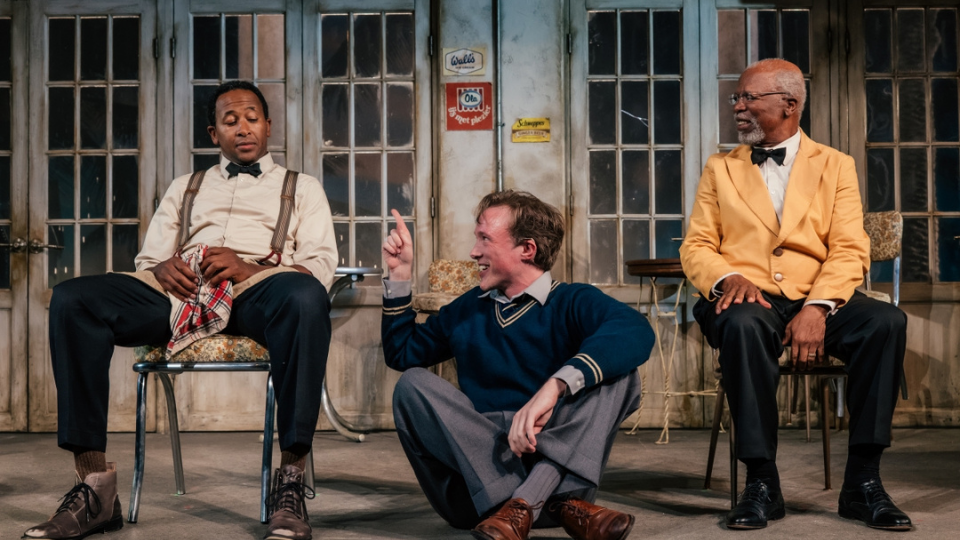
Fugard’s play has those Aristotelian classical unities of action, time, and place. “Master Harold”…and the Boys transpires during a rainy, dreary day at Port Elizabeth, a seaport in the Eastern Cape province of South Africa, where the parents of the titular Master Harold, aka Hally (Ben Beatty), own the St. George’s Park Tea Room where the eponymous “boys,” Sam Samela (renowned South African thesp John Kani, whose screen work includes 2018’s Black Panther and 2019’s The Lion King ) and Willie Malopo (Nyasha Hatendi), work. Hally, a student, is white, while Sam and Willie are Black. While the Caucasian is about 17 years old, Sam appears to be in his sixties or seventies (Kani is actually in his eighties), and Willie seems to be in his thirties or maybe early forties.
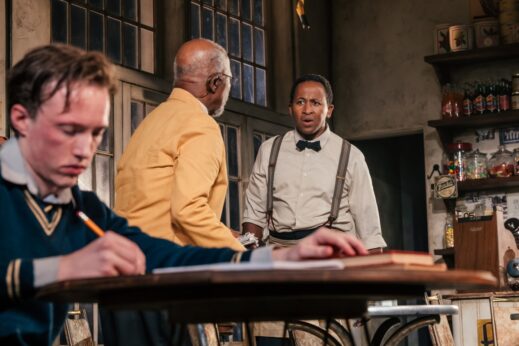
During the course of Fugard’s one-act play, the racial power dynamic of South African apartheid is unraveled. Ranging from familiarity to domination and subservience, the white adolescent is called the diminutive “Hally” by his longtime servant and intimate, Sam. But when he seeks to regain control and commands obedience based solely on his racial prerogatives and economic power, the owner’s son demands to be addressed as “Master Harold.”
The dialogue and action are set on a low flame, as the tension and storytelling simmer. Some may consider much of the play to be a talkfest, but it all does eventually lead to a boiling over. In the highly informative Playbill, an insightful article by co-director Emily Mann, who had a professional and personal relationship with Fugard, quotes the bard as contending: “We can’t be silent! We must give evidence! We are witnesses!”
One of the truly remarkable things about The Wretched of the Earth is that, in addition to psychoanalyzing the colonized, Fanon also put the psyche of the colonizer under the magnifying glass. In the section entitled “Colonial War and Mental Disorders,” Fanon not only examines what torture does to the victim, but the toll that carrying out such cruelty exacts on the torturer, too.
In that vein, the “evidence” Fugard tellingly drew upon to write “Master Harold”…and the Boys seems to be autobiographical. Athol Fugard’s birth name was actually none other than “Harold” (I believe he was called “Hally”), he spent much of his childhood in Port Elizabeth, and like the offstage parents in the play, his Afrikaner mother owned a tearoom, while his father was disabled—and named “Harold.”
Of course, in addition to revealing the mentality of the oppressor, this three-hander also probes the psychology of the oppressed. Despite their circumstances, living under the evils of apartheid, where they are subject to the whims of capricious “masters” such as Harold, Sam and Willie have their own dreams. They revolve around an upcoming dance competition—Sam instructs Willie on how to cut a rug—and an incident involving Sam and a kite from Hally’s childhood.
Predictably, “Master Harold”…and the Boys was censored by the apartheid regime’s police state (as artistic director of the McCarter Theatre at Princeton, starting in 1990, Emily Mann provided an overseas artistic home for Fugard’s plays). In 1982, “Master Harold” was the first of Fugard’s plays to open overseas, first at the Yale Repertory Theatre and then at the Lyceum Theatre on Broadway. On both stages, the Johannesburg-born actor Zakes Mokae depicted Sam, which earned him a Tony Award, while Willie was portrayed by none other than the likewise great Danny “Lethal Weapon” Glover. Like Glover, Mokae has extensive screen credits, including at least three explicitly anti-apartheid dramas, including 1987’s Cry Freedom (as a character interestingly named “Father Kani”), Fanon’s fellow Martinican Euzhan Palcy’s 1989 A Dry White Season (for which Marlon Brando was Oscar-nominated), as well as Michael Lindsay-Hogg’s 1985 TV movie adaptation, wherein a younger John Kani played Willie, with Matthew Broderick in his film debut as Hally.
The press preview at the Geffen Playhouse, co-directed by Mann and Tarell Alvin McCraney, the Geffen’s artistic director, “Master Harold”…and the Boys is well-acted, as the cast moves from a low flame to what another literary chronicler of racism, James Baldwin, called “The Fire Next Time.” It’s great to see Ben Beatty in the kind of socially conscious production his politically-minded father, Warren Beatty, often excelled at, most notably as the star, co-writer and director of 1981’s Reds (which reminds me, while the characters in “Master Harold” name a number of great men, for some reason Fugard has them cite “Karl Marx”…).
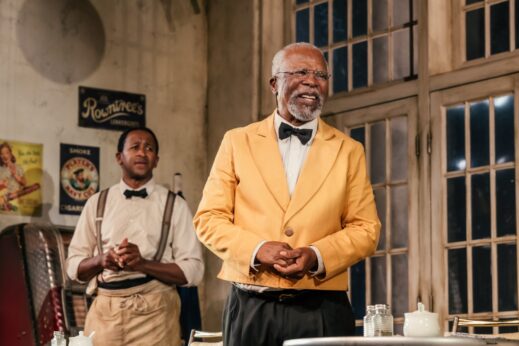
Scenic designer Beowulf Boritt’s forlorn set, with the falling rain and silent jukebox in the drab tearoom, perfectly captures the tenor and tone of Fugard’s hard-hitting drama. The choreography, skillfully executed by the still deft Kani and Hatendi, whose characters are too poor to play the jukebox, is by co-choreographers Koko Iwasaki Nyemchek and Kiki Nyemchek. The one dreamy song that’s finally heard is quite significant, referencing those who yearn to escape from the racist misery of apartheid (or, for that matter, the Trump regime).
While Fugard’s ending of “Master Harold”…and the Boys may be extremely different from the one I suspect Frantz Fanon (who unsuccessfully dabbled with amateur playwriting) might have penned, I do imagine that the apostle of liberation would have approved of the woman-beating Willie’s evolution in regards to his mistreatment of his offstage dance and life partner (the proverbial “slave’s slave”). Although I’ve previously seen the 2006 Oscar-winner for Best Foreign Language Film, the South Africa-set Tsotsi (based on a novel by the prolific Fugard, who also acted), this revival of “Master Harold” is my introduction to the plays of Athol Fugard—but it won’t be the last, as the colloquy that is life rolls on.
“Master Harold”…and the Boys is being performed at 8:00 p.m. Wednesdays – Saturdays, and on Saturdays at 3:00 p.m., plus Sundays at 2:00 p.m. and 7:00 p.m., through May 10, at the Gil Cates Theater, The Geffen Playhouse, 10886 Le Conte Avenue, Los Angeles, California 90024. Tickets and info can be found here and at (310) 208-2028.
We hope you appreciated this article. At People’s World, we believe news and information should be free and accessible to all, but we need your help. Our journalism is free of corporate influence and paywalls because we are totally reader-supported. Only you, our readers and supporters, make this possible. If you enjoy reading People’s World and the stories we bring you, please support our work by donating or becoming a monthly sustainer today. Thank you!
CONTRIBUTOR