DETROIT—The victories of labor-backed candidates that swept Michigan on Nov. 3 were won in large part by the extensive role of the trade union movement here, particularly in Wayne County, home to Detroit.
Trade unionists all across the city spent months speaking with, door-by-door and shop-by-shop, their fellow union members and mobilizing each other to take political action on the grim realities facing the working class: stagnant wages, increasing costs of housing and rent, the cost-of-living crisis made worse by the war on Iran, and the necessity of healthcare being a democratic right.
Exit polls nationally showed union households voting 21 percentage points more for Democrats than Republicans, driving victories decisive for control of Congress. Union voters made up a historic high of 15% of the overall electorate, and even higher in key battleground states, according to the AFL-CIO.
But those numbers only describe the result. The story is in the machinery that produced it—a machinery built by the labor movement on its own terms, with its own lists, its own canvassers, and its own expectations for the candidates it backs. The United Auto Workers is a case in point.
“We mobilized our membership. We have 350,000 members here in Michigan, and over 200,000 voted early,” UAW President Shawn Fain told Michigan Advance. “Our members have been out with 500,000 phone calls, 100,000 doors knocked on. We’ve seen double digit percentages of support.
“You had a lot of rich people who tried to inject a ton of money, outside groups who came to Michigan, to buy a seat, to buy these races,” he said. “Michiganders are smarter than that and they’re telling these people they’re not for sale.”
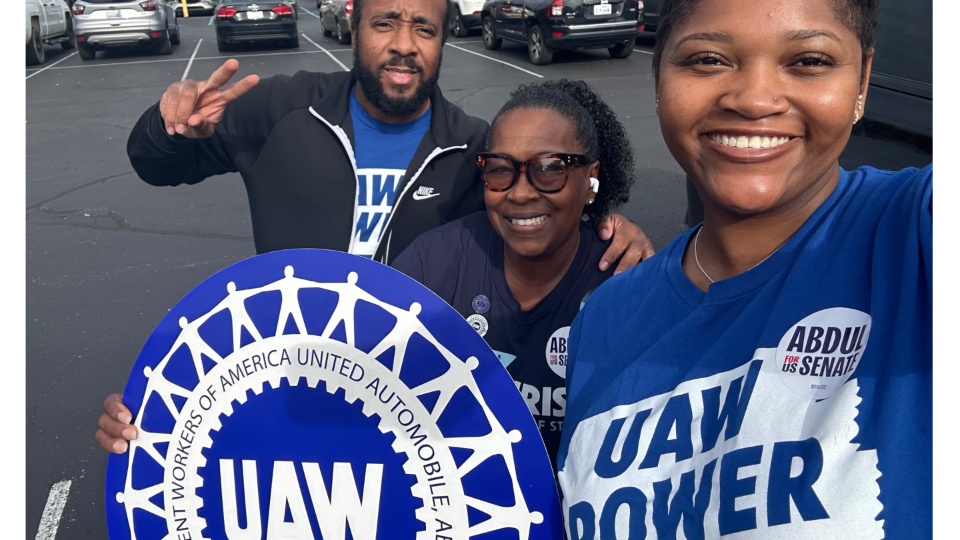
The UAW’s political program was an extension of its contract fights, particularly the 2023 Stand Up Strike, Fain said back in June at the AFL-CIO Convention. The union endorsed Abdul El-Sayed for the open U.S. Senate seat in June, after a process led by its member-elected Community Action Program (CAP) board.
El-Sayed had appeared at the CAP conference forum, where he highlighted that he was the only card-carrying union member in the race. The event also allowed UAW members to question the candidates directly.
In their endorsement, the Auto Workers were explicit about the standard they were setting.
“UAW members in Michigan want a fighter in Washington, D.C., who isn’t afraid to push forward a strong working-class agenda with moral clarity,” the union said. “Having never taken a dime from corporate PACs, Dr. Abdul El-Sayed is someone we can trust to have our backs, including when we need it most—like come May Day 2028.”
“We’ve served notice,” said Fain. “We’re done getting behind candidates just because of a party label. The days of just endorsing people are over. They’ve got to do the work, and we have expectations.”
The UAW’s endorsement stretched beyond El-Sayed. The union also backed Jocelyn Benson for governor and Will Lawrence in Michigan’s 7th Congressional District, among others. And its ground game reflected that breadth. UAW members knocked on over 100,000 doors and made 500,000 phone calls statewide, with dozens of member-to-member volunteers working the doors of fellow workers.
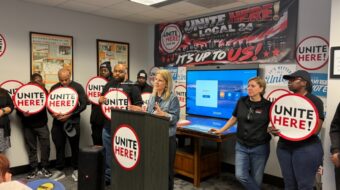
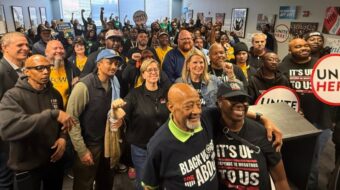
The UAW was one of the largest engines, but it was not alone. UNITE HERE Local 24 knocked on 150,000 doors for El-Sayed alone in the general election, President Terrell George said at their offices on Election Day, and had plans to keep canvassing until the polls closed.
The American Federation of Teachers ran “Red for Ed” walks every weekend throughout Wayne County, and AFT President Randi Weingarten said that “in race after race, those who supported public schools and rejected private school vouchers triumphed.”
SEIU Healthcare Michigan teamed up with the Michigan Working Families Party to run an extensive get-out-the-vote operation across Wayne County. The Teamsters’ Joint Council 43 also endorsed El-Sayed and Benson, adding another layer to the labor coalition. They were joined by the National Nurses United, American Federation of Government Employees, the Laborers, IATSE, IBEW, and the Michigan AFL-CIO.
El-Sayed won his race, becoming the first Arab and Muslim U.S. senator. He did so despite a torrent of outside money. AIPAC spent $32 million in a failed attempt to defeat him in the Democratic primary, backing Rep. Haley Stevens. The group’s super PAC, United Democracy Project, spent over $33 million on ads in the primary against El-Sayed. In the general election, AIPAC resumed spending, targeting 130,000 Jewish voters with mailers attacking El-Sayed, to the tune of $100 million.
It did not work. El-Sayed won Dearborn by 65 percentage points. Dearborn Mayor Abdullah Hammoud reported that 45,464 residents voted—the highest turnout in the city’s history. Michigan has an estimated 400,000 Arab American voters, concentrated in Metro Detroit. The attacks from AIPAC, the Rogers campaign, and even El-Sayed’s primary opponent, Stevens, did not suppress that vote but rather supercharged it.
Down the ballot, labor-backed candidates won across the board, too. In the 7th District, Lawrence defeated MAGA money and corporate interests, including a vicious anti-socialist campaign. He came up in the Sunrise Movement and was a fixture in the tenants union organizing scene in Lansing.
Democratic Socialists of America candidate Donovan McKinney, a former SEIU Healthcare Michigan member, defeated corporate incumbent Shri Thanedar in the 13th District primary and cruised to victory in the general election, joining fellow DSA member Rashida Tlaib in representing Detroit in Congress. The 13th District will once again have an African American representative, which is very significant, as the district itself is majority Black.
Tlaib herself easily won re-election. Eli Savit, who promised a dedicated Workers’ Rights Unit in the Attorney General’s office, won his race. And Jocelyn Benson won the governorship.
There is the tendency to treat electoral victories as an end in themselves and to stop fighting once the ballots are counted. But trade union leaders here, such as the UAW’s Fain, are resisting that temptation and encouraging workers to keep the pressure on and continue the struggle after Election Day.
“Working-class people are sending a message tonight that they are fed up with struggling to afford to live,” he said. “If these candidates can get behind those issues, they’re going to be there for a long time. If they don’t, no matter which party they belong to, they’ll be out of the way the next round.”
The results in Michigan showed that when labor acts as an independent force in the elections, with its own program and its own expectations for candidates, regardless of political party, it can play a huge role in beating back the billionaire class and sending a message that getting elected must run straight through the working class.
No paywalls at People’s World
We hope you appreciated this article. At People’s World, we believe news and information should be free and accessible to all, but we need your help. Our journalism is free of corporate influence and paywalls because we are totally reader-supported. Only you, our readers and supporters, make this possible. If you enjoy reading People’s World and the stories we bring you, please support our work by donating or becoming a monthly sustainer today. Thank you!
CONTRIBUTOR