Mortal Kombat II is the sequel to 2021’s Mortal Kombat, itself a reboot of a film franchise adapted from a video game universe. I didn’t realize I had any expectations for this film until I walked out of the theater and found those expectations unmet. It is an essentially unsalvageable film with a handful of entertaining sequences. It exemplifies the long death or dumbing down of American culture, the further straining of existing rather than original ideas, and a paean to bad taste.
My inner nerd was hoping for something better from this franchise, whose source material has a rich, if silly and unkempt, fantasy-world history, and, specifically, this film, a cast replete with capable actors. Alas, no dice, and I am happy to get off the ride now if they insist on making a sequel.
Former Army Special Forces Sonya Blade (Jessica McNamee) and Jax (Mehcad Brooks), Earth’s greatest kung-fu warrior Liu Kang (Ludi Lin), former MMA fighter Cole Young (Lewis Tan), and lightning god Lord Raiden (Tadanobu Asano) return as protagonists on a quest to win a to-the-death fighting tournament (the titular “Mortal Kombat”) to prevent Earth Realm from coming under control of the despotic indistinguishable dark fantasy known as Outworld.
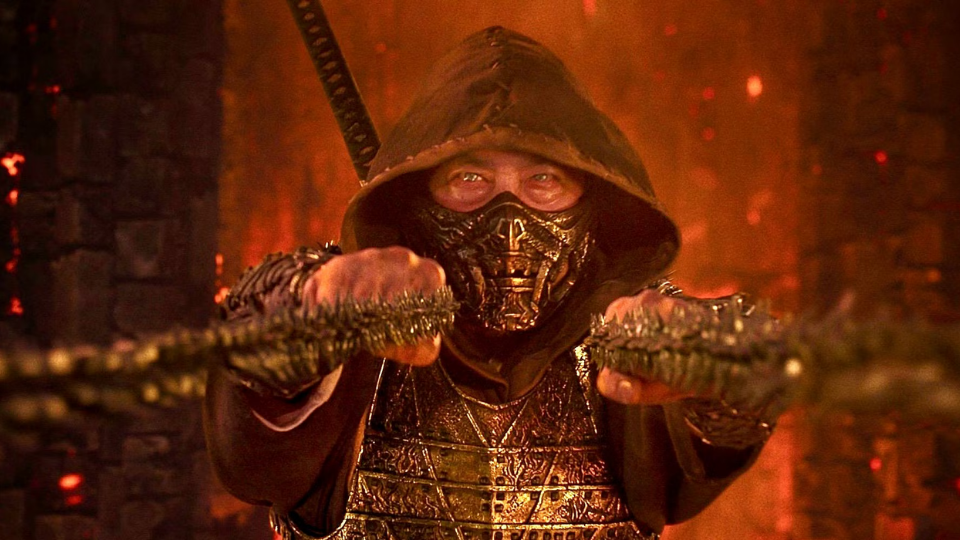
They also recruit washed-up action-movie star Johnny Cage (Karl Urban) to help them on their quest. Sorcerer Shang Tsung (Chin Han) and superpowered assassin Bi-Han/Noob Saibot (formerly ice-wielding “Sub-Zero,” he now has shadow powers, still portrayed by Joe Taslim) return among the Outworld contingent, serving under Shao Kahn (massive monster man in a helmet, debut portrayal by Martyn Ford). Josh Lawson appears as laser-beam-eyed undead Australian criminal Kano; Hiroyuki Sanada appears as iconic antihero and former secondary protagonist Hanzo Hasashi/Scorpion. Adeline Rudolph debuts as Shao Kahn’s adopted daughter Kitana, and Tati Gabrielle plays her bo staff-wielding best friend/bodyguard Jade. Like Kano, Kung Lao (Max Huang) returns through the necromancy of Quan Chi (Damon Herriman, in a different role from the one he played in the first film). Series co-creator Ed Boon has a small cameo.
The plot of the film has a few minor, predictable double-crosses, but it’s a basic story of good triumphing over evil without eliciting real reason to care about the characters or the world they exist in, chock-full of visual references to the video game series, with little in the way of originality. The CGI isn’t terrible, but this isn’t the sort of film where I forget I’m watching actors on a soundstage against a virtual background. The dialogue is generally unmemorable, and the script and direction place the actors on irreconcilable levels of seriousness in their engagement with the material. The performances are relatively sound (Rudolph especially feels wasted here in her best moments), but the juice isn’t worth the squeeze. Hiroyuki Sanada is a permanent poetic treasure, but I could watch him and Asano in Shogun right now, an experience miles higher in artistic quality.
Mortal Kombat II is an aesthetic mess, compositing a story from forty years of video game lore. Always a convoluted cliché pile, at least over the space of hours of gameplay released over decades, you can immerse yourself in the story’s world. Here, it feels like a smattering of formulaic tropes thrown against the wall, complete with redundant flashbacks to events from the first film, released to and then forgotten on HBO Max near the height of the U.S. response to the COVID pandemic.
The Mortal Kombat franchise is historically notable for its use of blood and guts, an archetypal spectacle of violence built on North American appropriation of stereotypes of East Asian (most specifically Chinese and Japanese) martial arts and mythology, augmented with fantasy gibberish. The intrinsic recklessness of the MK worldbuilding can be a forgivable sin when leaning into ridiculous fantasy culminates in something edifying or thought-provoking. Unfortunately, like much of the current era of broadly targeted fantasy action films, Mortal Kombat II makes fun of itself. It comes a bit shorter of winking at the camera than contemporary Warner Bros. Discovery-D.C. or Disney-MCU films, but Urban’s Cage nonetheless reminds you by name of better films you could be watching. This movie is sometimes funny, but it is difficult to tell when this is intentional, and its inconsistent ability to take its own world seriously wastes time.
In any event, the fate of Earth and humanity hanging in the balance does not render the film serious. Mortal Kombat II’s basic structural flaws, though, are its inability to hone a protagonist or demonstrate a character arc. When Johnny finds his moment of revelation, its inspiration is unclear and its articulation vague. Meanwhile, the excessive blood and guts are signatures of the Mortal Kombat franchise, but add little else artistically. Contrast this with the meaningful expression of corporate corruption and civil erosion captured in the gore of Paul Verhoeven’s RoboCop, or even the electric chair just desserts handed to a Nazi scientist in Guy Ritchie’s The Man from U.NC.L.E.
Josh Lawson’s (Superstore, St. Denis Medical) Kano is the crudely funniest character, though the comedy from him and elsewhere feels ill-suited to the film’s gore and the gravity of its situations. It’s comic relief without any drama to be relieved from. The general contradiction between the imperviousness of the heroes to most physics and the over-the-top gruesomeness of their deaths makes this feel every bit the video game film.
The most visually engaging fight is between Liu Kang and the zombified form of his adopted brother Kung Lao. The funniest moments beyond Kano are in Johnny Cage’s fight with many-toothed tribal clan leader Baraka (CJ Bloomfield). Somehow, in a two-hour movie that was nothing but fights and mediocre dialogue, it felt like we needed more fights. This is in part because of the mediocrity of the dialogue, but also in part because if you are going to over-index on CGI-laden martial arts, you are best off committing to the action as a narrative instrument (like in, for instance, practical effects films like Wong Kar-Wai’s The Grandmaster or Johnnie To’s Exiled or, for something actually CGI-heavy, one of the better MCU films like Black Panther).
It is all too easy for critics and other audience members to watch a franchise reboot film and think, “The old one was better.” However lazy and reflexive this sometimes feels, it is nonetheless often true that the first swing at the concept is the hardest, or at least the most earnest. Perhaps the presence of Hiroyuki Sanada inherently grants this film a place over 1995’s Mortal Kombat: Annihilation, but that’s not enough to hang a hat on.
Funnily enough, this movie underutilizes the most recognizable MK reference—the theme song. With a soulless “for the fans” Mortal Kombat II starting off the summer movie season well ahead of two MCU superhero flicks, this is going to be a big year for jangling keys cinema that pats you on the back for noticing references to old material, rewarded for nostalgia of juvenile experience, and unrefined taste. In a time of global turmoil (and when isn’t it?), we need meaningful art, and this isn’t it.
Mortal Kombat II will be released in U.S. theaters on May 8, 2026.
We hope you appreciated this article. At People’s World, we believe news and information should be free and accessible to all, but we need your help. Our journalism is free of corporate influence and paywalls because we are totally reader-supported. Only you, our readers and supporters, make this possible. If you enjoy reading People’s World and the stories we bring you, please support our work by donating or becoming a monthly sustainer today. Thank you!
CONTRIBUTOR