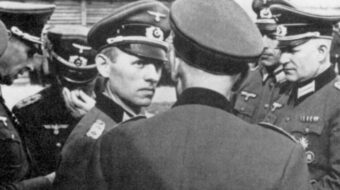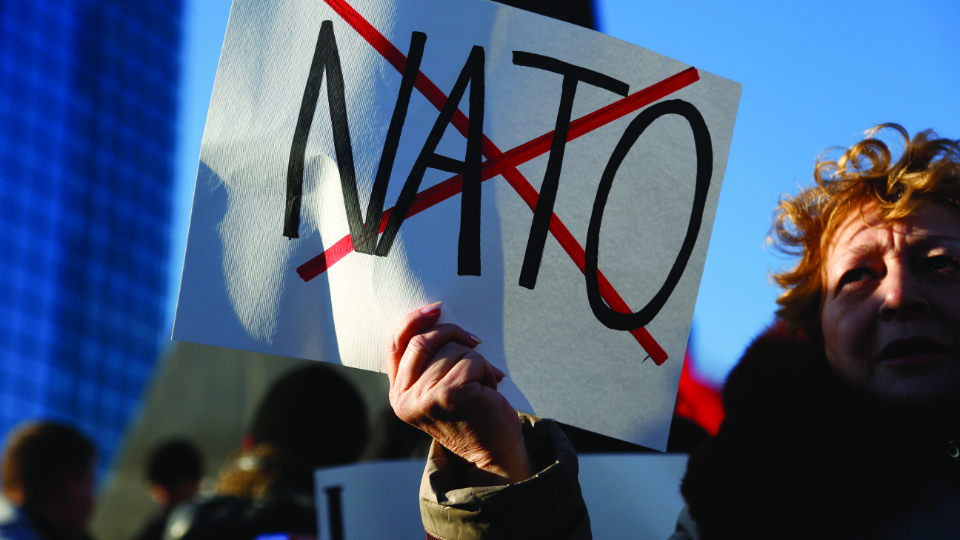
Recently, the North Atlantic Treaty Organization (NATO) marked its 76th anniversary. Founded in 1949, in the early days of the Cold War, by twelve countries—the United States, Canada, and ten in Europe, its main purpose was to contain “the spread of communism.”
It should be noted that in the years which followed NATO’s establishment the United States also concluded similar multinational “defense” treaties in the Middle East (CENTO), Southeast Asia (SEATO), the Rio Pact (Latin America), Australia and New Zealand (ANZUS), as well as bi-lateral treaties with Japan, South Korea, the Philippines, and Taiwan.
In each case, the perceived enemies were the socialist countries, particularly the Soviet Union and the People’s Republic of China. In response, the USSR and the socialist states established the Warsaw Pact.
By 1991, when the Soviet Union went out of existence, most of these alliances were either moribund or had ceased to exist—but not NATO.
In the 35 years since the demise of its supposed primary adversary, NATO has continued as a vehicle for the United States and the western European capitalist states to carry out their policies of world military and economic domination. The alliance has inserted itself into conflicts, both in Europe (Serbia, Bosnia and Herzegovina, Kosovo) and beyond—Iraq, Afghanistan, Libya, and Somalia.
Today, it has 32 members, with most of its new ones being the former socialist countries of central and eastern Europe. But there are reports that NATO is also working on ways to inject itself into East Asia and the Pacific.
The U.S.-Israel war on Iran has brought to the surface, once again, lingering sensitive points between the major European NATO countries and Donald Trump. The U.S. president has often had a contentious relationship with his other alliance partners. During his first term, the defining issue was Trump’s demand that all members pay assessments that equal at least two percent of their Gross Domestic Product (GDP). Several countries have met that threshold, but others are resisting it.
Any increase in a country’s contribution to NATO, however, means less money to pay for the needs of its people, a major problem that we face in the United States. It’s no secret that the trillions of dollars wasted on the military has weighed heavily on the American working class. Trump’s recent statement on the topic said the quiet part out loud: It’s “not possible” for the U.S. to pay for Medicaid, Medicare, and day care because “we’re fighting wars.”
The problem with NATO goes back to its origins—the war alliance was brought into existence based on a lie. The idea that “communists” were ready to invade western Europe and install “dictatorships” in those countries as part of their supposed march to world domination was a fabrication. It was a cover for the U.S. and European imperialists to expand and rebuild their control over the rest of the world.

The USSR, on the other hand, consistently followed a policy of peace. This was no more clearly stated than in 1940, while war was raging in Europe and Asia, before the Soviet Union entered the conflict, and before the advent of the Cold War. Soviet Foreign Minister V.M. Molotov, speaking to his country’s legislature, said the position of the Soviet Union was “to continue a policy of peace and of strengthening business relations with all countries…to be cautious and not to allow our country to be drawn into conflicts by warmongers.” This policy remained a cornerstone of Soviet global relations for another half century. The imperialists, however, did all they could to weaken and destroy the USSR.
The reason for NATO’s existence was wrong in 1949, and it’s still wrong in 2026. Today, the world is a very different place than it was during the Cold War. Countries across the Global South are standing up for their rights with growing militancy and unity. They are calling for a more fair and equitable international order, and are often led in their efforts by a country that has lifted tens of millions of people out of extreme poverty—the People’s Republic of China.
China has advanced a new paradigm for a new world order. It is embodied in four initiatives—the Global Development Initiative (GDI), the Global Security Initiative (GSI), the Global Civilization Initiative (GCI), and the Global Governance Initiative (GGI). A recent statement made by Chinese President Xi Jinping, after meeting with Spanish Prime Minister Pedro Sanchez, summarizes the ideas behind the vision for a different order to replace the world of great-power hegemony represented by the United States and NATO:
“What kind of world to build and how to build it?” Xi asked. He stressed that “the world today is in turmoil, confronted with the contest between the rule of law and the rule of power. How a country treats international law and the international order reflects its worldview, its view of order, its values and its sense of responsibility.” Xi said that China’s worldview is rooted in “the idea of a community with a shared future for humanity.”
The Chinese newspaper Global Times summarized the argument, saying that “true multipolarity should not mean a handful of major powers carving out spheres of influence, but rather an equitable system in which all countries, regardless of size or strength, can find their place.” Globalization, it emphasized, should be about “ensuring that the benefits of development are shared by all.”
This vision represents a firm rejection of the Cold War mentality that U.S. leaders continue clinging to. It provides a simple, yet inclusive, argument for why the relics of a dead world, including NATO, need to be swept into the dustbin of history.
As with all op-eds published by People’s World, the views expressed here are those of the author.
We hope you appreciated this article. At People’s World, we believe news and information should be free and accessible to all, but we need your help. Our journalism is free of corporate influence and paywalls because we are totally reader-supported. Only you, our readers and supporters, make this possible. If you enjoy reading People’s World and the stories we bring you, please support our work by donating or becoming a monthly sustainer today. Thank you!
CONTRIBUTOR