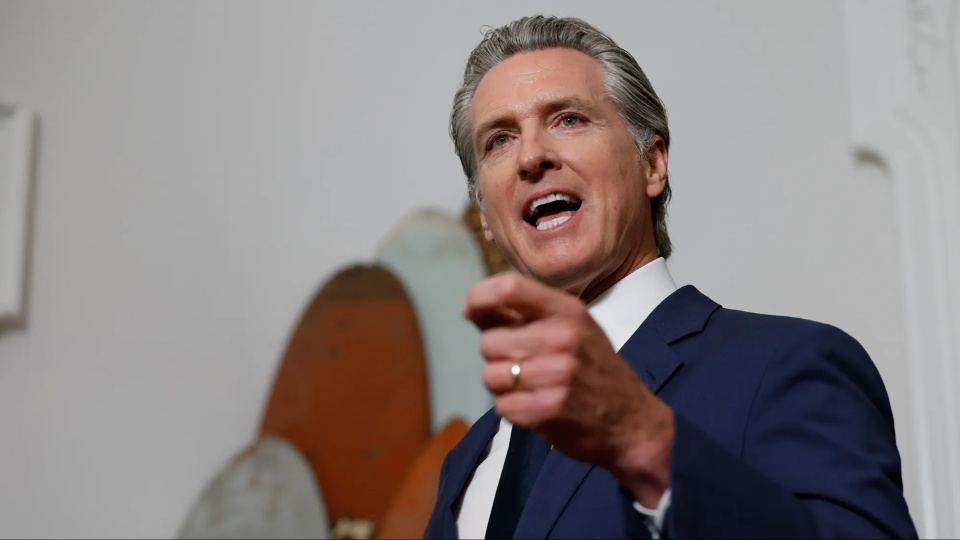
LOS ANGELES—As opposition to MAGA gains steam, California Gov. Gavin Newsom has surged onto the national stage with his vocal opposition to illegal ICE raids, the military takeover of Los Angeles, and Republican efforts to gerrymander congressional districts to maintain GOP control over the House.
A look at Newsom’s record as governor of a state under attack by Trump is key for understanding the recent controversy around the governor. He is the victim of retaliation for his progressive stands even as he has gotten flack for failure to deliver on issues important to workers.
Indeed, under Newsom, the working class has reaped a mixed bag of promise and peril, making the governor a complex figure in the coalition needed to defeat the MAGA offensive against immigrants, workers, scientists, and all racial, ethnic, and sexual minorities.
This summer, Newsom has been making a splash in the news with his parodies of Trump-style tweets and pithy comebacks aimed at the White House. But social media maneuvers alone will not defeat MAGA power. Newsom’s concrete actions to fight back against the MAGA coalition’s fascist takeover are sometimes less certain, though his California redistricting plan is drawing attention for positive reasons. His newest policy of forbidding federal ICE agents from using masks to conceal their identities in California is also very important in the fight against the MAGA forces.
Gerrymandering for a good reason?
This November, California voters will have the opportunity in a special election on the “Election Rigging Response Act,” or Proposition 50, to vote on a temporary redistricting of the state’s congressional district maps. The proposed redistricting, which would be in effect until 2030, would give an edge to Democrats in an attempt to nullify Texas’ efforts to win more seats for Republicans in Congress. The California legislature has approved the proposal for a special election, meaning voters will get the chance to directly choose whether they desire such a redistricting.
Since Newsom’s announcement, a progressive coalition has been forming around the plan, concurrent with staunch opposition from California Republicans and the Trump administration.
Notably, organized labor, under the banner of the California Labor Federation, has backed Newsom’s plan, seeing it as a way of restoring fair representation to marginalized communities and working people. More support comes from the NAACP California-Hawaii State Conference, which urged voters to approve the redistricting in a statement that condemns Texas lawmakers for trying to stifle the voice of Black and Brown voters.
The redistricting plan counts more support from a broad multiracial sector of the California legislative body, including the California Legislative Black Caucus, Latino Caucus, and Asian American and Pacific Islander Caucus.
California Democratic Socialists of America also voted to endorse the redistricting plan, similarly citing the opportunity to fight back against authoritarian expansion and potentially win space for progressive lawmakers. The California Working Families Party is also urging a yes vote on Proposition 50 and organized a virtual rally on September 23 with progressive lawmakers from the state to drum up support.
In summary, the progressive forces are aligning behind the redistricting plan, viewing it as a necessary corrective to racist gerrymandering and other forms of disenfranchisement. However, mailers urging a no vote have already cluttered voters’ mailboxes across California, most from the Protect Voters First committee and Right Path California.
Protect Voters First was started and funded by billionaire Charles T. Munger Jr., who has already invested tens of millions of dollars on an anti-redistricting campaign. Right Path California is headed by the former chair of the California Republican Party, and their finances are currently difficult to ascertain. The question remains of how voters will respond to this crucial moment this coming November.
Standing up to Trump
In June, Newsom decried the Trump administration’s deployment of National Guard and active-duty Marines to Los Angeles, calling the move a deliberate attempt to sow fear and inflame tensions. He also initiated a lawsuit over the illegal flex of federal power. Just recently, the governor signed into law a package of bills aimed at limiting the powers of immigration enforcement and strengthening sanctuary policies. These include outlawing immigration officers from wearing masks to conceal their identity and limiting their access to sensitive areas like schools and hospitals.
The move from the governor puts weight behind his public condemnation of the intensely cruel and lawless ICE raids throughout the state. This federal repression has galvanized organized resistance throughout the state as coalitions have formed to protect their communities and enforce the basic constitutional rights of immigrants.
The legislative package Newsom signed is the direct result of this organizing and advocacy, with key organizations like the Coalition for Humane Immigrant Rights playing major roles in shaping the bills.
There is doubt about how much these laws will restrain immigration enforcement operations in the state, as agents have routinely broken the law during the months of onslaught against California’s Latino and immigrant communities. In fact, the Department of Homeland Security has already stated on the platform X that ICE agents will not comply with the masking ban. Clearly, these attempts to protect Californians and create accountability for federal law enforcement are striking a nerve in the White House.
A crisis at home
While Newsom’s anti-Trump rhetoric is drawing praise from voters, and polls find his popularity surging, activists and advocates closer to home have criticized the governor’s draconian crackdown on unhoused people.
This year, Newsom has taken aggressive actions aimed at the unhoused. The actions press for encampments to be cleared and for local governments to criminalize camping on public property. In late August, Newsom launched a new task force to accelerate the dismantling of homeless encampments on state property.
Although official statements assure that the task force will also connect people with services and “assist in finding suitable shelter options” for those living in encampments, experts warn that moves to criminalize encampments are both ineffective and inhumane.
With an unhoused population close to 200,000, the state of California clearly is facing a housing crisis. But, after years of spending literally billions of dollars to address the issue, state officials have made little to no observable progress in keeping people housed. Simply put, making it more difficult for unhoused people to find places to camp might temporarily banish them from public view but does nothing to address the crisis in a sustainable way.
On the other hand, Newsom recently approved sweeping reforms of the California Environmental Quality Act, a landmark piece of environmental legislation that critics say has been used to slow housing development. The reforms effectively speed up the permitting process for new housing development in urban areas by reducing requirements for developers to study, predict, and mitigate the environmental impacts of new housing projects.
The move is celebrated by California YIMBYs, and the logic is that it will clear the way for development and so-called “urban infill” projects, leading to construction projects, increasing urban density, and ideally having a positive impact on the housing market by increasing supply.
However, without guarantees that new housing will be affordable or accompanied by adequate transit options, axing environmental regulations is likely to do little to address the housing crisis. Unhoused people with low or no income, poor credit records, or debt will still be unable to access the housing market, even if prices decrease slightly from new options on the market. Increased density without a matching investment in public transit will undoubtedly worsen traffic and decrease air quality in already congested urban areas.
Housing is a basic human right and the crisis of people on the streets must be addressed with public spending and evidence-based methods like housing-first policies, which place facilitating access to no-strings attached housing as the priority before tackling other issues facing unhoused people (such as addiction or mental health).
Catching heat from workers and climate activists
With issues like wildfires and extreme heat waves, both intensified by climate change, plaguing working class people in California, what is Newsom’s record on addressing climate justice issues? A look at bills he has sponsored or vetoed paints an uneven picture.
On September 19 of this year, Newsom signed a legislative package that overhauls California’s climate and energy policies. The new policies extend the cap-and-trade program, a market-based system to reduce carbon emissions.
They also greenlight the state to create a Western regional electricity market and increase oil drilling. The apparent logic of this “both/and” approach to energy is to reduce gas and electricity costs for consumers while still ostensibly preserving climate goals. However, the boost in oil drilling in Kern County constitutes a major handout to the Big Oil lobby and a policy reversal that sacrifices real progress on climate and environment targets, ignoring related issues like air and water pollution and relying on a shaky trade-off system to control emissions.
Despite climate disasters that have ravaged the state and the country recently, California lawmakers seem unwilling to treat the environmental crisis with the urgency and seriousness it deserves, and Newsom seems to have no problem signing off on mediocre, if not outright regressive, policies. In fact, some experts consider it unlikely that the move will even deliver lower gas prices.
Meanwhile, workers stand to face the worst effects of climate change. Last year, the governor vetoed SB 1299, which would have made it easier for farmworkers to make a workers’ compensation claim for heat illness.
The bill is sponsored by the United Farm Workers (UFW) and has support from labor groups and attorneys who represent injured workers in workers’ compensation claims. The UFW says the bill can put financial pressure on employers to comply with the heat rules, in the absence of more robust state enforcement.
In his veto message, however, Newsom wrote the enforcement of heat safety rules should be done only by the state’s workplace safety agency, the Division of Occupational Safety and Health (Cal/OSHA) and not be determined by the workers’ compensation system. Newsom’s appeal to bureaucratic hair-splitting reeks of a business-as-usual approach to policy that should caution equating his more recent anti-MAGA fervor with a working-class political program.
The climate catastrophe upon us means we will all have to contend with the reality of a hotter planet. For example, heat waves in California are growing longer and more intense, and many employers do not follow the state’s nearly two-decade-old outdoor work heat rules that require growers, farm labor contractors, construction site supervisors and others to provide shade, breaks and water, and to monitor their workers for heat illness.
It is time to reframe the common liberal adage that working-class people and frontline communities are “getting left behind.” Rather, they are on the cutting edge of resistance, resilience and perseverance before the conditions that will sooner or later afflict all humanity. Only a political program that places the working-class in the driver’s seat will succeed in addressing the problems affecting all people (either now or soon).
What’s needed in this moment from California leadership is real, decisive action to protect the working class from the deadly effects of a worsening climate crisis, not favors to oil corporations and agricultural giants doled out on the uncertain promise of affordability.
Shady business
If affordability is what is on the table, no other area is need of an overhaul than healthcare, a sector that places working people in the impossible situation of deciding between death by disease or debt. The nation’s healthcare system is a mammoth industry, full of esoteric fine print and labyrinthine corporate networks.
Last year, Newsom vetoed a bill that would work toward reforming these problems. SB 966, introduced by Sen. Scott Wiener, a Democrat from San Francisco, and co-sponsored by the California Pharmacists Association, California Chronic Care Coalition, Los Angeles LGBT Center and San Francisco AIDS Foundation, would prohibit pharmacy benefit managers (PBMs)—who work as middlemen between insurance companies and drug manufacturers and process claims, negotiate drug prices and help determine the list of drugs that health insurance plans cover—from restricting where patients can fill prescriptions and mandate that 100 percent of discounts negotiated with drug manufacturers be passed onto health insurance plans.
PBMs oversee critical decisions about access to and affordability of medications without transparency or accountability to the public. Thus, the bill would have also required the state insurance department to license PBMs and improve price transparency. Supporters of SB 966, which include the Pharmaceutical Research and Manufacturers of America, which represents drug companies, say that PBM practices have forced the closure of 300 pharmacies across the state and limited drug access.
In 2022, the Federal Trade Commission issued special orders pursuant to the six largest PBMs, requesting data and documents regarding these PBMs’ businesses and business practices. A report from the Federal Trade Commission, which is investigating the middlemen, found that PBMs exert substantial influence over independent pharmacies, who struggle to navigate contractual terms imposed by PBMs that they find confusing, unfair, arbitrary, and harmful to their businesses. Between 2013 and 2022, about ten percent of independent retail pharmacies in rural America closed.
Essentially, PBMs are huge monopolies with lots of power over drug prices. About two decades ago, the top three PBMs managed 52 percent of prescription drug claims. Today, they control about 80 percent. The six largest PBMs—Caremark Rx, LLC; Express Scripts, Inc.; OptumRx, Inc.; Humana Pharmacy Solutions, Inc.; Prime Therapeutics LLC; and MedImpact Healthcare Systems, Inc.—manage 94 percent of prescription drug claims in the United States.
As spending on prescription drugs in California ballooned 39% in just five years, according to the most recent state data, so has the wealth of the CEOs of these middlemen corporations. David Joyner, the former president of CVS Caremark, who was promoted to CEO of CVS Health in October of 2024, for example, makes 18 million dollars a year, while some CVS workers barely make 18 dollars an hour and struggle with access to healthcare.
In his veto message, Newsom said while prescription drug prices are too high and there needs to be more transparency, “I am not convinced that SB 966’s expansive licensing scheme will achieve such results.” Instead, he said he’s directing the California Health and Human Services Agency to “propose a legislative approach to gather much needed data on PBMs next year.”
Flirting with MAGA or a movement?
Before Newsom’s recent splash of social media offensives against Trump, he drew criticism for platforming far-right talking heads on his podcast platform launched earlier this year. While he has hosted personalities from across the political spectrum on his podcast, “This is Gavin Newsom,” Newsom’s early decision to cozy up to conservatives like Charlie Kirk, Steve Bannon, Michael Savage, and Dr. Phil left many confused as to his motivations with the project.
Perhaps the occupation of Los Angeles, Trump’s declining approval rating, or MAGA’s brazen anti-democratic trickery catalyzed in Newsom a genuine change. And perhaps Newsom is the working-class’s best bet at this moment to pose a serious challenge to MAGA’s political power in Congress, the Supreme Court, and the White House. But opportunity is not opposition.
Beyond media antics, the anti-MAGA movement needs a leader who knows that power comes from below. Rather than balancing between placating big money and popular grievance, Newsom and other leaders hoping to grasp the reigns of the growing resistance to Trump must be capable of convening the masses behind a genuinely transformative program that delivers on the economic and social reforms the working class so desperately needs.
Opinions expressed in this article are those of the authors.
CONTRIBUTOR