

The recently concluded AFI Film Festival, L.A.’s biggest and best yearly film festival, screened 160-plus features and documentaries. AFI Fest presents indies and foreign films, but also major motion pictures from Hollywood studios.
Nuremberg, distributed by Sony Pictures Classics, was one of AFI Fest’s “Red Carpet Premieres,” and this portentous, prestige picture was screened at TCL Chinese, formerly Grauman’s Chinese Theater, arguably one of the world’s most famous movie palaces.
Essentially, screenwriter/director James Vanderbilt’s Nuremberg is a courtroom drama, but what’s at stake here is of far more world-historical importance than whether or not the butler did it. Because in this movie’s dock are the Nazi high command, who are on trial for committing war crimes against humanity.
This postwar court case is the first of its kind, and the stakes couldn’t be higher. The lead defendant of the 22 Nazi prisoners, including Rudolf Hess (Andreas Pietschmann), is Hitler’s second in command, Hermann Göring, who is here uncannily played by an almost imperceptible Russel Crowe, sure to get an Oscar nomination.
During this fact-based International Military Tribunal, the notorious Nazi is facing off against the U.S. prosecutor, Justice Robert H. Jackson, an Associate Justice of the Supreme Court (depicted by an intense Michael Shannon, who fully grasps the import of the outcome of this historic, unprecedented trial) and Sir David Maxwell-Fyfe (Richard E. Grant), who in the movie acts as sort of the prosecution’s designated hitter, called upon to hit a homer in the bottom of the ninth, with two men out.
Psychiatrist Douglas Kelley, a Lt. Colonel in the U.S. Army Military Intelligence Corps (Rami Malek, who captures the character’s complexity), assists the prosecution in the case against Göring and his jackbooted cohorts.
A key insight Kelley gleans from his interactions with Göring is that the Reichsmarschall is a “narcissist” who only cares about himself. This is precisely the diagnosis of Donald Trump publicly advanced by many shrinks, including Mary Trump, who in addition to being the Fuhrer’s – uh, I mean “President’s” – niece, is a clinical psychologist.
This is one of Nuremberg’s sly contemporary, relevant references. The movie is especially interesting in that it focuses on the interplay between The Nazi and the Psychiatrist, which is the title of the 2013 book by Jack El-Hai, which Nuremberg is based on.

Vanderbilt’s almost two-and-a-half-hour adaptation is in the grand Tinseltown tradition of World War II-themed, history-based, big-budget epics with all-star casts, such as 1962’s The Longest Day, 1976’s Midway, 1977’s A Bridge Too Far, and more recently, 2023’s Oppenheimer.
But Nuremberg does not commit the cinematic sin of omission perpetrated by Christopher Nolan’s account of the creation of the atomic bomb, which very cowardly avoided showing onscreen what the invention of nuclear weapons – Oppenheimer’s actual raison d’être–actually did, once unleashed upon humanity.
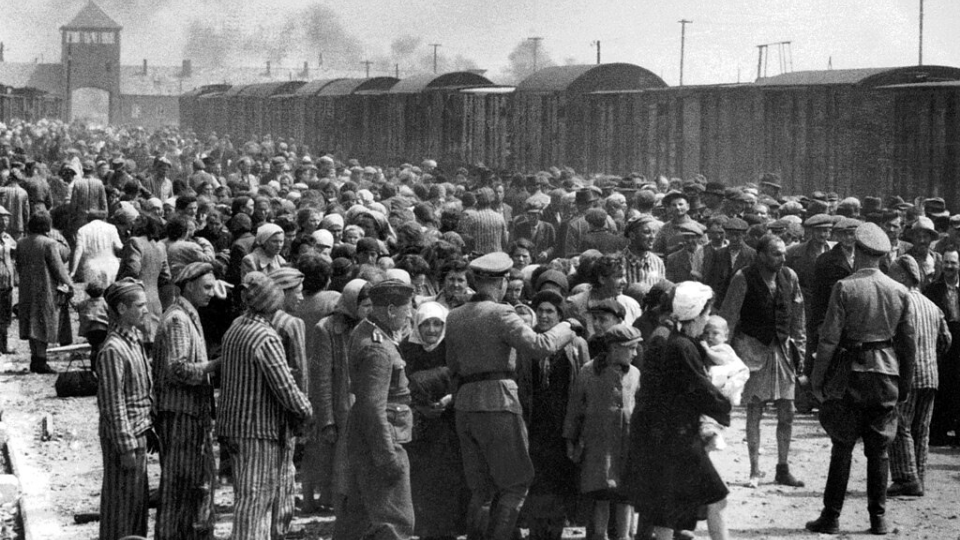
Much to its credit, Nuremberg incorporates a detailed sequence where footage of the atrocities committed at the concentration camps is screened (unlike Jonathan Glazer’s 2023 Auschwitz-set drama The Zone of Interest). This is presented as evidence in the trial against the 22 Nazis, but also cleverly informs and reminds moviegoers of the crimes against humanity committed by the Third Reich against Jews and others.
Vanderbilt does not take it for granted that younger theatergoers will be familiar with this grim chapter of (in)human history. The 2020 U.S. Millennial Holocaust Knowledge and Awareness Survey found that “63 percent of all national survey respondents do not know that six million Jews were murdered” and other shocking facts, indicating ignorance of epic proportions among large swathes of our ill-informed public.
Of course, one reason why Nuremberg graphically depicts its atrocities, while Oppenheimer cowardly concealed them, is that the latter’s were committed by the USA, while Nazi Germany and their complicit collaborators executed the former.
So American ticket buyers don’t have to feel uncomfortable about U.S. complicity while watching newsreel shots of the death camps, which, after all, Americans and our Soviet and other allies liberated. Interestingly, in Nuremberg, on the witness stand, Göring accuses America of hypocrisy, for dropping A-bombs on Japan, thus “vaporizing 150,000” people. Touche, Hermann!
(Alas, there’s a missed opportunity for Nuremberg to skewer another glaring example of Washington’s hypocrisy: Vanderbilt’s film goes into detail describing 1935’s so-called Nuremberg Laws, which imposed an oppressive system of apartheid on German Jews (and beyond), but does not mention the contention that for their race rules, the Nazis learned from the segregated South’s Jim Crow laws, as Pulitzer Prize-winner Isabel Wilkerson argues in 2020’s Caste.
The movie also omits the role the Soviet and French prosecutors played in the international tribunal – they are merely mentioned in passing, but their contributions to the prosecution of the war criminals are overlooked.)
Be that as it may, Nuremberg is a powerful dramatization of and required viewing about fascism. At the end of the movie, Kelley tries to warn Americans about the threat of domestic Nazis and how we have to be very vigilant about homegrown fascism. Surely, a red alert we have to take pay close attention to today as we’re menaced by the MAGA maggots.
Nuremberg is a masterful movie, well written and directed by a top-notch ensemble of thespians of the highest order. Expect lots of Oscar nominations for this cast and crew.
Look for the tears trickling down Richard E. Grant’s cheeks while the concentration camp images are projected in the courtroom. The 1st Earl of Kilmuir may not have been Jewish, but he was a human being, and he cried the tears of a brokenhearted humanity.
By revealing to the world how these atrocious crimes against human beings could ever have been committed, the Nuremberg tribunal sought to put an end to them for all time. (BTW, although it depicts the world’s worst anti-Semites ever, Nuremberg depicts anti-Semitism – a scary scourge still threatening us today, with Jew-hater Nick Fuentes being wined and dined by Donald Trump and given ample airtime by Fucker Carlson – sensitively, in a non-sensationalistic manner.)
Some viewers may find this epic to be stagey, talky, and too long. The film suffers from being filmed in Budapest, Hungary (although there are brief black and white shots that may be actual historical footage filmed in the courtroom, incorporated with Vanderbilt’s reenactment), instead of at Nuremberg, where Leni Riefenstahl rather infamously shot those Nazi rallies (briefly glimpsed in Vanderbilt’s movie) for 1935’s Triumph of the Swill.
Nevertheless, I found Nuremberg to be an utterly compelling odyssey into the heart of darkness and humanity, with some unexpected real-life plot twists. I could not foresee what befell the psychiatrist Rami Malek so poignantly etches. Paging Dr. Freud!
So, what’s the judgment on Nuremberg? Inevitably, Vanderbilt’s film will be compared to director/producer Stanley Kramer’s 1961 magnum opus, Judgment at Nuremberg.
Shot in glorious black and white, Kramer’s three-hour masterpiece is another one of those star-studded WWII epics, co-starring Spencer Tracy, Marlene Dietrich, Maximillian Schell, and Burt Lancaster. Although they were non-Jews, Montgomery Clift and Judy Garland are simply unforgettable portraying Jewish characters who take the witness stand during the Nuremberg trial, delivering harrowing, chilling performances that capture the soul of suffering humanity. The renowned independent producer Stanley Kramer and screenwriter Abby Mann were both Jews.
What an irony of history and shame that the Prime Minister of Israel, Benjamin Netanyahu, has been charged by the International Criminal Court with “war crimes of starvation as a method of warfare and of intentionally directing an attack against the civilian population; and the crimes against humanity of murder, persecution, and other inhumane acts” committed against Palestinians.
For all those who carry out, finance, and support the atrocities executed against children and others in Gaza and the West Bank, I have two suggestions:
1) Look yourself in the mirror and ask yourself: “Who’s the Nazi now?”
2) Go see Nuremberg, an anti-fascist movie meditation on genocide and man’s inhumanity against man and woman for our times, as democracy itself is on the line once again.
Nuremberg is mostly in English with some German and English subtitles, and theatrically opens wide on Nov. 7. Don’t miss it!
We hope you appreciated this article. At People’s World, we believe news and information should be free and accessible to all, but we need your help. Our journalism is free of corporate influence and paywalls because we are totally reader-supported. Only you, our readers and supporters, make this possible. If you enjoy reading People’s World and the stories we bring you, please support our work by donating or becoming a monthly sustainer today.
CONTRIBUTOR



MOST POPULAR TODAY

Israeli military attempts to kill war correspondent Steve Sweeney

Strategic retreat or strategic pivot? The state of the Target boycott

Praising Trump’s war, monarchist forces hijack Iranian diaspora

Trump’s Postmaster General says USPS may shut down in a year

Why don’t the Haitian people rebel against their non-stop oppression?