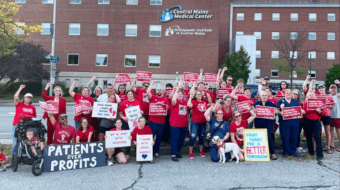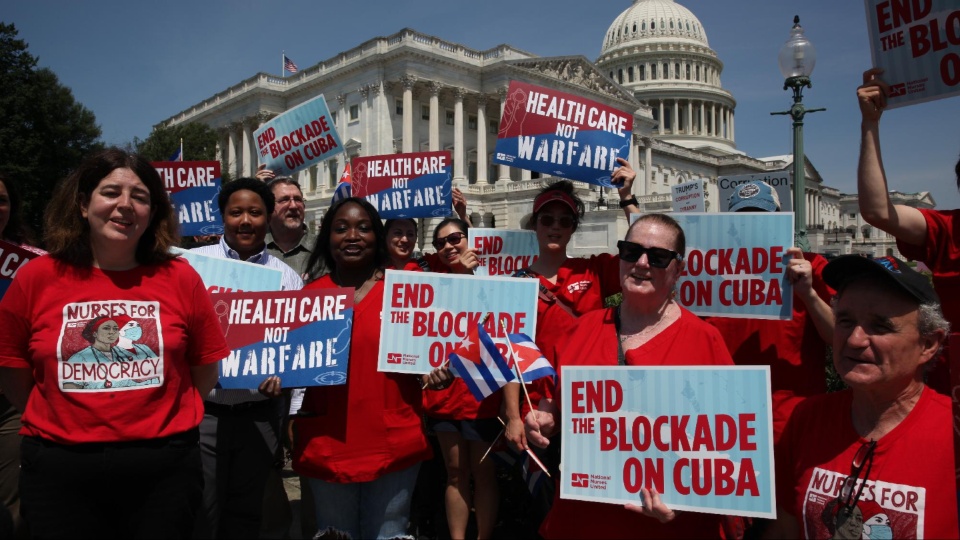
WASHINGTON—In the sweltering 100-degree heat outside the U.S. Capitol on Tuesday, about 100 nurses, lawmakers, and solidarity activists gathered here to demand an end to the U.S. blockade on Cuba. “End the cruelty. End the war against the Cuban people!” they chanted.
The press conference, organized by National Nurses United (NNU)—the nation’s largest union of registered nurses—brought together four progressive Democratic members of Congress, the United Electrical workers union (UE), representatives from Global Health Partners, CodePink, and the International Workers Institute (IWI-WFTU), all standing united in their condemnation of the Trump administration’s escalating economic warfare against Cuba.
“Nurses are guided by a simple principle: Every human being deserves dignity, safety, and care. No government should use healthcare, food, fuel, or medicine as leverage to impose their will on another country,” said NNU President Jamie Brown, RN, opening the press conference.
“The blockade has left Cubans suffering from frequent blackouts, shortages of fuel, food, and other life-saving necessities, and a severe impact on healthcare delivery. As nurses, we know that when hospitals lack medicine and clinics lack supplies, patients suffer—and they die.”
Brown was joined by U.S. Representatives Delia Ramirez (IL-03), Pramila Jayapal (WA-07), Jonathan Jackson (IL-01), and Ro Khanna (CA-17)—all progressive Democrats who have made opposing the blockade a part of their foreign policy agenda.
‘Act of war’
Jackson, who traveled to Cuba over the Easter weekend with Jayapal to assess the humanitarian situation firsthand, spoke on the harsh realities facing the Cuban people as a result of U.S. imperialism’s policy targeting the socialist country.
“What we saw was cruelty. The Cuban people have not seen America’s generosity,” Jackson said. “To see the young baby Alessandro—a low birth weight baby—being denied medicine, being denied incubators, being denied care. This is not simply a blockade. This is an act of war.”
Jackson pointed to the U.S. naval presence surrounding the island as proof of the blockade, which the Trump administration denies is happening. Even when they do admit it exists, they falsely insist that it is not the blockade which causes the hardship there, but rather the socialist system.
“When you engage the United States Navy, you surround a nation, and you cut off the vital supply—that’s an act of war. We are demanding that Secretary of Defense Pete Hegseth end the war against the Cuban people immediately. Every day this goes on, it equals death. Every day this goes on, it is cruelty.”
He said that Cuba is not a distant foe but a close neighbor. “Cubans are not foreigners. Cubans are our neighbors. They’re 90 miles off of our shore,” he said. “There are 10 million people suffering on that island, being denied healthcare, being denied access to medicine, being denied access to equipment.”
Infant mortality doubles
Jayapal described what she witnessed during her visit to Cuba just two months ago.
“I went to Cuba and saw the devastation and destruction of the U.S. blockade firsthand—people living with no electricity to power their refrigerators or gas to put in their cars, doctors keeping babies alive in incubators run by generator power,” Jayapal said. “I left Cuba shocked by the inhumane effects of U.S. policy.”
Bob Schwartz, Executive Director of Global Health Partners, said that infant mortality in Cuba, which had been brought down to 4.8 per 1,000 live births after the Cuban Revolution, has now doubled as a direct result of the fuel blockade. Over 32,000 pregnant women are at risk due to disrupted access to ultrasounds and prenatal care. Healthcare workers are reportedly manually ventilating newborns during daily power outages.
Khanna framed the issue of the blockade in stark humanitarian terms. “People in Cuba can’t get critical healthcare or access medicine,” he said. “Trump’s economic and military aggression is causing a human rights crisis.”
Ramirez connected the blockade to a broader critique of U.S. imperialism. “Despite history having shown us that peace and democracy have never been realized through strongmen, United States imperialism, or unilateral military intervention, Trump and Rubio have established another blockade against Cuba,” Ramirez said.
“The immoral, inexcusable, cruel blockade has cut Cubans off from healthcare, safe food, potable water, and security. I stand with Cubans demanding self-determination, freedom, and safety. We must become good neighbors. We must end the blockade and the siege on the Cuban people.”
Dr. John Ruwer, a physician with 40 years of medical practice, offered a rebuttal to the administration’s characterization of Cuban medical missions as “human trafficking”—a charge that has been used to pressure countries to end their contracts with Cuban doctors.
“Only a government that exports mostly weapons and war could even begin to say that exporting doctors is somehow a bad thing,” Ruwer said to applause.
He described meeting Marina, a 35-year career family doctor who lives in an apartment above her neighborhood clinic. In return for her medical training, she agreed to care for a couple of hundred neighbors for years—and described with relish how wonderful it was to get to know them and provide their care. Her practice was punctuated by medical mission trips to Brazil, Venezuela, and Namibia.
“When she heard that it was implied that she was a victim of Cuban trafficking, she could only laugh,” Ruwer said.
He also met Yuri, a young man from Gaza offered a full medical education and orthopedic residency in Cuba in return for serving the Cuban people and eventually returning to serve his own people.
“He was thrilled with his plan in his life—until he started watching so many of his family and friends killed in Gaza by policies pushed by this country. And now he’s prevented from going home to care for his people.”
Ruwer also met several U.S. medical students studying in Cuba who said they were there because they wanted an education centered around patient care rather than a business model.
“So why is providing patient-centered healthcare for Cubans and many other people around the world considered so threatening?” Ruwer asked. “It is clearly the threat of a good example and a refusal to submit to the domination of the wealthy.”
‘Criminal policy’
Olivia DiNucci of CodePink detailed how U.S. threats against oil suppliers have left Cuba relying only the 40% of its required crude oil which it is able to produce domestically. The result is frequent blackouts, shortages of gasoline and cooking gas, and dwindling supplies of the diesel that powers the nation’s water pumps.
The impact on vaccines has been particularly devastating. At least 30,000 children have missed doses—not because the vaccines themselves don’t exist but rather because refrigerated transport is paralyzed by fuel shortages.
Schwartz announced that Global Health Partners is launching a campaign to bring incubators, ventilators, neonatal monitors, prenatal vitamins, and better nutrition to Cuba. NNU nurses have already donated to seed the effort.

Chris Townsend, retired UE Washington Representative and current member of the Executive Committee of the International Workers Institute (IWI-WFTU), placed the Cuban blockade in the context of the international struggle against imperialism.
“For decades, not years, but decades, the World Federation of Trade Unions has opposed this criminal war against Cuba. That’s what it is,” Townsend said. “This is not some convenient block. No, this has been a war for decades and decades.”
He noted that workers around the world are speaking up—in London, Dublin, Sao Paulo, Mexico City, Johannesburg, Tokyo, and elswhere—“as the trade union movement gets up off its knees and says, ‘Enough, enough of this war’.
“This is a criminal policy. This is a genocidal policy. Sisters and brothers, we’ve seen where this genocide goes. It looks like Gaza. This is the future of Cuba if we do not intercede.”
Next steps
Schwartz urged support for House Concurrent Resolution 106, which would assert congressional authority to prevent war with Cuba.
“We have an administration that is literally out of control, and the Congress must stand up and tell the administration: If you want war with Cuba, you’ve got to go through us,” Schwartz said.
As NNU President Brown put it, “Nurses cannot and will not stay silent while our president’s policies cause immense suffering, at home or abroad.”
We hope you appreciated this article. At People’s World, we believe news and information should be free and accessible to all, but we need your help. Our journalism is free of corporate influence and paywalls because we are totally reader-supported. Only you, our readers and supporters, make this possible. If you enjoy reading People’s World and the stories we bring you, please support our work by donating or becoming a monthly sustainer today. Thank you!
CONTRIBUTOR