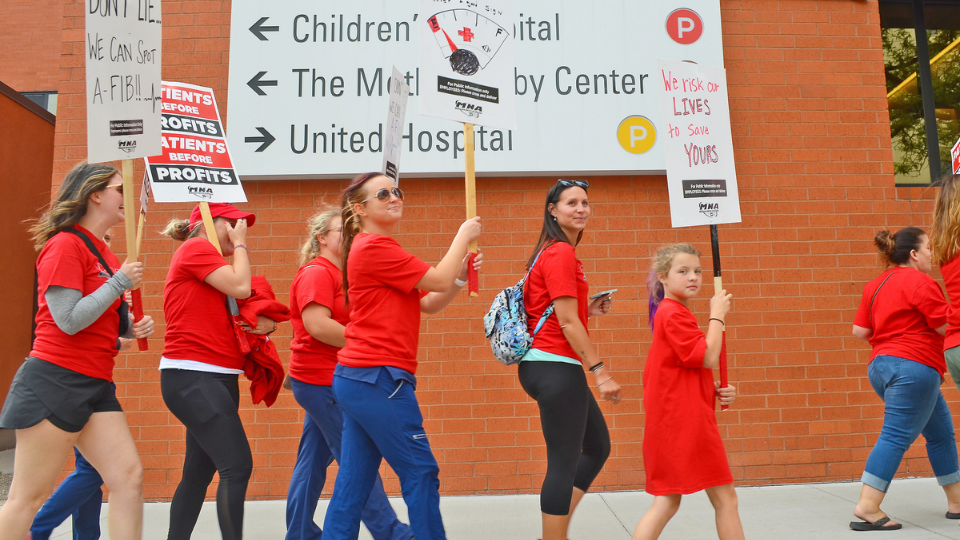
WASHINGTON—Nurses “speak truth to power” when hospitals put profits over patients, and union contracts protect them when they do, says National Nurses United President Mary Turner, RN.
And that’s why unions and workers’ rights should be strengthened through passage of the Protect The Right To Organize Act, she told the Senate Health, Education, Labor and Pensions Committee.
Turner, a Minnesotan, was one of two pro-worker witnesses on October 22 at the GOP-run panel’s second in a series of hearings on the state of U.S. labor law and the need for reform.
About the only statement that both parties on the panel agreed upon is that, as one GOP senator said, the National Labor Relations Act was written in an industrial era when work, worksites, and the economy in general were quite different. It needs modernization.
The witnesses split on how, with unionists on the side of strengthening it and a top union-buster, a right-wing think tanker, and a conservative grad student worker who’s represented by a union and who objects to its political stands on the other.
Current labor law has been weakened by GOP-run Congresses and federal court rulings over the last 90 years. That led Turner to declare, “Our ability to advocate for patients and communities is stronger with labor laws that protect our right to organize. Right now, those laws are broken and not just in states with ‘right-to-work’ laws.
“Employers routinely violate workers’ rights with little to no consequence. The National Labor Relations Act, once intended to protect working people, has become toothless.
The positive impact of the PRO Act goes beyond wages and benefits, Turner later told Sen. Maggie Hassan, D-N.H. “The PRO Act protects from union-busting, from being fired” without cause and “from harassment,” on the job, the National Nurses United leader said. “It’s everything to the nurses. That’s why 85% of them in the state are unionized.”
Nevertheless, “Big hospital systems will reduce services, cut staffing levels, retaliate against nurses who organize, refuse to purchase essential medical supplies and equipment, close departments or units, and even shutter hospitals in rural or underserved communities,” Turner testified earlier.
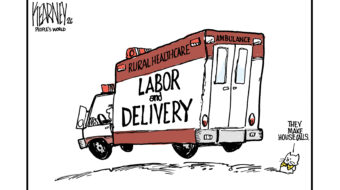
“In Minnesota, we’ve heard those empty promises before. When Essentia Health acquired the nonprofit hospital in Fosston—a rural community of about 30,000—it pledged to maintain core services. But in 2022, Essentia shut down the hospital’s labor and delivery department, citing workforce shortages and population decline. In truth, it was more profitable to send expectant mothers 65 miles away to Detroit Lakes.
“Union nurses joined residents to demand accountability, and the Fosston City Council ultimately voted to end its contract with Essentia after months of failed negotiations. Essentia refuses to comply, insisting it will continue operating the hospital,” Turner added.
That’s one example of how contracts protect workers, because a union contract covering the RNs at the hospital protects them from retaliation by forcing the hospitals to prove their cases when they try.
Sen. Bernie Sanders, Ind-Vt., who heads the Labor panel’s bloc of Democrats and independents, put the whole debate over labor law reform into the context of corporate greed, which has robbed workers of the benefits of their productivity for the last 52 years.
Sanders cited a chart showing that, adjusted for inflation, workers have lost ground over that time, while productivity has risen by just over 150% and average CEO pay has risen by 400%. “We have a situation now where Elon Musk owns more wealth than 52% of American families” combined “and where the top 1% own more wealth than the bottom 95%.
“How does that happen? It has to do with an attack on trade unions in this country. Millions of workers want to join a union but cannot” because there are no meaningful financial penalties for bosses who break labor law, stall bargaining, threaten and intimidate workers during organizing drives, and draw out disputes in federal courts.
And, thanks to GOP President Donald Trump, “there’s no NLRB” to enforce the law, because the labor board lacks the required three members—out of five seats–for a quorum. Right now, it has one member, Democrat David Prouty. “So people get fired and nothing happens,” Sanders said.
The other pro-worker witness, Joshua Armold of Machinists Local 837B in St. Louis, described how he and his 3200 co-workers have been forced to scramble to keep themselves and their families alive and healthy during their strike against Boeing, which began August 4.
“There are very few tools available to our workers,” except to strike, Arnold said. Boeing has backtracked on proposals since the strike began. “And we’ve missed six paychecks.”
Arnold said the immensely profitable aircraft company refuses to give its St. Louis and Southern Illinois workers, who manufacture F-15 fighter planes and a variety of other aircraft and weapons, pay and bonuses equal to what IAM successfully won for 33,000 Boeing workers in the Puget Sound area and elsewhere on the West Coast last year.
Boeing also cut off St. Louis workers’ health care, forcing them to pay for COBRA benefits—which it must legally offer—at a cost of $2500 per month. Weekly IAM strike benefits, Arnold added, are far less. Besides the COBRA costs, Arnold reported some co-workers “face foreclosures and evictions.”
In a prior contract, Boeing wiped out guaranteed old-style defined benefit pensions for both groups, replacing them with 401(k) accounts. That leaves workers at the mercy of stock market vagaries and investment managers. Now, in St. Louis, Boeing limits its match to workers’ contributions to 401(k)s, and it won’t budge, unlike in Seattle.
“In our 2025 negotiations, Boeing has been unwilling to put a suitable offer on the table,” Arnold said. “Granted, these are good jobs” at the two St. Louis aircraft plants and another in Southern Illinois, “but our members are not getting rich.
“And Boeing threatens us with ‘take our contract or else,’” they’ll close plants. “The company does not respond to the dedication of skilled workers,” many of whom have worked there for decades.”
The committee’s Republican-called witnesses included a Stanford University grad student worker who complained about being “forced” to pay for United Electrical Workers’ political activism and stands he disagrees with. UE represents the grad student workers at the California campus. The worker is now studying economics at Stanford’s Hoover Institute, noted for its conservative bias.
Other GOP witnesses advocated such measures as national right-to-work laws, legislation to let workers opt out of paying union dues, and in return the union would not have to represent them in discipline hearings or in bargaining on pay, and a ban on card-check union recognition.
Another GOP witness, for a right-wing think tank, touted making more workers “independent contractors” but also letting them bargain—individually—for health care and other benefits. He also pushed to make the removal of an incumbent union at a workplace, called decertification, easier.
And if card-check was in effect, workers would “hear little or nothing about union dues or how unions can’t guarantee outcomes” in negotiations, alleged Thomas Beck, a “senior adviser” to the policy institute of the nation’s leading union-buster, the Littler Mendelson law firm.
The panel’s ruling Republicans took no stands on extreme rewrites of labor law. Several of them got into arguments with panel Democrats over the 22-day-and-counting Trump regime partial federal shutdown, Trump’s elimination of federal union contracts, and his continued firings of tens of thousands of federal workers, despite court orders against such executions.
Sen. Josh Hawley, R-Mo., was an exception. He’s met with the St. Louis Boeing IAM workers. He criticized Boeing’s refusal to raise its wages, pensions, and company 401(k) contributions to equal those of the Puget Sound workers. He also hit its denial of health coverage. The media mentions Hawley as a possible 2028 GOP presidential hopeful.
Health care for the St. Louis workers would be a minuscule share of Boeing’s revenues and profits, Arnold pointed out. The cost of covering the whole St. Louis-area workforce for a year would be less than half the cost of manufacturing one F-15 fighter, he testified.
By contrast, even with COBRA, “it means you have to pay up the wazoo,” for health care coverage, Arnold told Hawley. “You’re up the creek without the proverbial paddle.” Replied Hawley: “This is unbelievable. Boeing executives make unbelievable dollars and don’t pay attention to workers—or safety standards.
“You can’t be pro-family” as a politician if workers “can’t make enough to support a family,” Hawley chided his fellow Republicans.
We hope you appreciated this article. At People’s World, we believe news and information should be free and accessible to all, but we need your help. Our journalism is free of corporate influence and paywalls because we are totally reader-supported. Only you, our readers and supporters, make this possible. If you enjoy reading People’s World and the stories we bring you, please support our work by donating or becoming a monthly sustainer today. Thank you!
CONTRIBUTOR