The kidnapping of President Nicolas Maduro and military invasion of Venezuela by U.S. military units is a continuation of the Monroe Doctrine’s legacy, heavily influenced by the Southern aristocracy’s eagerness to expand slavery nearly two centuries ago.
The extension of slavery was precisely the issue that led to the American Civil War, the bloodiest in our country’s history.
“The very places that are under attack are all [U.S.] spaces that are led by Black leaders,” declared Chicago’s African American Mayor Brandom Johnson at the National Legislative Conference of the Congressional Black Caucus (CBC) September 24-28.
“That is very intentional because there is an extremism in this country that has not accepted the results of the Civil War, and they’re fully engaged in the rematch,” added Mayor Johnson.
Today’s “rematch” encompasses all the lands north and south of the Rio Grande. The initial target of Trump’s legions of Border Patrol and ICE (Immigration and Custom Enforcement) agents have been U.S. cities where peoples of Latin American and Caribbean heritage along with African American descendants of enslaved Americans predominate.
Pivot to the Americas: Jingoistic ideology of Manifest Destiny
Not coincidentally, today’s foreign policy pivot to Latin America and the Caribbean has its roots in the U.S.-Mexico war of 1846-48, in which our ruling class annexed 55% of Mexico’s territory.
With a bully’s swagger, Trump initially quipped that Canada ought to be the 51st state of the Union, essentially laying claim to the whole of the Western Hemisphere. Basking in his glory after the Venezuela venture, Trump is now threatening Colombia and its president; menacing to intervene in Mexico supposedly to halt drug trafficking; described Cuba as “ready to fall”; and reasserted his desire to take control of Greenland.
Because of the overwhelming military power and economic influence of the U.S. ruling class—now dominated by Trump, the neo fascist authors of Project 2025, and the most reactionary sections of capital—the role of our nation’s people in advancing its self-interests with that of the collective interests of the hemisphere’s nations is pivotal.
And so it is that last year’s Nov. 4 and Dec. 9 election results were victories of seismic proportions for the people of the U.S. and, in a sense, the peoples of the Americas, opening cracks in MAGA’s ranks.
It was the sense of betrayal by Trump who bragged he’d brought down the cost of commodities that weighed down Republican candidates, especially those who parroted their president’s demagogic claims.
While hammering away at Trump and Republican contenders’ false claims, Democratic candidates presented credible alternatives to bringing down the cost of living that resonated with voters. That was even truer of Democratic Socialist Zohran Mamdani’s successful New York mayoral trailblazing campaign.
One “Big Lie” after another
On top of voter rejection of Trump’s economic failures, his popularity ratings are in the dump. At times sending our nation to war serves as a distraction from the problems an administration has at home, rallying public opinion behind a perceived threat to the nation. But, in this case, initial polling suggests overall sentiment is divided into thirds—for, against, and undecided—hardly a ringing endorsement. Two-thirds of Trump’s base, however defined by the survey, supported Trump’s action.
Perhaps former Republican Congresswoman Marjorie Taylor Greene, Trump’s ardent defender turned scathing critic, was reflecting the thinking of a section of MAGA’s base when she forcefully condemned Trump’s invasion of Venezuela. Greene said the Venezuela action represented one more broken promise by Trump to keep the nation from going to war, after having falsely pledged to bring down the cost of groceries and other necessities of life.
Already, the power of the Democratic election victory precipitated an implosion in MAGA’s camp, in open defiance of Trump and House Speaker Republican Mike Johnson. Groups of House Republicans started using the discharge petition congressional maneuver, in collaboration with a united Democratic caucus, that allows a majority of House members to place a measure for consideration and vote directly on the House floor, bypassing the Speaker’s prerogative to do so.
The House Democratic caucus, collaborating with the Senate Democratic caucus and a few Republicans, has introduced a bill reclaiming the right of Congress to declare war, ordering an end to military aggression within and against Venezuela.
Before the holiday congressional break, the House barely defeated, 213 to 211, a measure demanding “direct removal of United States Armed Forces from hostilities within or against Venezuela…not authorized by Congress.” Three Republicans joined with all Democrats, except for one, in voting for the Democratic-introduced resolution.
Meanwhile the AFL-CIO leadership condemned “Trump’s unconstitutional actions in Venezuela,” along with a long list of liberal/left mass organizations, many of which also characterized Trump’s aggression as a violation of the United Nations charter and international law. Among other issues, vehemently opposed by Trump and Johnson, making the threshold necessary to put a discharge petition on the House floor is the Affordable Care Act (ACA), to be voted on later this month.
The big question
The big question before Congress and the nation is how to confront the unilateral action of Trump who flagrantly violated Venezuela’s sovereignty and kidnapped its president and his wife.
For all of Trump’s bluster, Venezuela’s government, its military, and parliament, as well as its mass organizations and networks for defense of the nation, appear to be supportive of the Maduro administration. Meanwhile, the Trump administration and its worst hawks are doubling down on Venezuela’s ability to export its oil, its main source of foreign exchange and income necessary to satisfy the basic needs of the people.
The goal is to force Vice President Delcy Rodríguez, newly installed as president, and key figures in the government to succumb to the will of Trump and the key players in his administration who, among other things, want to privatize and turn over to the oil monopolies Venezuela’s vast oil reserves. Their aim is also to squeeze ever tighter the economic damage to Cuba and its people, cutting off its main source of fuel to power the country, already the victim of a cruel blockade that has been repeatedly and overwhelmingly denounced by the United Nations General Assembly.
Except for a few right-wing governments, the gross violations of international law by Trump and his administration have been roundly condemned by the national democratic governments of the three largest nations in Latin America—Brazil, Mexico, and Colombia—as well as several smaller ones. Among them is the hemisphere’s longest-lasting beacon of socialist democracy, Cuba, which contrary to U.S. government designation as a terrorist state, its main export has been doctors and medical personnel to some of the most impoverished nations in the world.
The European nations are also up in arms, condemning the Trump administration’s bellicose language generally but particularly in reference to Greenland, which is adamantly proclaiming its sovereignty.
Pivot to the home front
Trump’s military aggression in Venezuela is an extension of militarized aggression on the home front, all of which has become too familiar to the nation, brutally so to the communities directly affected.
In a new dangerous development little reported in the commercial media, the U.S. Immigration and Customs Enforcement (ICE) is buying millions of dollars’ worth of new surveillance tools at the same time Trump has scaled back protections for use of civilian data—a combination that could lead to a vast expansion of domestic surveillance that goes far beyond immigrants.
The surveillance technology includes social media monitoring tools, facial recognition software, license plate readers, and services to find where people live and work.
“ICE is already well beyond their initial responsibility and is fully into the realm of political policing of protesters and dissidents,” said Matthew Guariglia, a senior policy analyst on surveillance and technology at the Electronic Frontier Foundation, which has been tracking the growth of government surveillance capabilities. “They’re building up this mass automated surveillance infrastructure,” he added, “and the question we have to be asking is: What is it for?”
D.C. occupation—a vision of what’s to come?
During the occupation of Washington, D.C., Trump took advantage of the special laws governing the nation’s capital giving the president powers to subsume the capital’s police force and deploy other policing agencies at will.
Routine calls that might have been handled solely by the Metropolitan Police Department (MPD) mobilized an alphabet soup of federal agencies: ICE, Border Patrol, FBI, National Guard, Homeland Security, Drug Enforcement Administration, and the Bureau of Alcohol, Tobacco, Firearms and Explosives. At checkpoints, law enforcement agents have been pulling over cars occupied by “Black skin” and “brown skin” people, for minor infractions, hauling them to jail and, at the slightest questioning, arresting them on trumped-up charges.
Of course, immigrants and car occupants of color unable to provide proof of being native born citizens would be apprehended and taken to detention centers for an indefinite period and potentially expelled from the country without due process.
The D.C. pilot project, so to speak, as well as the new ultra-modern weapons of spying and license to move anywhere in the country, bestows on ICE and its parent Department of Homeland Security (DHS) unlimited weapons of repression.
The precedent-setting initial occupation of cities led by African American mayors and populated by large concentrations of Black and brown peoples could well serve as the prelude for a more generalized repression of whole populations.
More recently, Trump singled out Haitians and Somalians, among a plethora of other peoples of color regardless of their immigration and citizenship status. The new enhanced powers of repression can be deployed to apprehend leaders of movements, critics of the Trump administration, and subjugate a whole people in a modern-day version of the South’s Jim Crow segregation system.
That applicants can be directly vetted by DHS to pick new hires of right-wing views, unscrupulous violent behavior, and unquestionable allegiance to ICE and Border Patrol senior officials—making them preferable over National Guard and full-time military troops. These would be the equivalent of the Brownshirts, Hitler’s most reliable storm troopers of fascist Germany.
Closer to home, they can be compared to the slave catchers who, for a price, were given license to go North by the Supreme Court’s 1850 Dred Scott decision to hunt down runaway enslaved Black people and return them into slavery. Trump’s plan to develop a “quick reaction force” of National Guard troops trained to deal with civil disturbances recently hit a snag.
The Supreme Court ruled against Trump’s attempts to federalize the National Guard for domestic law enforcement, finding he lacked authority under federal law, specifically citing the Posse Comitatus Act, without invoking the Insurrection Act. However, speaking to reporters Oct. 29 aboard Air Force One during his trip to Asia, Trump said, “You know if I want to enact a certain act, I’m allowed to do it routinely,” an apparent reference to the Insurrection Act of 1807.
The Act allows the military to suppress a rebellion and insurrection or quell violent domestic rebellion, as in Los Angeles during the aftermath of the Rodney King verdict. As for invoking the Insurrection Act, Trump said, “But we haven’t chosen to do that because we’re doing very well without it.
“But I’d be allowed to do that, you understand that, and the courts wouldn’t get involved, nobody would get involved, and I could send the Army, Navy, Air Force, Marines, I can send anybody I wanted.”
Two plus two equals millions
The video of six congressional representatives, high-ranking veterans of the armed forces and intelligence community, informing soldiers of their right and duty to refuse to obey their superiors’ orders if they are in violation of the Constitution and the law shook up the Trump administration. But their initiative opens a new front of mass resistance. No two periods in history are the same, but overall trends can reappear in changed form.
During the Vietnam War, the fightback started with a few draft resisters but over time caught fire with soldiers going AWOL, refusing orders, and even turning on their officers until it became a massive movement among active-duty GIs headed for and already on the frontlines of the “killing fields.” So far, there has not been any massive deployment of troops abroad, but National Guard, workers often with families, are on temporary duty on the domestic front.
Former Guard members have reported consternation on the part of active-duty Guard to use physical force against their own people. Now as then, the massive outpouring of resistance by the people is a key factor that is bound to influence members of the military to refuse to obey a command that goes counter to the law, the Constitution, and, not least, their own sense of morality. By the same token, a movement of military personnel refusing to obey an unlawful order can give added momentum to civic mass developments.
Picking up steam since its initial disorientation a year ago, the fightback has grown to include mass street heat, legislative and electoral struggle combined with a robust presence in conventional and social media, legal court battles, door-to-door canvassing, phoning, texting, and other forms of non-violent struggle which, conditions permitting, has involved civil disobedience.
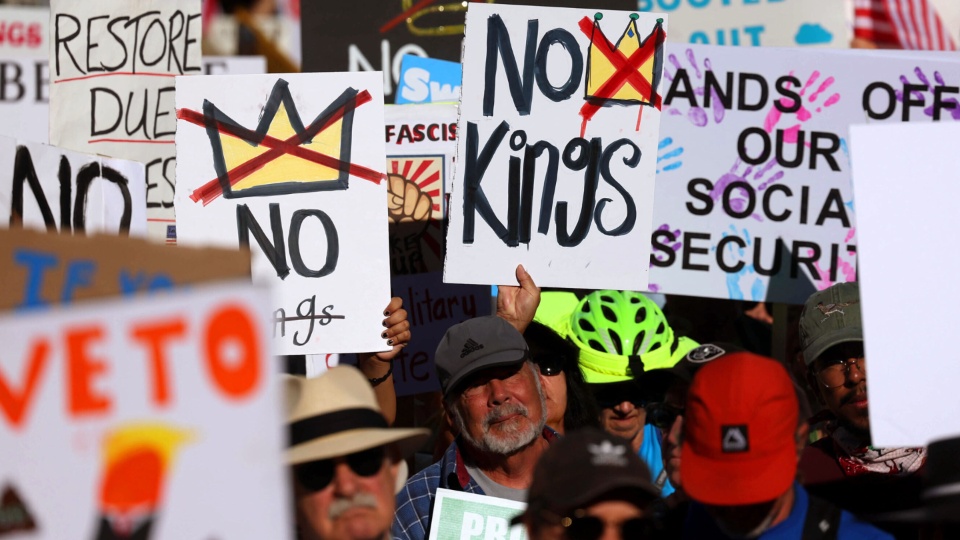
A record five million Americans participated in the first “No Kings” day of protest, followed by seven million in the second. Coalition building from the State Capitols and City Halls to the neighborhood hubs in response to the brutal presence of ICE and Border Patrol must continue, especially given events in Minneapolis this week.
Armed with whistles, neighbors announce the presence of modern-day versions of hooded Klansmen about to pounce on brown and Black people fitting the profile of “illegal” immigrants. In droves, they emerge from their homes, cell phones ready to document the often-brutal handling of neighborhood friends and acquaintances, shouting and shaming the perpetrators. The booming sound of pots and ladles bang away in the middle of night at hotels and motels where immigration agents lay down their heads for night.
These are but a few of the traditional and new forms of struggle involving the mass democratic participation of the people, constituting a formidable force in preparation for the November mid-term elections.
African American mayors blast Trump’s militarization
A powerful expression of Black and brown unity is the vigorous defense of immigrants by Black mayors and public officials at all levels of government.
Contrary to often innocently and sometimes maliciously amplified cases of division between Black and brown peoples, come election time, Latinos have tended to go out in force to support Black candidates for mayor, who usually include Hispanic leaders in their campaigns and governing cabinets.
As with Black and brown public figures, the rejection of Trump’s blatant racism and xenophobia by a multi-racial, including whites, multitude of Democratic and liberal/left independent leaders and masses constitute a formidable force for winning over the battle for minds and souls of the American people.
As Chicago Mayor Johnson, a schoolteacher by profession, put it, “The assignment is to finally bury white supremacy.”
As with all op-eds published by People’s World, the views reflected above are those of the author.
We hope you appreciated this article. At People’s World, we believe news and information should be free and accessible to all, but we need your help. Our journalism is free of corporate influence and paywalls because we are totally reader-supported. Only you, our readers and supporters, make this possible. If you enjoy reading People’s World and the stories we bring you, please support our work by donating or becoming a monthly sustainer today. Thank you!
CONTRIBUTOR