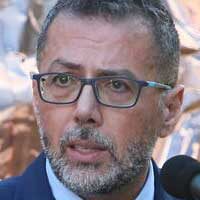
Canadian Prime Minister Mark Carney sounded more like a populist leader than a former central banker during his address at the World Economic Forum in Davos on January 20. Bemoaning the “fading” of the rules-based order, Carney delivered a surprisingly blunt speech. “The old order is not coming back,” he declared. “We are in the midst of a rupture, not a transition.” In this new reality, he warned, quoting Thucydides, “the strong can do what they can, and the weak must suffer what they must.”
The “revolutionary” rhetoric did not stop there. Carney called for “strategic autonomy” for middle powers, warning that “if we’re not at the table, we’re on the menu.” He insisted that the West could no longer rely solely on “the strength of our values,” but must pivot to “the value of our strength.”
Yet, before mistaking Carney for a Sankara or a Lumumba, one must recall his administration’s record on the slaughter in Gaza. The irony is inescapable: Carney rails against a world where “might makes right” when it involves American tariffs or threats to Greenland, yet he presides over a policy that facilitates exactly that in the Middle East.
The contrast between Carney’s Davos persona and his actual policy on Gaza is best illustrated by a single moment in Calgary on April 8, 2025. During a campaign rally, Carney was interrupted by a shout: “Mr. Carney, there is a genocide in Palestine!” The Prime Minister responded directly: “I’m aware. That’s why we have an arms embargo.”
For a few hours, it appeared the leader of a G7 nation had finally acknowledged the legal reality unfolding in Gaza. But the supposed honesty Carney championed at Davos was nowhere to be found the following day. After immediate political backlash, Carney performed a semantic retreat. “I didn’t hear that word,” he fumbled to reporters. “I heard ‘Gaza’… I was stating a fact in terms of the arms restrictions.” With that, the official Canadian line returned to its former self: reducing the systematic extermination of the Palestinians to a mere humanitarian concern.
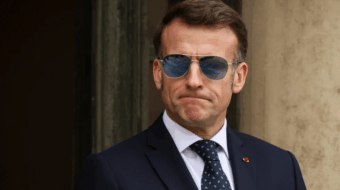
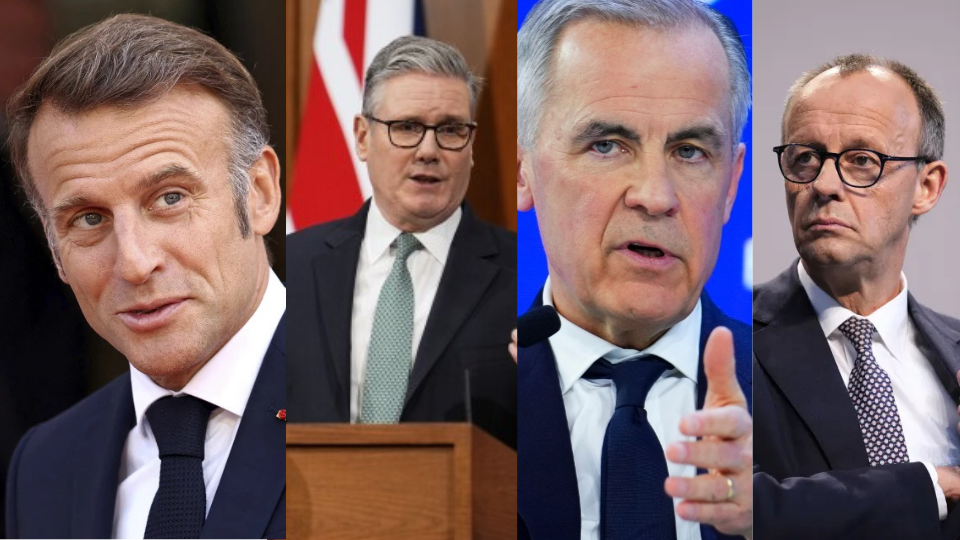
Carney is far from alone. French President Emmanuel Macron, British Prime Minister Keir Starmer, and German Chancellor Friedrich Merz have all perfected this brand of strategic double speak. Their headlines tell the story of a West that is fiercely protective of its own sovereignty but indifferent to that of others.
On January 8, Bloomberg reported: “Scholz: U.S. Must Respect Inviolability of Borders,” as German leadership reacted to U.S. rhetoric regarding the “purchase” of Greenland. Macron warned of a “world without rules” while appealing for European unity against U.S. economic coercion. In London, The Guardian ran a headline on January 21: “Enough appeasement: Britain needs its own ‘trade bazooka’ to take on Donald Trump.”
Respect for international law, it seems, is a “bazooka” to be used against trade rivals, but a meritless nuisance when applied to Israel. Now, compare those headlines to the typical Western output on Palestine:
“Canada unequivocally reaffirms support for Israel’s right to defend itself” (PMO Statement).
“Germany stands by Israel: ‘Israel has the right and duty to defend its citizens'” (Bundesregierung).
“U.K.’s Starmer: Arms suspension is ‘legal decision,’ not a change in support for Israel’s right to self-defense.” (Courthouse News).
The irony reaches its peak when the legal institutions that are the crown jewels of Carney’s “rules-based order” become the targets of Western attack. When the International Criminal Court (ICC) issued arrest warrants for Benjamin Netanyahu and Yoav Gallant for war crimes, the self-appointed guardians of the order did not uphold the law; they labored to misinterpret it.
In Canada, while Carney pays lip service to international courts, his government filed a motion in November 2025 to dismiss El Batnigi v. Canada—a landmark case seeking to hold Ottawa accountable for its failure to prevent genocide. The government’s argument? That the court has no jurisdiction over “political questions” of foreign policy.
In Europe, the fracture is even more visible. France’s Ministry for Europe and Foreign Affairs suggested Netanyahu might have immunity because Israel is not a member of the ICC. In Germany, Chancellor Friedrich Merz attacked the court’s legitimacy, calling the prospect of arresting an Israeli leader “completely absurd.”
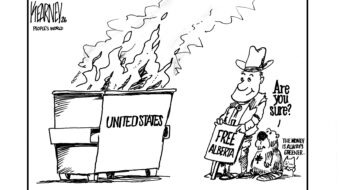
The West’s conception of a “global order” has always been structural, not accidental—privileging its own strategic interests while marginalizing the rights of the Global South. This imbalance is not a bug in the system; it is the very modus operandi of the system itself. Canada and Europe are only crying foul now because, for the first time in generations, they feel the walls of the privileged club closing in on them. They scream for international law to protect their trade routes and borders from Trump, yet they actively dismantle that same law to shield an ally in Gaza.
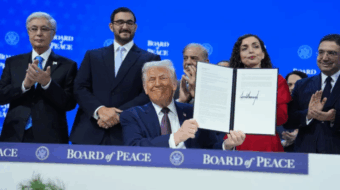
Yet, the U.S.-Israeli attempt to reshape global politics presents Europe and Canada with a rare opportunity to confront this legacy of selective legality. While it is difficult to sympathize with their current grievances, that position could change if they chose to reorient themselves morally. They could enforce international law consistently, pursue war criminals without bias, and end their roles as junior partners in Washington’s unconditional support for a brutal occupation.
Failing to do so merely exposes the “rupture” Carney describes as a self-inflicted wound. Even Mr. Carney must realize that values held only when convenient are not values at all; they are merely leverage. If the West continues to shout for the rules only when its own interests are on the menu, it shouldn’t be surprised when the rest of the world stops listening to the lecture. In fact, for many of us, we already have.
As with all news-analysis and op-ed articles published by People’s World, the views reflected here are those of the author.
We hope you appreciated this article. At People’s World, we believe news and information should be free and accessible to all, but we need your help. Our journalism is free of corporate influence and paywalls because we are totally reader-supported. Only you, our readers and supporters, make this possible. If you enjoy reading People’s World and the stories we bring you, please support our work by donating or becoming a monthly sustainer today. Thank you!
CONTRIBUTOR