WASHINGTON—Aiming to show that “affordability” is more than just a campaign slogan, a parade of advocates plus pollster Celinda Lake laid out details of what the Democratic Party should be campaigning on in the final six weeks before the Nov. 3 election.
In a two-hour session, labor organizations and their allies—making up what they called the “Paychecks and Prices Coalition”—called for getting candidates to pledge to more than triple the current federal minimum wage to a living wage of $25 per hour and to demand restoration of federal tax credits for medical care.
The GOP-run Congress let the credits lapse last Dec.31, and health insurance prices skyrocketed as a result, while the share of people covered declined.
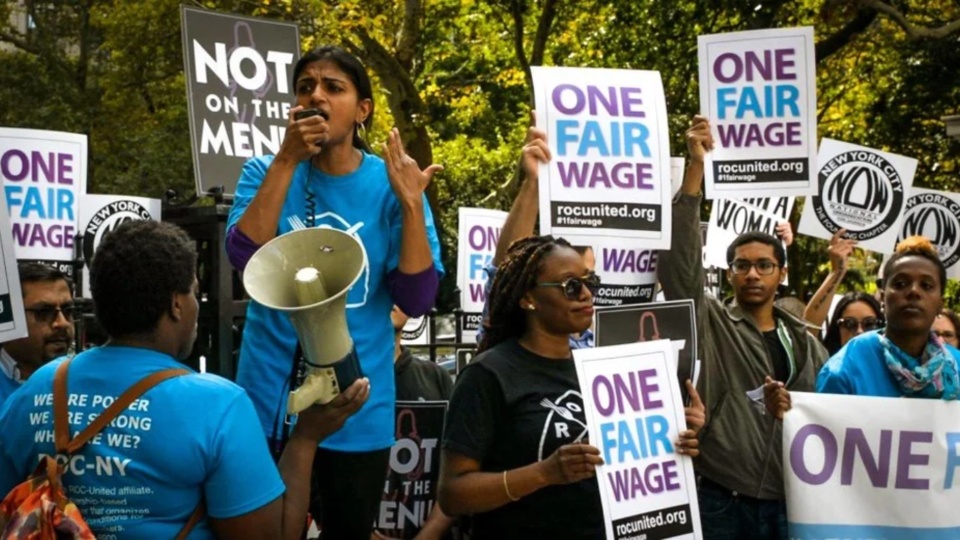
Saru Jayaraman, founder of One Fair Wage, moderated the session.
The coalition members represented at the Sept. 17 gathering are “coming together as a united front on affordable housing, health care, paid family leave, and a living wage,” Jayaraman said. Paychecks for “half of all workers do not meet the cost of living.”
In a nod to “affordability” becoming more than a slogan, Jayaraman warned the crowd that “I’ve never met a worker who says ‘I need affordability.’ They say ‘prices are too high and my wages are too low.’ They need paychecks to go up and prices to go down.”
The effort comes on top of a platform-building effort which pro-worker House Democrats have pushed almost since the start of the 119th Congress on Jan. 3, 2025. It also includes a minimum wage hike.
Their “platform” includes labor’s top priority, the Protect the Right to Organize (PRO) Act, paid family and medical leave legislation, and the Protect America’s Workforce Act, which would restore the federal union contracts President Donald Trump trashed.
It also includes measures mandating equal pay for equal work and to strengthen the Occupational Safety and Health Administration. Thanks to some Republican defections, the House actually approved the pro-federal workers’ bill. And a parliamentary maneuver by Rep. Bobby Scott, D-Va., to force debate and a vote on the PRO Act failed by one vote.
The coalition’s two-hour session in a crowded small meeting room in the Capitol complex drew congressional aides, political pros, and occasional reporters. It was full of statistics and statements about what “affordability” would really mean, plus pledges to enact the agenda within the first 100 days of the next Congress should Democrats retake the House.
Besides tackling both sides of the living equation—higher pay and lower prices—it would also mean taking on the billionaires who now pull the nation’s economic strings under Trump and curbing their price gouging, speakers said.
Rep. James Walkinshaw, D-Va., who represents a mixed suburban district outside D.C.—where migrants and struggling homeowners live side by side with some of the richest people in the U.S.—said affordability also means fighting back against the GOP tilt towards the billionaires.
“In this Congress and this White House, there is a clear agenda to pick our pockets and line the pockets of the billionaires and people closest to the president,” he elaborated. “My constituents don’t have a father who can get them $1.6 billion” in federal funding to pay for “a tungsten mine in Kazakhstan,” as Trump has for one of his sons.
Two speakers, Melody Campbell of the National Coalition of Black Civic Participation, and Pennsylvania Democratic state legislator Chris “Rep” Rabb, the U.S. Representative-elect from center city Philadelphia, emphasized the particular hit African-Americans are taking from GOP policies and their tilt to the rich.
“Black women are taking it on the chin,” said Campbell. “Our unemployment rate has gone up, and we’ve lost 600,000 jobs” to private sector layoffs and Trump’s firings of federal workers. “We’re being purged out of government jobs and out of corporate America.
“I’m a caregiver and I see the everyday impact of that. Some 74%” of people she servers “say the cost of food is too high and 41% say the cost of housing is too high. And 81% would support a candidate who could lower costs.”
It was left to Rabb to make the connection between the economics and political repression. “The attack on voting rights is high on their list,” he said of the GOP.
“We need a really overwhelming turnout” in November “so that no one can dispute what the American people want—and that people engage with their members of Congress about the pain they are experiencing,” Walkinshaw concluded.
No paywalls at People’s World
We hope you appreciated this article. At People’s World, we believe news and information should be free and accessible to all, but we need your help. Our journalism is free of corporate influence and paywalls because we are totally reader-supported. Only you, our readers and supporters, make this possible. If you enjoy reading People’s World and the stories we bring you, please support our work by donating or becoming a monthly sustainer today. Thank you!
CONTRIBUTOR