In a major move laying the groundwork for regime change in and war against Venezuela, President Donald Trump ordered the seizure Wednesday of a Venezuelan oil tanker near the coast of that country.
The serious escalation of tensions in the region has been condemned by several U.S. lawmakers.
Sen. Chris Van Hollen, D-Md., a member of the Senate Foreign Relations Committee, said the administration’s claim that the seizure was about “preventing delivery of oil to terrorists and interdicting drugs is a big lie and is just one more piece of evidence that this is about regime change by force.”
Democratic Sen. Dick Durbin of Illinois said on MSNBC Thursday that Trump was “preparing for war against Venezuela.”
Venezuela’s government said in a statement that the seizure “constitutes a blatant theft and an act of international piracy.
“Under these circumstances, the true reasons for the prolonged aggression against Venezuela have finally been revealed.… It has always been about our natural resources, our oil, our energy, the resources that belong exclusively to the Venezuelan people,” the statement said.
Nicolás Maduro, the president of Venezuela, also declared the action “an act of piracy,” saying it was aimed at removing him from office.
In a discussion with the press Wednesday, Trump—whose health and ability to focus appeared to be rapidly deteriorating—made no secret of his intention to oust Maduro, declaring “he has got to go.”
He refused to rule out a full-scale land invasion of the country and even extended his threats to neighboring Colombia, saying that the “president of Colombia will be next, if he doesn’t watch out.”
He claimed that the leadership of that country, too, was also encouraging the international drug trade. The president made no mention, of course, of his recent pardon of the former president of Honduras, Juan Orlando Hernández, found guilty in the U.S. of being a major international drug trafficker.
The seizure of the Venezuelan tanker, illegal under international law, follows the illegal U.S. bombing and sinking of many small vessels over the last few months. The Trump administration claims, without any evidence, that they were carrying illegal drugs. More than 80 people on those small boats, most of which were powered by outboard motors and unable to travel through ocean waters to the United States, have been killed so far.
The U.S. has built up the largest military presence in the waters around Latin American countries in decades, signaling that Trump is prepared to do anything he wants internationally, regardless of U.S. or international law.
The Venezuelan tanker, named “Skipper,” was actually first sanctioned by the Biden administration in 2022 for allegedly carrying oil to Iran, a country the U.S. has sanctioned for years before Trump took over. No military action was taken, however, by the U.S. against the ship until Trump took over.
In line with standard practice for the Trump administration, Attorney General Pam Bondi released videos that she said showed the takeover of the ship by U.S. forces. The videos are meant to give the impression of undefeatable U.S. forces doing whatever they want anywhere around the world.
In what could have been footage for a Hollywood movie, the video depicts U.S. forces being dramatically lowered on board the Skipper by sliding down ropes dropped from attack helicopters. The video gave no clues about what the troops did after landing on the ship. No resistance by Venezuelans on board was shown.
RELATED STORIES:
> Hegseth distances himself from deadly boat strike
> Trump’s National Security Strategy: ‘America First’ doctrine aims for global domination
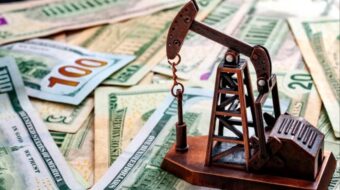
Trump gave away what is really behind his attacks on Venezuela when he spoke with the press and they asked him what would be done with all the oil on board the tanker. “I guess we will keep it,” the president responded.
Venezuela holds the world’s largest known reserves of oil. For many years, the U.S. was the largest purchaser of Venezuelan oil, but punishing sanctions imposed by Washington—regardless of whether the Republican or Democratic Party was in power—caused exports to the U.S. to completely dry up.
China is today the biggest buyer of the country’s oil, followed by India. The third largest importer is Cuba, whose government has also long been targeted for overthrow by the U.S.
Another major reason for the seizure was thus to inflict more pain on Cuba, which, in order to fight the economic blockade placed on it by the U.S., has been importing Venezuelan oil to survive economically.
The seizure of the Skipper is seen by many as a prelude to an even tighter restriction of Venezuelan oil exports—an action which could cripple Cuba and also advance the U.S. goal of cutting Latin America off from trade with China.

As for Venezuela, the major crime committed by its government, as far as big U.S. oil companies are concerned, is the use of profits from the sale of their oil to do things like building massive public housing, schools, and hospitals rather than, as the U.S. oil companies do, line the pockets of billionaires.
Furthermore, seizure of Venezuelan oil serves the interests of U.S. oil companies that want to control petroleum profits around the world. Nations like Venezuela, and Russia, also a large oil producer, are high up on their list. Oil resources are used by countries like Venezuela and Russia to mitigate the effect of U.S. economic sanctions against them.
Russia has helped Venezuela skirt many of the U.S.’ restrictions by sharing strategies it has used to continue exporting its own sanctioned commodities.
Here in the U.S., the seizure serves as another attempt by the Trump administration to draw attention away from its failed economic policies and the huge increase in health care costs that will faced by millions of Americans in only a matter of days.
Many fear that a new war, under a Trump administration, can serve as an excuse for all kinds of repressive measures—up to and including declaration of a national emergency or even martial law.
We hope you appreciated this article. At People’s World, we believe news and information should be free and accessible to all, but we need your help. Our journalism is free of corporate influence and paywalls because we are totally reader-supported. Only you, our readers and supporters, make this possible. If you enjoy reading People’s World and the stories we bring you, please support our work by donating or becoming a monthly sustainer today.
CONTRIBUTOR