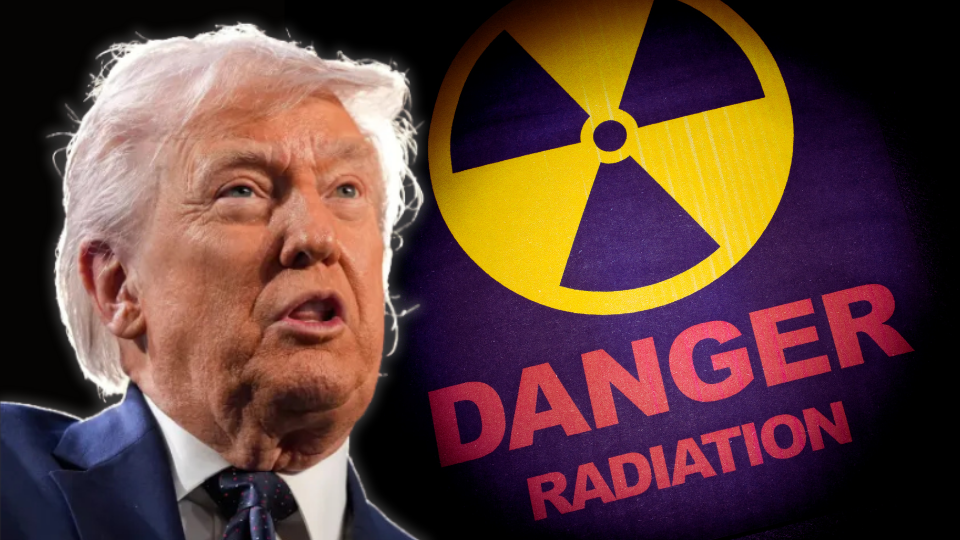
On March 4, attorneys general from several states across the country announced they’ve formed a coalition to oppose the Trump administration’s new rules slashing security and environmental requirements for experimental nuclear reactors. The coalition asserts that the new rules incentivize the creation of “much more nuclear waste.” They argue that the fundamental nature of nuclear fission technology entails risks to the environment and public health, which the federal government is downplaying.
In January, exclusive reporting from National Public Radio revealed that President Donald Trump’s Department of Energy (DOE) quietly overhauled a set of safety directives related to nuclear power plants. The changes were shared with the companies the administration is charged with regulating, but not with the public, according to documents obtained by NPR.
As reported by the news outlet, the orders eliminate hundreds of pages of security requirements for reactors. The updated rules loosen protections for groundwater and the environment, cut back on record-keeping requirements, and raise the amount of radiation a worker can be exposed to before an official accident investigation is triggered.
The public announcement of this move didn’t come until early February, when the DOE finally disclosed the fact that it was establishing a categorical exclusion (CatEx) for the application of the National Environmental Policy Act (NEPA) procedures on the authorization, construction, operation, reauthorization, and decommissioning of advanced nuclear reactors.
The DOE defended the change, claiming that it is “based on the experience of DOE and other federal agencies, current technologies, regulatory requirements, and accepted industry practice.” In a statement sent to NPR after it broke the initial story, the DOE asserted that the “reduction of unnecessary regulations will increase innovation in the industry without jeopardizing safety.”
Yet the announcement, and the Trump administration’s rationale for it, have drawn immediate backlash from critics who say the move is dangerous and irresponsible.
Edwin Lyman, director of nuclear power safety for the Union of Concerned Scientists, asserted that the experimental reactors have insufficient operating experience “to justify a claim that you can just turn them on and they’re going to be safe and that you don’t have to worry.”
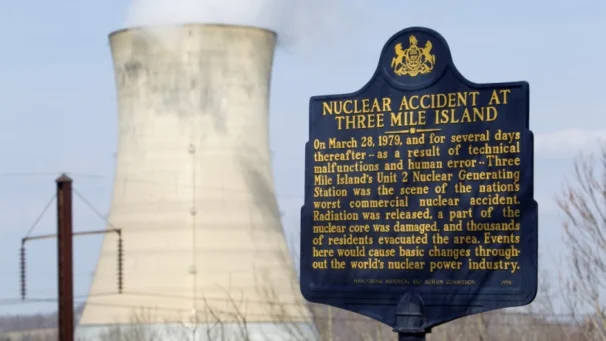
The scientist said that the administration was taking a “wrecking ball to the system of nuclear safety and security regulation oversight that has kept the U.S. from having another Three Mile Island accident,” referencing the historic 1979 nuclear meltdown in Pennsylvania.
The overhaul of the reactor rules came about after the president signed an executive order in May last year titled “Reforming Nuclear Reactor Testing at the Department of Energy,” which called for three or more experimental reactors to come online in time for the 250th anniversary of U.S. independence on July 4, 2026. The new rules seem to be intended to help the administration meet the unprecedentedly tight deadline, despite warnings of danger.
According to the Nuclear Regulatory Commission (NRC)—which has usually been in charge of regulating commercial nuclear reactors—”advanced reactors” are defined as next-generation nuclear fission systems that “differ from today’s reactors primarily by their use of inert gases, molten salt mixtures, or liquid metals to cool the reactor core. Advanced reactors can also consider fuel materials and designs that differ radically from today’s enriched uranium-dioxide pellets within zirconium cladding.”
While the DOE touts these new reactors as being designed for improved safety, economics, and environmental impact, scientific reports paint a different picture. In 2021, a report by the Union of Concerned Scientists (UCS) found that “they [‘advanced’ non-light-water nuclear reactors] are no better—and in some respects significantly worse—than the light-water reactors in operation today.”
According to a 2022 report in the Proceedings of the National Academy of Sciences (PNAS), a peer-reviewed journal of the National Academy of Sciences (NAS), the new generation of reactors can produce up to 30 times more waste than their predecessors and leak more neutrons.
Critics also note that Trump’s push for more nuclear reactors by July 4 may have less to do with “advancement” or celebrating our nation’s birthday than with the demands of AI and the tech billionaires connected to it.
Billions of dollars in private equity, venture capital, and public investments are reported to be backing the reactors. This includes tech giants Amazon, Google, and Meta. According to the organization Food and Water Watch, some of Trump’s largest Big Tech donors “aim to make a fortune from expanding artificial intelligence (AI), which requires massive amounts of power for AI data centers.” Instead of looking into renewable energy, the group said, these CEOs are investing in nuclear.

Last year, when numerous nuclear power industry executives visited the Oval Office, Trump called the industry “hot” and “brilliant.” This sentiment seems to align with his aggressive public rejection of renewable energy sources such as wind and solar power.
Yet, the coalition of attorneys general—from Washington, California, Illinois, Maryland, Massachusetts, Minnesota, New Mexico, New York, Nevada, Oregon, Vermont, and the District of Columbia—is sounding an alarm that the administration’s actions will be detrimental to the environment and communities.
“The words ‘exemptions,’ ‘exclusions,’ and ‘nuclear safety regulations’ should never be put together. When it comes to nuclear energy and public safety, there should be more safety regulations and environmental protections, not less,” said coalition participant California Attorney General Rob Bonta.
“With this new exemption, the Trump administration is trying to run before it can walk by accelerating the development of certain experimental and largely unproven advanced nuclear reactors—just like the president himself acknowledged,” Bonta said in a statement.
“This is an attempt to weaken essential safeguards in the present and create additional regulatory loopholes that can be exploited in the future. I urge this administration to halt unlawful NEPA cutbacks and go back to work defending and protecting public safety and the environment.”
Bonta noted that advanced nuclear reactors lack a proven track record of safety.
The coalition’s comment letter makes a number of key assertions. It states that the DOE failed to adequately consider the potential environmental impacts of advanced nuclear reactors and that the department provided no concrete data demonstrating the reactors do not have the potential to “create significant environmental impacts.” The letter also accuses the DOE of exceeding its authority to regulate nuclear reactors.
The recent expansion and deregulation of nuclear power around the globe, particularly in the United States, has been a cause of concern for many environmental and safety advocates who warn that the world is sliding further down a “slippery nuclear slope.”
We hope you appreciated this article. At People’s World, we believe news and information should be free and accessible to all, but we need your help. Our journalism is free of corporate influence and paywalls because we are totally reader-supported. Only you, our readers and supporters, make this possible. If you enjoy reading People’s World and the stories we bring you, please support our work by donating or becoming a monthly sustainer today. Thank you!
CONTRIBUTOR