WASHINGTON—With an end-of-December deadline staring them in the face, senators from both parties scrambled to put on a show of trying to prevent huge health insurance premium hikes from hitting tens of millions of people. But partisan politics means they likely won’t succeed.
And that could mean double-digit health care premium hikes for families, and costs of $30,000 a year for each of them, says Dr. Drew Altman, CEO of the non-profit Kaiser Family Foundation, a health care analysis organization.
The two political parties have “solutions,” many of which are not solutions at all, but neither is acceptable to the other, so nothing gets done.
The Democratic “solution,” extending Affordable Care Act tax credits for three years to offset the costs of health insurance, is likely to be voted down by the Republican majority. The vote is scheduled for December 11.
When two moderate Senate Democrats floated a compromise, with tighter guardrails on who the Affordable Care Act/Obamacare would cover, Republicans balked. “They couldn’t put pen to paper,” Sen. Peter Welch, D-Vt., said. “They couldn’t propose something that was concrete, where they could say, ‘We’ve got four votes or five votes or six votes’” to break a potential GOP filibuster.
“They’re not serious,” retorted Senate Majority Leader John Thune, R-S.D., about the Democrats’ three-year plan.
The latest Republican “solution” is $1,000 checks to every taxpayer aged 18-49, and $1500 checks to those 50 and older. Right-wing Senate Health Committee Chair Bill Cassidy, R-La., unveiled it on December 8. It’s only a drop in the bucket for the average U.S. family’s health care costs.
Kaiser’s Dr. Altman says the health care foundation’s estimates show “employer premium increases may not touch double digits but could come close.
“The average cost of a family policy for employers could approach $30,000. It’s likely that cost sharing and deductibles will rise again after plateauing for several years,” Altman adds.
Which means Cassidy’s $1000 and $1500 checks won’t go very far.
The best solution, a single-payer system like Medicare-for-All, would be the most effective solution, leaders in the fight for healthcare say, but is opposed by the powers that be in both parties because it would eliminate the parasitic health insurance companies altogether.
Trump and Republicans caused the problem when they jammed Trump’s “Big Beautiful Bill”—or as Democrats and unions call it “The Big Ugly Bill”—through Congress before July 4.
To partially pay for that measure’s $4.5 trillion 10-year tax cut for the 1%, their law cut $880 billion from Medicaid, $200 million-$300 billion from food stamps, and up to $500 billion from Medicare, all over the same coming decade. It also throws 14 million people out of health care and at least doubles health care premiums through the Affordable Care Act/Obamacare for 22 million more.
Those measures throw so many people out of health care that “uncompensated care” in hospital emergency rooms will skyrocket, with the costs passed on to insurers, and by them, to the rest of us.
And taxpayers know it, are up in arms, and blame the GOP. So does organized labor.
“Working people showed up across the longest government shutdown in our nation’s history to demand Congress protect affordable healthcare for every American,” Service Employees President April Verrett said in November. Her union represents hundreds of thousands of health care workers.
“But unfortunately, Republican leaders showed they would rather jeopardize people’s health and punish federal workers than make billionaires pay taxes.
“Millions of working families of all backgrounds will now see their healthcare costs skyrocket as ACA tax credits expire…We won’t back down until Congress takes action to resolve our healthcare crisis and ensures every federal worker receives backpay. Working people don’t fold. We fight forward.”
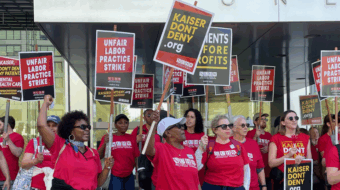
They are doing so, from coast to coast, in protests in cities as large as New York and as small as Harrisonburg, Va. Thus, the senatorial scramble to “do something.”
Cassidy’s panel convened a hearing on December 3 on health care costs, where he touted his legislation, claiming it would help taxpayers, not the insurance companies. He didn’t discuss the fact that it is completely inadequate. The two Republican-called witnesses then split: One advocated doing nothing, leaving people to the “mercy” of the insurers. The other backed Cassidy’s idea.
The sole Democratic witness, Dr. Claudia Fegan, the recently retired Chief Medical Officer for the Cook County (Chicago) public health care system, called Cassidy’s bill “a farce” which wouldn’t solve the problem, and still leave the insurers in control.
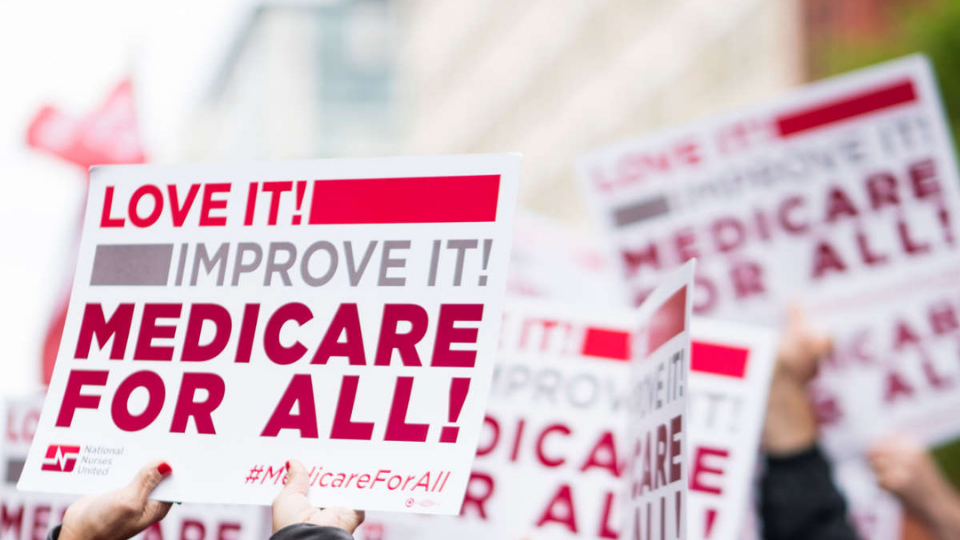
Dr. Fegan, now an officer in Physicians for a National Health Plan, touted Medicare for All as the solution. It’s a prime cause of Sen. Bernie Sanders, Ind-Vt., who leads the Democratic-Independent bloc on the panel, of her organization and of a dozen unions, led by National Nurses United.
The problem, again unspoken, is that the health insurers’ clout killed both Medicare For All and its weaker cousin, the “public option,” when Democratic President Barack Obama pushed the ACA through a narrowly Democratic Congress 15 years ago.
“An expanded Medicare for All system would solve many of our problems related to the cost of healthcare. We could have high-quality, trustworthy universal healthcare free of profit-driven conflicts of interest and deliver better health outcomes for Americans,” Dr. Fegan said.
In the meantime, “Without enhanced premium tax credits,” as the Democrats advocate, “people will die. The subsidies established in the Affordable Care Act and expanded in the American Rescue Plan Act allowed workers to purchase health insurance and saved lives.
“When 10 million people lose their Medicaid coverage because of the changes in the Republican reconciliation bill, over 42,000 people may die as a result,” said Dr. Fegan, citing studies in the Annals of Internal Medicine. Even now, with the subsidies, 31,000 die yearly because they can’t get—or can’t afford—health care coverage.
Under the past health care non-system, “Time and time again, I saw patients who came in with advanced conditions, like cancer, that could have been prevented or cured if they had come in earlier.
“I saw patients who came in with kidney failure, who needed dialysis that could have been prevented if their hypertension had been treated,” she added. Those impacts would return, she testified, without the subsidies.
“As people are looking at the increases in premiums they are facing on January 1st, they are weighing the decision to go without health insurance. There are patients trying to get screening tests done before the first of the year or to get preventive services while they can.
“Common sense and basic compassion teach us that treating high blood pressure to prevent a stroke is better than dealing with the possibility of permanent disability and rehabilitation. It saves money and lives to provide patients with chronic diseases such as diabetes and hypertension with routine care instead of waiting for their conditions to spiral out of control.”
We hope you appreciated this article. At People’s World, we believe news and information should be free and accessible to all, but we need your help. Our journalism is free of corporate influence and paywalls because we are totally reader-supported. Only you, our readers and supporters, make this possible. If you enjoy reading People’s World and the stories we bring you, please support our work by donating or becoming a monthly sustainer today. Thank you!
CONTRIBUTOR