RICHMOND, Va.—In what would be a major advance for organized labor in Virginia, Service Employees Local 512 is renewing its campaign to have the state be the official “employer” of thousands of home health care workers in the state to unionize.
But to do that, they must first get HB1263/SB378 through the state legislature. It would repeal the state’s Jim Crow-era ban on collective bargaining for state public workers, create a Virginia Home Care Authority to be their employer of record, and create a state Public Employee Relations Board to oversee the whole process—including follow-up union recognition elections.
If the union succeeds, Virginia would join a handful of other states, including California, New York, and Illinois, in establishing a state authority that would be the employer of the home health care workers, allowing them to unionize.
While home health care companies in Virginia are expected to fight the measure, there’s a new complication on the horizon: Home health care firms pay their workers with money they in turn receive from Medicaid, and the Republican-run Congress just slashed national Medicaid spending by more than $800 billion over the next decade to help pay for its 10-year $4.5 trillion tax cut for the 1%.
Virginia lawmakers approved a similar bill last year to let the home health care workers unionize, but then-Gov. Glenn Youngkin (R) vetoed it. But new Gov. Abigail Spanberger (D), a former moderate-to-liberal congresswoman who campaigned for the state’s top political job on a platform of accountability and affordability, and easily won, is considered more sympathetic.
The legislation is important for several reasons. One is that most of Virginia’s home health care workers are women of color, as is the case nationwide. Another is that home health care workers have been one of the most-exploited groups in the U.S. for decades, for both racial and political reasons.
The median wage for a Virginia home health care worker is $13.88 hourly, the union says, though the median in wealthier and more progressive Northern Virginia—which is now the state’s political heavyweight—is $17.97 hourly. Neither figure is close to a living wage in the Old Dominion, Local 512’s fact sheet says.
A third important point is that passage of the measure would mark yet another step in Virginia’s decades-long move away from what many consider the old racist Byrd Machine and its dominance. Lawmakers took a similar step under then-Gov. Ralph Northam (D), Youngkin’s predecessor. Northam signed a law to let local government workers unionize—if the local governments gave the OK first. They did in Northern Virginia.
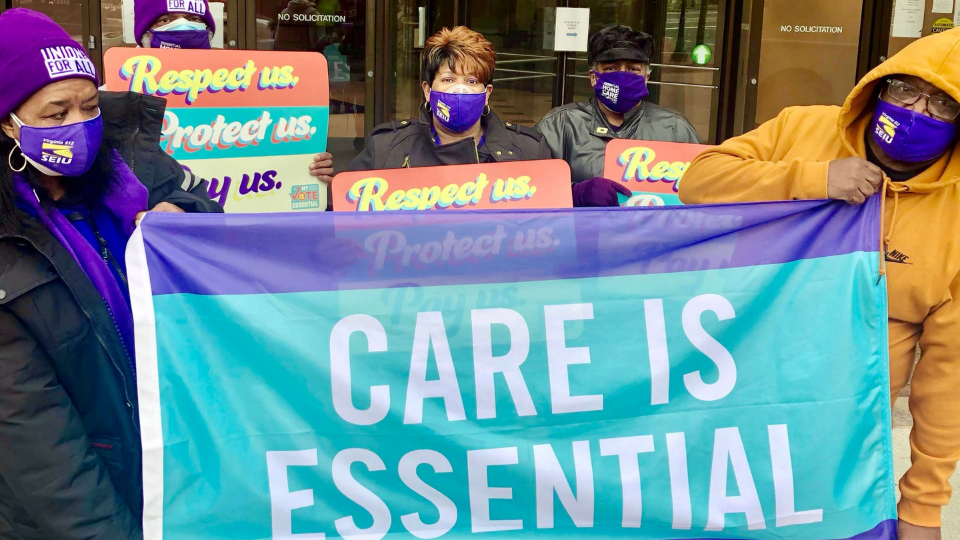
The union held a “Care Week” from January 19-23 to show lawmakers how vital home care work is and planned a two-day lobbying blitz on January 26-27. That may have been snowed out by the massive blizzard that buried the Northeast, the Mid-Atlantic States, the Midwest, and the trans-Mississippi states under mountains of snow, and most of the rest of the nation with subfreezing temperatures.
That didn’t stop Local 512 and home health care workers from advocating for their cause the week before.
“Home care workers paid through Medicaid provide life-sustaining support to seniors and people with disabilities—helping them bathe, dress, eat, and remain safely in their homes,” Local 512 said in a backgrounder.
“Despite the reality this work is often 24 hours a day, the Commonwealth only compensates workers for up to 16 hours, leaving them unpaid for overnight care, hospital bedside support, and other critical responsibilities. Many caregivers provide care for family members and are paid through state programs for this essential work.” The proposed legislation would remove that limit.
“Home care workers are providing essential care that makes all other work possible, yet they are denied dignity, fair pay, and a voice on the job,” Local 512 President LaNoral Thomas told a January 20 press conference in the state capital, Richmond. “Our Care Agenda is about moving Virginia forward: Investing in care, respecting workers, and ending policies rooted in a long history of undervaluing women and people of color and the work we do.”
Unionization, sponsors say, would also ease a looming home health care worker shortage in Virginia, which in turn is part of a nationwide shortage. That’s because the chance to bargain for higher pay, better benefits, and better working conditions would “make it easier to recruit and keep experienced workers, strengthen public services, and ensure working families can thrive,” Local 512 says.
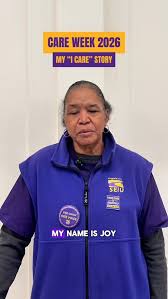
“I’ve been a home care worker for more than 30 years, and I’m here because this work—and the people we care for—deserve dignity,” home care worker Joy Barnes told the press conference. “We help seniors and people with disabilities live safely in their own homes, but too many of us are still living paycheck to paycheck without a real voice on the job.”
Right now, Barnes can’t afford to take a sick day when she falls ill. After a medical emergency from anemia, she struggled “to play catch-up” on bills—because she didn’t get paid while recovering. She’s also caught colds and infections—including some which required hospitalization—from clients.
Those are other reasons to approve the bill and let the home health care workers unionize, said Local 512 member Athena Jones. The home health care workers “are the backbone of the health care industry,” and let other people go to work, rather than staying home to provide unpaid care.
“We need the opportunity to be able to say what we need as home care workers—being able to thrive, not just survive,” Jones said. Home health care workers, she added, are often “treated as invisible” among other health workers
“We’re a part of the system that allows other people to be able to go to work, allows industries to thrive, allows opportunities where there may not be because the support isn’t there,” she said.
We hope you appreciated this article. At People’s World, we believe news and information should be free and accessible to all, but we need your help. Our journalism is free of corporate influence and paywalls because we are totally reader-supported. Only you, our readers and supporters, make this possible. If you enjoy reading People’s World and the stories we bring you, please support our work by donating or becoming a monthly sustainer today. Thank you!
CONTRIBUTOR