
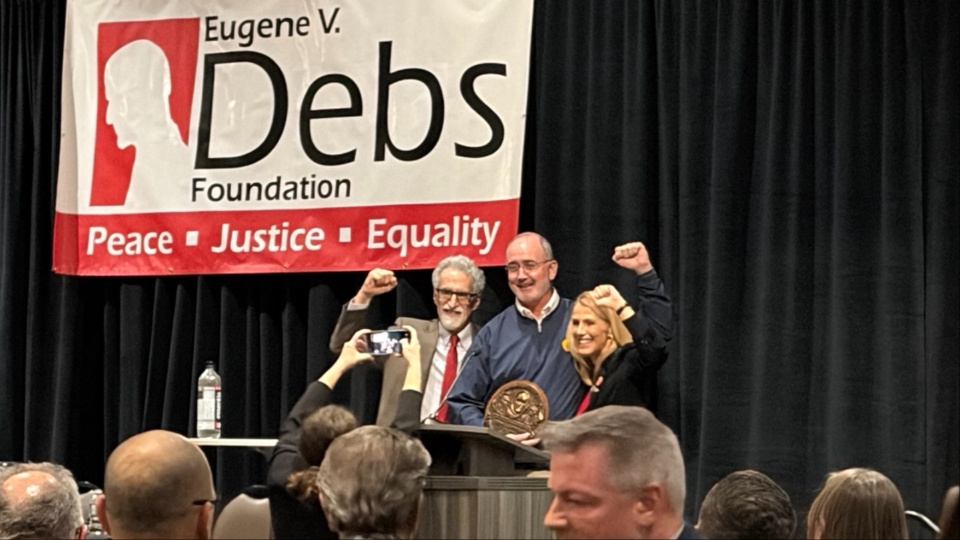
TERRE HAUTE, Ind.—A century after the death of Eugene V. Debs, the socialist who ran for president and got a million votes from a prison cell, the Eugene V. Debs Foundation that keeps his memory alive handed its highest honor to a labor leader who says he is still fighting Debs’ fight.
United Auto Workers President Shawn Fain accepted the 2026 Eugene V. Debs Award on Nov. 21 before a crowd of union members, retirees, and activists at the Terre Haute Convention Center. “We never win by playing it safe,” Fain told them. “We win by fighting back. We win by uniting in a common cause.”
Fain was born and raised in Kokomo, about two hours north of here, and he called the evening a homecoming. His mother, Stella Fain, and his sister made the drive down for it.
‘The most vital and potential power’
Annually since 1965, the award has gone to people and organizations that work in Debs’ spirit for industrial unionism, social justice, and world peace. The two most recent winners were Sen. Bernie Sanders in 2025 and Sara Nelson, president of the Association of Flight Attendants-CWA, in 2024.
Nelson, who joined others in nominating Fain for the award, introduced him by reading the words Debs spoke in Indianapolis in 1904, during his second run for president. She noted that he said them 33 years before the Flint Sit-Down Strike and 119 years before the UAW’s Stand-Up Strike.

“Ten thousand times has the labor movement stumbled and fallen and bruised itself, and risen again,” Debs said. It had been “enjoined by courts, assaulted by thugs, charged by the militia,” and “sold out by leaders.” Yet it remained “the most vital and potential power this planet has ever known,” and its mission of “emancipating the workers of the world from the thralldom of the ages” was “as certain of ultimate realization as is the setting of the sun.”
“Shawn Fain and the UAW embody that quote,” Nelson said.
She traced Fain’s rise to a hard-won victory for union democracy. For more than 70 years, a single caucus ran the UAW through a convention delegate system. A federal corruption probe made public in 2017 led 11 union officials, two former presidents among them, to plead guilty.
Rank-and-file reformers in Unite All Workers for Democracy, including Ford electrician Scott Houldieson, pushed for one member, one vote. In a 2021 referendum, members chose direct elections 63.7% to 36.3%.
In the first direct election, in 2023, Fain unseated the incumbent by 483 votes out of more than 138,000 cast. Months later he led the Stand-Up Strike against Ford, General Motors, and Stellantis. In October, members re-elected him with 68% of the vote, according to the union monitor’s preliminary tally, and sent his entire slate to the union’s executive board.
“It’s not enough to have a democratic process,” Nelson said. “You actually have to have people who are willing to stand up and fight for it.”
Nelson also credited Fain for putting the union’s weight behind calls to end the genocide in Gaza. “Because of those efforts, Shawn has been attacked by this government,” she said. “And the UAW members said, ‘Screw you.'”
Fain singled out Houldieson in his own remarks. “Without his fight, I wouldn’t be here,” he said. Houldieson won a seat in the Indiana legislature this month with 57% of the vote.
From the bread box to the ballot box
Fain drew a straight line from Debs to the founders of the modern UAW. While Debs was imprisoned at Moundsville, W.Va., for opposing World War I, he was visited by a young Walter Reuther and his brother Victor, brought by their father.
Victor Reuther later wrote that Debs taught their father the lesson he repeated to his sons: “There is a relation between the bread box and the ballot box.” What workers want to achieve, Fain said, “must be won not only in the workplace, but in the political arena as well.”

Fain’s own politics, he said, were forged in hardship. As an apprentice electrician with the International Brotherhood of Electrical Workers in Kokomo in the early 1990s, he paid bills on $80 a week in unemployment benefits. His family qualified for the Women, Infants, and Children (WIC) nutrition program to buy formula and diapers for their first child.
“These events shaped my beliefs of the reality of a system that, by design, doesn’t work for people,” he said. “It only works for the corporations and the richest people at the top.”
All four of his grandparents were what he called “economic refugees of the Great Depression” who came to Kokomo from Kentucky and Tennessee. His grandfather hired in at Chrysler in 1937, the year the UAW organized it, and saved every pay stub until he retired in 1972. Fain carries one of them to work every day, dated Sept. 25, 1939: 40 hours, $35.34.
“They lived what Eugene Debs preached,” he said: “the emancipation of the working class.”
That world, Fain said, was dismantled by corporate greed. Kokomo once had more than 12,000 General Motors jobs. When bargaining began in 2023, 63 were left.
‘Land of cornfields and communism’
Fain recalled how CNBC host Jim Cramer called the UAW’s 2023 demands class warfare and labeled him a communist.
“We’ve been in class warfare for our entire lives,” Fain said. “But what’s radical about wanting the working class to take our rightful place as the majority of society? What’s radical about wanting a decent life? What’s radical about justice?”
He said he laughs at the label. “I come from Kokomo, Indiana, the land of cornfields and communism,” he joked. “What’s radical isn’t what we’re proposing. What’s radical is what the rich and corporate class have done to us.”
Fain laid out four demands that he said unite working people everywhere: wages a person can live on, health care as a right, retirement security, and “getting our time back” from seven-day weeks and second jobs. Sixty percent of Americans have no retirement savings, he said, “not because they’re not responsible” but because nothing is left after the bills are paid.
He was blunt about how the billionaire class keeps workers divided, blaming diversity programs, immigrants, LGBTQ people, and religion for the damage done by corporate greed.
“When I see some destitute person trying to cross the border to find a better life, I don’t see the problem,” Fain said. “I see my grandparents.” The only difference, he said, was that his grandparents crossed state lines instead of national ones.
Drawing on his faith, he quoted Ecclesiastes: “A cord of three strands is not easily broken. That is what solidarity is.” He also urged the crowd to read Pope Leo XIV’s Magnifica Humanitas, which warns that artificial intelligence must serve “the good of all” and not a concentration of power. “Do you believe that’s what a handful of rich people want AI to be used for?” Fain asked.
The road ahead, he said, runs through a general strike on May Day 2028. “Every strike, every organizing drive, and every political election” is about “organizing, unifying, and mobilizing the working class to turn this system upside down.”
With Democrats taking the House this month, Fain said labor would not hand politicians a blank check. “We have to make demands, and we have to hold them accountable, because winning elections means nothing if they don’t take action,” he said.
He named the first demands: immediate legislation to lower the Medicare eligibility age, lifting the cap on Social Security taxes to keep the program fully funded, and increasing Social Security benefits. “We want to see all these types of things that benefit the people, not a handful of rich people,” Fain said.

“If they don’t get behind it, and they don’t support it, then we vote them the hell out, too,” he said. “And we keep pushing. We keep voting into office more and more people that we know are gonna fight for us.”
Fain closed by highlighting the continuity of the struggles Debs took on: the railroads of the 19th century and the auto plants of the 21st, politics “from a jail cell or the halls of Congress,” and war, “whether in Europe or like what we’ve seen in Gaza.”
“It’s in that spirit that I accept this award tonight,” he said, ending with Debs’ own words: “The earth for all the people. That is the demand.”
Voices from the floor
Among the guests, the talk turned to this month’s election, in which Democrats won control of the U.S. House. Adam Stant summed up the mood with a lyric from a Tom Morello song: “Revolution is the new f— you.”
Indianapolis District 13 Councilor Jesse Brown suggested:
“Let’s make sure the fights for workers’ needs are felt at every level of society. There are a lot of powerful Democrats who characterized this election as, on the national level, a repudiation of fascism. I think it’s important to show people that elections can have real consequences in people’s lives. The key will be showing people what political power within capitalism can actually deliver for working people, the limits of that, and for people to start thinking about what it would mean to go beyond that.”
Dave Brant, who grew up in Muncie, said his father was a union member in a town where “everyone had someone who was in the union.” Then the factory shut down and people left. This fall, he campaigned for a friend running for Congress and was stunned when neighbors told him they had voted for his candidate.
A week after the election, Brant texted the winner, urging him to back the PRO Act and a minimum wage increase. “If you live in a small town like that, there just isn’t opportunity, and it keeps getting worse and worse,” Brant said. “People want change, and that has to actually happen. We can’t just have hope. We have to have actual plans.”
No paywalls at People’s World
At People’s World, we believe news and information should be free and accessible to all, but we need your help. Our journalism is free of corporate influence and paywalls because we are totally reader-supported. Only you, our readers and supporters, make this possible. If you enjoy reading People’s World and the stories we bring you, please support our work by donating or becoming a monthly sustainer today. Thank you!
CONTRIBUTOR