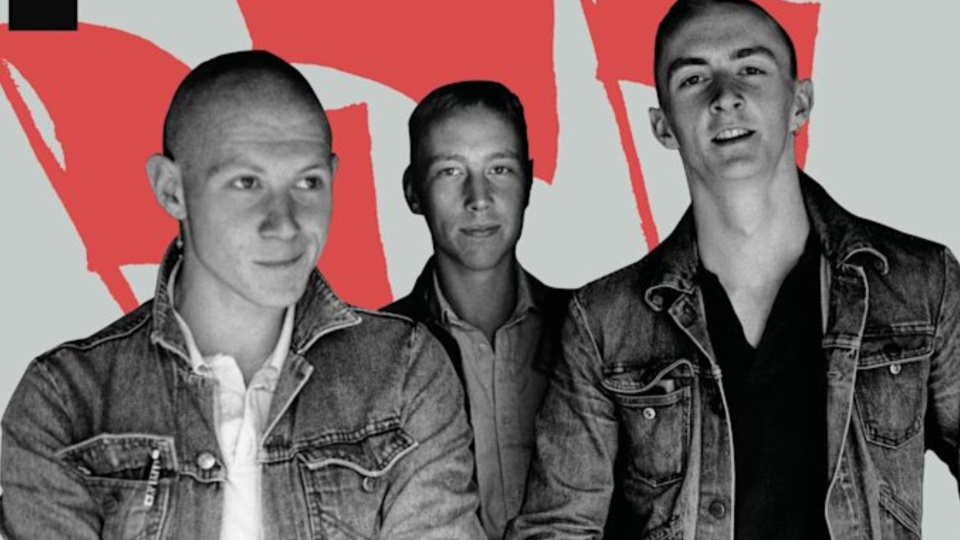
Editor’s note for U.S. readers: This article is reprinted from Morning Star, Britain’s daily socialist newspaper. In the United States, “skinhead” is often shorthand for neo-Nazi, and “Redskins” is rightly recognized as a slur against Native Americans. Neither meaning is what the band The Redskins, the subject of this book review, intended. The skinhead subculture began in late-1960s Britain among working-class youth, both Black and white, who borrowed their music and style from Jamaican immigrants: ska, rocksteady, reggae, and soul.
When the subculture revived in the late 1970s, far-right groups like the National Front and British Movement actively recruited skinheads, and the image of the racist skin took hold. Many skins resisted that takeover, and among them were left-wing and anti-fascist skinheads who called themselves “redskins,” with “red” meaning socialist or communist.
The band took that name to declare their politics and to reclaim a working-class youth culture from the far right. At the time, British listeners would have heard no reference to Native Americans in the name. Today, though, the word’s racist meaning in the U.S. is impossible to ignore, which is why it appears here only as the band’s name.
Marxism In Music by Gregor Gall hits bookstores this month. It is an important study of the seminal left-wing band The Redskins (1982-86), who formed to inject a much-needed revolutionary socialist message into Thatcherite Britain.
Gall’s book captures the zeitgeist of the era and the cultural and political environment into which the band inserted themselves. This was an era of mass unemployment under a government that was hell-bent on seeking confrontation with trade unions and embarking on post-imperial adventures in the South Atlantic.
The band’s first single, “Lev Bronstein” (London, 1982), whose title referred to Leon Trotsky’s birth name, signalled its musical manifesto. They were tenuously aligned with the Socialist Workers Party, so nods to Troskyism peppered their work at times. The band’s political ties with the SWP were often strained, however, due to the party’s rather austere views of working-class culture and its possibilities.
It was the follow-up single, “Lean on Me” (Decca, 1983), that really marked The Redskins’ breakthrough into the pop mainstream. It reached number three on the independent charts.
Gall provides a very good analysis of the band’s attempts to mix politics with pop music during the 1980s. He makes the broader observation that it is difficult to use music explicitly to convey left-wing messages, even during a decade when pop music was more overtly political and left-leaning.
 In his thorough research, he reminds us of the band’s involvement in Billy Bragg’s Red Wedge project. Despite its political idealism, Red Wedge was nevertheless an unsuccessful attempt to turn Britain’s youth culture towards supporting the Labour Party and its diluted form of social democracy.
Regardless of the difficulties involved in using three-minute pop songs to convey political complexity, The Redskins made some highly danceable political pop. Songs such as “Keep on Keeping On” (Decca, 1984), which supported the miners’ strike of 1984-85, filled dance floors while also serving as a political anthem for young people on the left during that period of working-class crisis.
If you want to learn about The Redskins, the band that aimed to “sing like The Supremes, walk like The Clash,” then Gall’s Marxism in Music is an excellent starting point.
Marxism in Music: Constructing a Communist Contra-Culture with The Redskins, Rock’n’roll, and Revolution
By Gregor Gall
Bloomsbury Publishing
Available here
Morning Star
No paywalls at People’s World
We hope you appreciated this article. At People’s World, we believe news and information should be free and accessible to all, but we need your help. Our journalism is free of corporate influence and paywalls because we are totally reader-supported. Only you, our readers and supporters, make this possible. If you enjoy reading People’s World and the stories we bring you, please support our work by donating or becoming a monthly sustainer today. Thank you!
CONTRIBUTOR