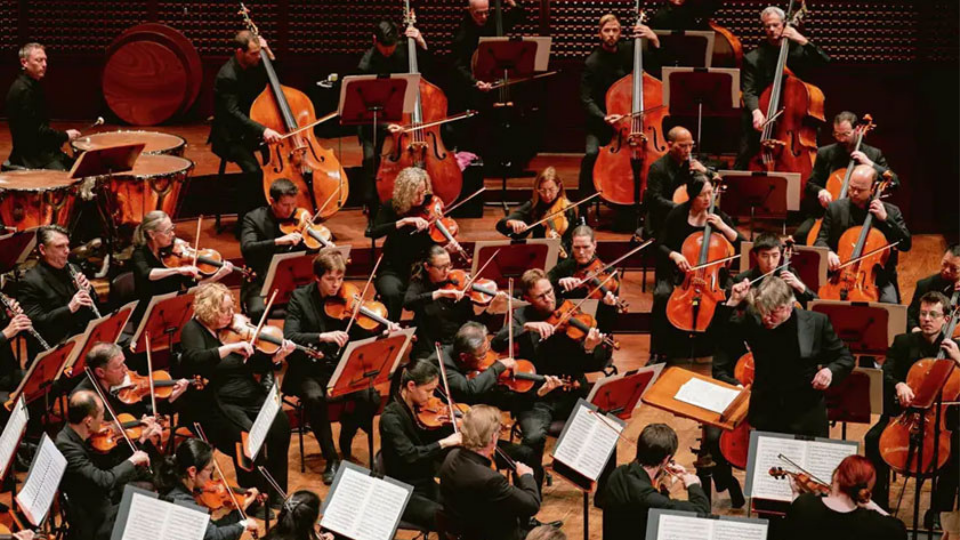
SAN FRANCISCO—There are a lot of sour notes sounding in San Francisco these days, as the artists of the city’s world-renowned symphony, members of Musicians Local 6, voted overwhelmingly to authorize a strike.
But dig a little deeper into the disc(h)ord, and you find it’s the symphony board that’s been off-key against its workers, and even its Music Director.
Two issues drove the San Francisco Symphony Orchestra to a strike authorization vote on September 4. One is a low-ball pay offer. The other is board misperformance. So the musicians want more accountability and a say in how the orchestra is run.
“Symphony leadership has not presented a contract that offers fair compensation, values artistic leadership, restores vital programming, or establishes proactive fundraising efforts and transparent financial practices,” the local said in announcing the strike authorization OK. “A labor action (could) take place at any time, which could come in the near future if a fair agreement is not reached.”
Indeed, reviewing the history of the board’s relations with its musicians, its chorus and with famed—and now-departed–Music Director Esa Pekka-Salonen, and stretching back over almost a decade, it looks like the board is mis-reading the orchestral score.
Playing under expired contract
This is an orchestra whose musicians have been playing under an expired contract since last Thanksgiving, plus two extensions through April 26. And the musicians worked without a contract for 300 days in 2022-23, after the coronavirus pandemic—which shut down U.S. orchestras–had peaked.
Last November, the musicians sang in tune with choral colleagues who had to fight the board. The choristers, members of the American Guild of Musical Artists, now return the support, with an open pro-musician letter signed by their entire bargaining committee.
Pekka-Salonen decamped after five years on the podium. The board made him an offer he could refuse. He took top posts this season with the Los Angeles Philharmonic and the Philharmonie de Paris, reported former San Francisco Chronicle music critic Joshua Kosman. Kosman called the board’s decision “bone-headed,” among other things.
The board’s been flipping musical pages on its finances, too. First, it said it ran a big $116 million deficit over 10 years, due to the pandemic. Then it said the red ink was only $46 million over 15 years. Local 6 counters that it actually had a surplus of $106 million from 2013-23, thanks to grants, investment gain,s and pandemic-era federal funds.
All this cacophony occurred on the eve of the San Francisco Symphony Orchestra’s new season. Its opening gala was scheduled for September 12, with the regular opening concert slated for six days later.
The chair of the orchestra’s bargaining committee, violist Dave Gaudry, told an orchestra-oriented publication that “It has become clear we have no choice but to plan for a strike. The proposals presented to us are still far below the bare minimum of what an acceptable offer looks like.”
But pay is only one sour note. The local challenges the quality of “organizational leadership, programming, and the financial health of the institution,” it said.
“A year after the high-profile and unexpected departure of the symphony’s music director due to disagreements with management and the board, there is still no new announced music director, no plan to resume touring, no plan to restore programming, and no known plans from the board to fundraise or increase philanthropy.”
San Francisco Symphony bosses and the board sidestepped all those issues. Instead, they offered a “last, best and final” three-year contract retroactive to last Thanksgiving with a 5.5% raise for the first year and 2% each successive year. There would also be pension increases. And it’s an old-time defined benefit pension, the board said.
The board also claimed the musicians would make more money beyond their base pay through overtime, seniority pay, and extra pay for performing outside the symphony’s main hall and in small ensembles.
“During the Covid-19 pandemic, the musicians accepted pay reductions to support the organization,” Local 6 responded. “As of May 2025, these salaries have not been fully restored to pre-pandemic levels. The musicians are the only group among peer orchestras whose pay has not been fully reinstated post-pandemic.
“Yet, symphony management has not only restored their own salaries to pre-pandemic levels but have dramatically increased non-musician salaries along with spending on administrative/non-artistic matters.”
We hope you appreciated this article. At People’s World, we believe news and information should be free and accessible to all, but we need your help. Our journalism is free of corporate influence and paywalls because we are totally reader-supported. Only you, our readers and supporters, make this possible. If you enjoy reading People’s World and the stories we bring you, please support our work by donating or becoming a monthly sustainer today. Thank you!
CONTRIBUTOR