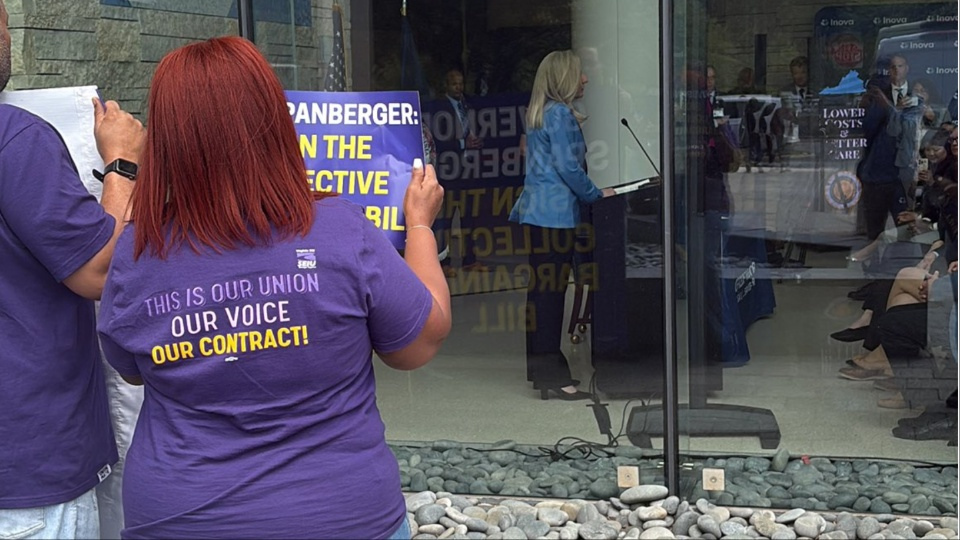
Last month, a veto by Virginia Gov. Abigail Spanberger threw labor into an uproar. Accusations of betrayal surrounded Spanberger’s legislative action culminating in a protest demonstration in Richmond’s Capitol Square on May 21. However, when viewed in the larger context of Virginia history, the governor’s action unfortunately stands in continuity with an anti-labor Democratic Party culture dating back some 80 years.
Spanberger’s veto of Bill 1263, legislation passed by Democratic Senators in the General Assembly, killed what would have been historic legislation. If it had become law, the measure would have dismantled the state’s Jim Crow-era “right-to-work” law found in Article 3 of the state codes. It would have granted half-a-million public service workers, including local government employees, home care workers, firefighters, and emergency medical workers, the ability to bargain collectively for fair wages and safer working conditions.
In Virginia, employment lawyer D.S. Gordon points out, right-to-work laws “restrict labor-management agreements requiring workers to financially support the union that represents them.” In other words, the burden on unions to represent all employees—including non-members not paying dues—cripples their finances, membership, and bargaining power.
Spanberger’s stance has changed on right-to-work laws since she was a congresswoman. In 2021 during the first session of the 117th Congress, she both co-sponsored and voted ‘Yea’ on the “Protecting the Right to Organize Act.” According to the AFL-CIO, the “PRO Act,” had it not died in committee, would have overridden state right-to-work laws. This pro-labor voting record provided “proof” for supporters to point to when Spanberger ran for governor in 2025.
However, apparently once Spanberger shifted from congressional work for District 7 to a statewide campaign for governor, her position on Right to Work laws shifted as well. She told local news outlet WRIC in May 2025:
“We have seen reforms and adjustments to it [the right-to-work law] over the years, and recognizing that as Virginia and our economy moves forward, reforms may be necessary into the future, but no, not a full repeal.”
In a statement released by Spanberger to the General Assembly, the governor explained that she vetoed the bill due to the rejection of “reform” amendments that she had put forth.
According to the Economic Policy Institute, the governor’s amendments would have the effect of “weakening the proposed collective bargaining framework…extensively.” So much so that it would become “optional.”
The fact that a Democratic governor in Virginia held the line on supporting instead of dismantling right-to-work law shouldn’t come as a total surprise. The state of Virginia has a long anti-labor history, including within the Democratic Party.
Indeed, Virginia has been a right-to-work state since the policy was introduced by Democratic Gov. William M. Tuck in 1947. During his tenure, Tuck not only ushered in an era of anti-labor legislation but also threatened to draft striking union members into the state militia and fought against progressive civil rights measures, including school desegregation.
Tuck was an ally of Harry F. Byrd, Sr.—a conservative Democrat and political powerhouse, leader of his own political machine, the Byrd Organization. A staunch opponent of both President Franklin Roosevelt’s New Deal reforms and the Civil Rights Movement, Byrd shaped the culture of democratic politics in Virginia for decades.
The Virginia Pilot reported in 1991 that then-Gov. Douglas Wilder took a hard stance supporting right-to-work laws. “I’m the governor of Virginia, and I strongly support the laws in Virginia,” he said at the time. Labor constituents were disappointed given Wilder’s working-class background and previous claims of support.
In 2019, the first time Democrats had taken control of the General Assembly since 1995, hopes were high for a right-to-work repeal. Democratic Gov. Ralph Northam shut down those hopes during an address to the Governor’s Advisory Council on Revenue Estimates (GACR). “I value our status as the best state for business. We’re going to work hard to keep it,” Northam said. “We also value our AAA bond rating, and I do not foresee Virginia taking actions that would hurt these, including repeal of the right-to-work law.”
And so, Gov. Spanberger takes her place in Virginia’s long line of anti-labor political leaders. The Virginia Mercury recently published an observation by Stephen Farnsworth, a political scientist at the University of Mary Washington that “Spanberger appears to be caught between two audiences”: vying for Republican support by sacrificing a progressive agenda that won’t turn the boat over for centrist Democratic approval. In other words, business as usual in a purple state. It’s a dirty business in Virginia.
As with all op-eds published by People’s World, the views reflected here are those of the author.
We hope you appreciated this article. At People’s World, we believe news and information should be free and accessible to all, but we need your help. Our journalism is free of corporate influence and paywalls because we are totally reader-supported. Only you, our readers and supporters, make this possible. If you enjoy reading People’s World and the stories we bring you, please support our work by donating or becoming a monthly sustainer today. Thank you!
CONTRIBUTOR