

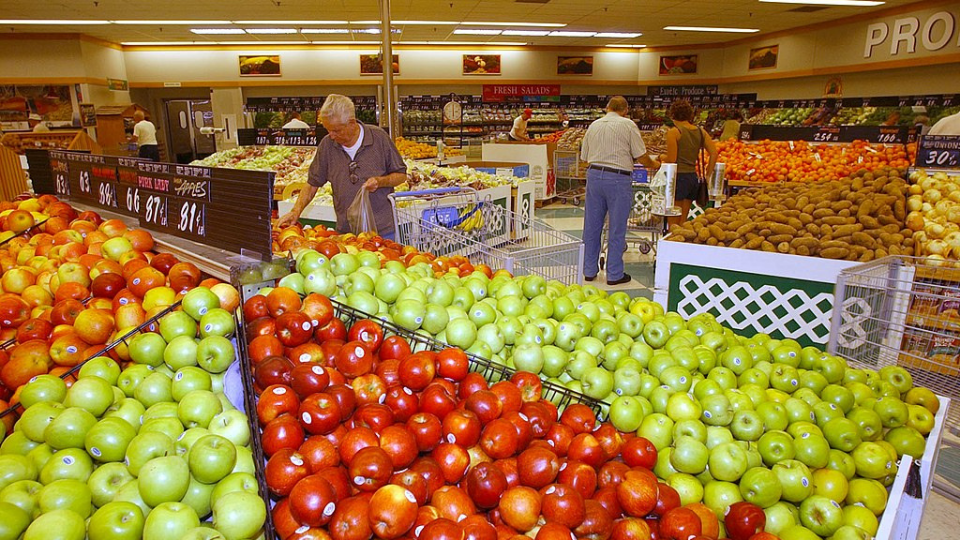
Following the June 24th Democratic mayoral primary victory of state representative Zohran Mamdani, the rich and powerful have spiraled into a frenzied panic. Among the allegedly “terrifying” policy proposals to them is the promise to create five citywide grocery stores.
Corporate media has been blasting out typical Red Scare propaganda about all of Mamdani’s popular affordability plans, including even his proposal for five municipal grocery stores in the vast city of eight million people. The New York Post compared the municipal stores to Soviet-style supermarkets.
John Catsimatidis, the owner, president, chairman, and CEO of the grocery chains Gristedes and D’Agostino Supermarkets in Manhattan, repeatedly compared Mamdani to Fidel Castro and Hugo Chavez. The Washington Post characterized it among other policies as a pie-in-the-sky dream of a worker’s paradise.
Grocery prices a political issue
Between 2020 and 2024, food prices in the United States rose by 23.6 %, deepening the strain on working-class families. This surge has been accompanied by rampant price gouging and price manipulation in the grocery store industry.
Meanwhile, the financial outcomes of major food retailers and wholesalers suggest that these rising costs translated into substantial profits, as their stock values increased dramatically in the first half of 2025. Companies such as Sprouts Farmers Market are up 29.1%, BJ’s Wholesale is up 20.4%, Village Supermarkets is up 20.1%, Kroger Company is up 16.4% and Walmart is up 8.7%.
While these companies continue to rake in record profits, they also consolidate more power by pricing out smaller stores and controlling larger portions of the market. Until the 1990s, most people shopped in local or regional grocery stores. Now, just four companies—Walmart, Costco, Kroger, and Ahold Delhaize—control 65% of the retail market.
This inherent tendency toward capital concentration extends beyond retail, shaping every aspect of the food system, from farming and manufacturing to distribution and sales.
Blueprint for public groceries
Mamdani’s entire campaign centered on the affordability crisis in New York City. Nearly one in four New York residents lives in a food-insecure household. Polling shows that 85% of the City pays more for groceries than they did last year, and 91% are concerned about the increasing costs of food. A staggering 66% of New Yorkers supported the idea of publicly owned grocery stores, including a striking 54% of Republicans.
Mamdani’s plan proposes five municipally owned and operated grocery stores, one for each borough of New York City. These five stores will be exempt from rent and property taxes, buy and sell at wholesale prices from centralized warehouses, and work with local vendors to keep prices low.
Most importantly, the stores wouldn’t need to generate a profit, allowing them to offer lower prices to consumers. During the campaign, Mamdani described the initiative as a “public option for produce.” The total cost of the program is estimated at $60 million—relatively modest in a city of 8 million people. Economists agree that the data is clear: “When the public sector steps in to correct market failures in the provision of essential goods, consumers benefit.”
Attempts to stir fear
Although many on the right and in the corporate media have attempted to stir fear by comparing the plan to so-called “authoritarian” regimes, similar initiatives already exist within the United States and have for a long time.
The modern grocery stores run by mega corporations are a relatively new part of American life. Cooperatives were common throughout the Great Depression in places like Chicago and Memphis. Multiple Greenbelt communities were created through the New Deal and featured public grocery stores. They emerged out of the need for survival and offered an alternative to the profit-driven logic of capital.
Currently, every branch of the U.S. military operates its own public grocery system, known as the exchange or PX, which includes tax-free commissaries and stores providing essential goods. With over $4.6 billion in annual revenue across 236 locations, the system rivals major national grocery chains in size and efficiency.
There are also several successful examples in small towns. In Kansas, publicly owned grocery stores operated in communities like Caney, Erie, and St. Paul. Larger cities like Madison, Wisconsin, and Atlanta, Georgia, also experimented with city-run groceries.
These efforts to counter corporate-controlled grocery systems aren’t limited to the United States—many successful models also exist around the world.
Greenland has 67 state-owned grocery stores
For example, Greenland’s government owns 67 grocery stores known as Pilersuisoq. Their stated mission, “We are responsible for supplying a selection of groceries and consumer goods at the best possible price to our customers. The aim is not for KNI to maximize its profits, but to ensure a responsible balance between the cost price we pay for a product, and what we sell it on for.”
In Bolivia, EMAPA is a state-owned organization established to manage food supplies and stabilize prices. It stores reserves in La Paz, processes grain into food products, and sells them to low-income families in urban areas at prices below the market rate.
The Pakistani state facilitates the Utility Stores Corporation with more than 5,500 outlets. It supplies millions of poor people with government-subsidized groceries and household goods. Essentials such as wheat flour, ghee, lentils, sugar, and rice were sold at prices 15 to 30 percent lower than the typical market rates. These stores served as a stabilizing force before they were targeted by the predictable IMF reforms.
The Bulgarian parliament recently approved a plan to create a government-owned grocery store chain with price caps. Agriculture Minister Georgi Tahov said, “Our aim is to improve access to essential products for citizens who currently have no nearby shopping options.”
These examples of publicly subsidized or government-owned grocery stores are found not only in socialist countries but also in capitalist ones where the state has intervened to support poor communities and ensure access to essential goods, further illustrating that public grocery models are both effective and politically pragmatic.
Why the ruling class panic?
Together, these examples make clear that public grocery systems are not only possible—they’re proven. Which raises a bigger question: why are the rich and powerful so afraid of even this most modest of reforms?
The massive right-wing and corporate reaction should be further investigated. There was no plan to close private grocery stores, enforce price controls on them, or seize their ownership for the public. Mamdani’s plan is merely a pilot program to offer one public option per borough—five stores, for over eight million people.
If corporations and the “free market” are truly more efficient than public programs, then these public grocery stores should surely fail on their own accord and fade into the dustbin of history. If socialism “doesn’t work,” as we’re constantly told, why not let it collapse under its own weight—unless, of course, the fear is that it might actually succeed.
Those that profit from our labor and the collective resources of our nation need to rely on the forty-year-old neoliberal lie that “there is no alternative.” The idea that we can run a society only if it allows the rich to pile up more and more profits is what makes this and other Mamdani plans so terrifying to them.
Toward food justice
Though wealthy and powerful businesses still hold an iron grip on all aspects of the food industry, the American working class can begin to chip away at that hegemonic control. Despite the United States and Israel voting against food as a human right at the United Nations, the American people overwhelmingly believe that food should be a human right.
The politics of food justice will be forged through mass struggle. It will take an enormous collective effort to overturn our profit-driven food system. What these programs ultimately look like—the way we ensure healthy food as a guaranteed right for all—will require experimentation, organizing, and persistence. One thing is certain: no capitalist should ever be in charge of the food supply.
To paraphrase the great political scholar Michael Parenti, capitalism is not a system about providing for the needs of the human community. The central purpose of capitalism is profits for the owners, and every other human value is secondary and at times antagonistic to that goal.
The fight for public groceries is just one small front in the larger class struggle for a society that puts the needs of people before profits. If we want a future where food is a right and not a commodity, we have to organize toward that end. The election of Mamdani will be a step in that direction.
As with all op-eds published by People’s World, the views reflected here are those of the author.
We hope you appreciated this article. At People’s World, we believe news and information should be free and accessible to all, but we need your help. Our journalism is free of corporate influence and paywalls because we are totally reader-supported. Only you, our readers and supporters, make this possible. If you enjoy reading People’s World and the stories we bring you, please support our work by donating or becoming a monthly sustainer today. Thank you!
CONTRIBUTOR



MOST POPULAR TODAY
As Iran war rages, Netanyahu builds ‘Greater Israel’ from Palestinian and Lebanese land

The other ‘lizard people’: Why the Epstein files are shattering global theory

Trump’s Postmaster General says USPS may shut down in a year

Rooted Resistance: Sustaining Detroit’s movements through education and revolutionary optimism

U.S. Student Association tells Congress: Save education, Stop the SAVE Act