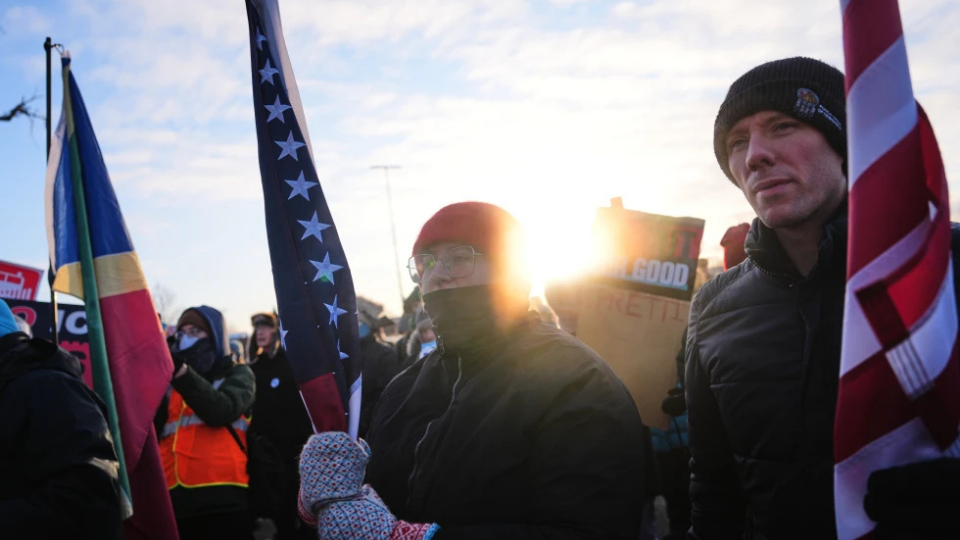
Roughly one in four Minnesota voters either participated in the Jan. 23 day of shutdown and protest against ICE, or have a loved one who did, according to new polling data.
Of those participants, 38% percent stayed off the job, either because they did not go to work, or because their employer closed for the day of action. The data does not distinguish between those who made the choice to stay out and those who saw their workplaces close. (Some workplaces were shuttered that day due to worker pressure.)
The poll was commissioned by the May Day Strong coalition, a network of local and national unions and community organizations, and was conducted by polling firm Blue Rose Research.
McKenzie Wilson, director of external affairs and message strategy at the firm, explained that researchers surveyed 1,940 Minnesotans who voted in 2024. The polling data can be viewed here.
Sixty percent of Minnesota voters said they had heard about the day of action “a lot,” and 23% “a little,” meaning a huge majority—83%—was aware of the action. It’s also important to note that a poll of 2024 voters excludes undocumented people, people younger than voting age, and disaffected voters who very well may have participated in the day of action.
The findings were celebrated by organizers as a sign of large-scale participation and support. “People were willing to take a real hit to their paycheck to demonstrate their resolve and the necessity of getting ICE out of their state,” said JaNaé Bates Imari, representative of the church, Camphor Memorial UMC, at a Jan. 30 press conference.
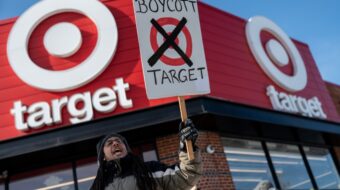
The mobilizations were part of a day of “no work, no school, no shopping” to protest the Trump administration’s deployment of thousands of armed, masked federal agents to the state. In the days leading up to the Jan. 23 day of action, major unions and labor federations endorsed the day of action. Among them was the executive board of the Minnesota AFL-CIO, a federation of more than 1,000 unions representing over 300,000 Minnesota workers.
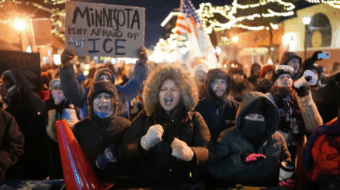
Organizers estimate some 50,000 to 100,000 protesters took to the streets of downtown Minneapolis that Friday, braving sub-zero temperatures, to demand federal immigration agents leave the state. Earlier that day, about 100 clergy were arrested in an act of civil disobedience at the Minneapolis-Saint Paul International Airport, the site of frequent deportation flights and worker abductions.
The poll found that 45% of voters “generally support the call for no work, no school, no shopping as a form of protest.” Two-thirds of Black voters supported the call, and numerous demographic groups saw at least 50% support: women, people under the age of 34, college-educated voters, Asian voters, and Hispanic voters.
As protesters nationwide continue to call for Democratic lawmakers to block continued funding to ICE, the poll also found that well over 80% of self-identified liberal voters supported the Jan. 23 action, with roughly one in five of those voters reporting that they or a loved one stayed home from work that day.
There was also significant participation from voters who did not go to college. (While the poll did not ask about income, college education is an imperfect indicator of lower-income or blue-collar workers.) Eighteen percent of respondents who did not go to college either participated or had a loved one participate in the day, compared to 29% of college graduates. And of the above participants, 39% of respondents who did not go to college declined to work that day, either because they stayed home or because their employer closed, compared to 38% of college graduates.
“Our workers are being impacted by what is happening in our communities by ICE every single day,” Chelsie Glaubitz Gabiou, president of the Minneapolis Regional Labor Federation, AFL-CIO, said at the Jan. 30 press conference. “We have workers who are being detained and workers who are being racially profiled and staying home.”
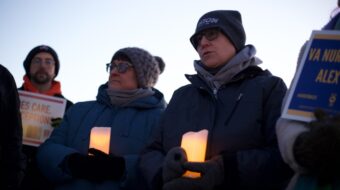
The January 23 day of action was followed by heartbreak for organizers and participants. “After our beautiful Day of Truth and Freedom, where 100,000 Minnesotans took action together, [federal] agents killed Alex Pretti on the streets of Minneapolis,” Bates Imari said at the press conference.
“And now we know that the federal government is also trying to Trump up charges, pun intended, against several peaceful ICE observers, against more peaceful protesters, against nonviolent protesters. And all of this in attempt to scare Minnesotans away from us doing what we do best: protect our neighbors, love on our people, care for our community.”
“ICE messed with the wrong profession,” said Mary Turner, president of National Nurses United. Pretti worked at the Department of Veterans Affairs Medical Center in Minneapolis and was a member of the American Federation of Government Employees Local 3669.
“Never get between nurses and our patients,” Turner said in a news release from the union, which noted that they were holding a week of actions and vigils in honor of Pretti and to call for justice for his murder. She added, “Nurses want ICE abolished. Not one more penny for their crimes.”
One commercial electrician at the protest, a member of IBEW Local 292, held a sign reading “General Strike is a Path to Justice,” and told me, “I mean, ICE is just deplorable.”
“I mean, anyone could get in the path of the ICE agents,” he said, as previously reported by In These Times. “It just infringes on our own civil rights.”
This article originally appeared in Workday Magazine and In These Times.
We hope you appreciated this article. At People’s World, we believe news and information should be free and accessible to all, but we need your help. Our journalism is free of corporate influence and paywalls because we are totally reader-supported. Only you, our readers and supporters, make this possible. If you enjoy reading People’s World and the stories we bring you, please support our work by donating or becoming a monthly sustainer today. Thank you!
CONTRIBUTOR