Oil, oil, oil, oil, oil—the word appeared five times in President Donald Trump’s Truth Social post on Tuesday announcing the U.S. military was imposing a “TOTAL AND COMPLETE BLOCKADE” of sanctioned oil tankers going into and out of Venezuela.
The White House occupant’s inability to restrain himself from openly coveting the South American nation’s natural resources exposed the emptiness of his administration’s claims that U.S. preparations for war in the Caribbean have any real connection to drug trafficking.

After illegal boat strikes that have so far killed 95 people and the stealing of an oil tanker in an act of piracy a week ago, Trump signaled that the next act in U.S. imperialism’s campaign to overthrow the government of Nicolás Maduro is about to open.
Venezuela holds 18% of the world’s proven oil reserves, making it the most petroleum-rich nation on Earth. In his announcement, Trump demanded it “return to the United States of America all of the Oil, Land, and other Assets that they previously stole from us.” He bragged of assembling the “largest Armada ever” and threatened the people of Venezuela with a “shock…like nothing they have ever seen before.”
When it comes to “stolen oil fields,” Trump is presumably referring to the major oil industry nationalizations that took place under late Venezuelan President Hugo Chávez nearly 20 years ago. It seems that energy giants like ExxonMobil, ConocoPhillips, BP, Total, Chevron, and others neither forgot nor forgave the Bolivarian Revolution’s expropriations of the early 2000s.
Instead of bolstering their profits, Venezuelan oil money has instead funded health, education, literacy, housing, and other social missions for the past few decades. Trump is out to help them recover some of those lost revenues. He asked energy executives for $1 billion in campaign cash during the 2024 election, promising he’d deliver their policy wish list in return. That meant environmental deregulation at home and, as is now apparent, war abroad.
The overthrow of the Venezuelan government, which has charted a path independent of U.S. control since 1999, would serve several other imperial goals beyond the seizure of oil riches. Since returning to office, Trump has been engaged in an effort to re-build a U.S.-dominated bloc, or sphere of influence, encompassing all of the Western Hemisphere.
His tariff wars, sanctions policies, and new National Security Strategy are all aimed at locking out competition for U.S. monopoly capital in North and South America—guaranteeing control of both markets and the natural resources needed to fuel the high-tech economy.
Venezuela—which maintains close economic ties with China, in particular, along with Russia, India, and other potential challengers to U.S. capitalist dominance—stands as a hurdle in the campaign to construct this U.S.-dominated hemispheric bloc.
Replacing its government with a puppet state friendly to U.S. corporate control would install another pliant partner akin to those in Argentina, Bolivia, Ecuador, Paraguay, Peru, and—as of this past weekend—Chile.
An armed embargo of oil exports from Venezuela also serves to tighten the noose around the neck of another victim of U.S. blockades—socialist Cuba. The country is highly dependent on its Venezuelan ally for energy, especially with its economy already reeling from the worsening effects of Washington’s six-decade economic siege.
Furthermore, a war at this moment would conveniently distract from Trump’s failing economic policies at home and the impending health care crisis that will come with the termination of Affordable Care Act insurance subsidies for millions of Americans.
In response to Trump’s menacing social media post, Maduro said it was a “warmongering threat” aimed at “stealing the riches that belong to our homeland.” The Venezuelan president told attendees at an event in Caracas, “Imperialism and the fascist right want to colonize Venezuela to take over its wealth of oil, gas, and gold, among other minerals.”
In Washington, there are moves underway to block Trump’s plans. Rep. Joaquin Castro, D-Texas, called the blockade “unquestionably an act of war.” He posted on social media that it would be “a war that the Congress never authorized and the American people do not want.”
Demand Progress is leading a campaign urging Americans to pressure Congress to support a Venezuela war powers resolution, which would restrict the White House from taking direct military action without congressional authorization.
The group’s senior policy advisor, Cavan Kharrazian, in a statement provided to People’s World, said that Trump “effectively declared a war with Venezuela through a Truth Social post.” He said Congress has the responsibility to “reclaim its constitutional war powers authority and stop us from being dragged into another foreign, regime-change war.”
The House of Representatives is due to vote on two resolutions that would rein in Trump’s aggression. One, sponsored by Rep. Gregory Meeks, D-N.Y, would suspend the deadly air strikes on boats in Venezuelan waters.
 A second resolution would ban land strikes in Venezuela or an all-out invasion of the country. It is sponsored by a bipartisan group of legislators, including Reps. Jim McGovern, D-Mass., Thomas Massie, R-Ky., Don Bacon, R-Neb., and Marjorie Taylor Greene, R-Ga.
The Communist Party USA is rallying its members to join in the effort to pass the resolutions. The CPUSA said it supports “the 70% who oppose another endless war for oil, which would endanger the region and world, all to enrich corporate profits.”
It demanded “immediate withdrawal of all funds from the lawless and unconstitutional military attacks on Venezuela” and that “Hegseth and the administration be held accountable for war crimes.”
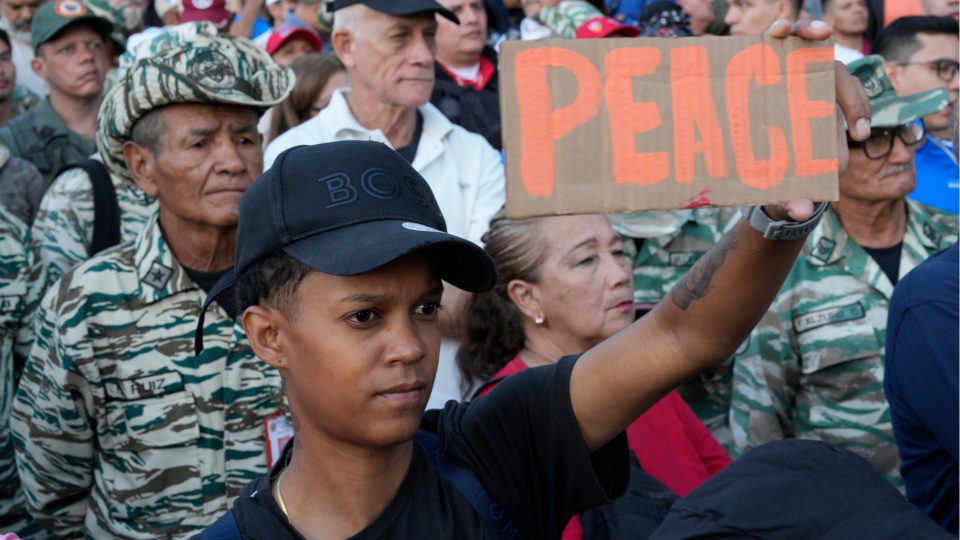
The parallels between what’s happening now and the lead-up to the 2003 U.S. invasion of Iraq—right down to the language used by administration officials to justify aggression—have been noted by many. The gigantic anti-war protests of that earlier era, however, do not yet have a contemporary equivalent.
Lobbying Congress to pass a war powers resolution is a valuable step forward, but, as one famed opponent of imperialism said 120 years ago, “we must not stop halfway.”
Stopping a war in Venezuela requires the widest possible mobilization—in the streets, on the phones, on social media, in workplace conversations—to pressure lawmakers and block Trump from launching another war on behalf of corporate monopoly and imperial domination.
The message must be spread far and wide: No blood for oil.
As with all op-eds published by People’s World, the views reflected here are those of the author.
We hope you appreciated this article. At People’s World, we believe news and information should be free and accessible to all, but we need your help. Our journalism is free of corporate influence and paywalls because we are totally reader-supported. Only you, our readers and supporters, make this possible. If you enjoy reading People’s World and the stories we bring you, please support our work by donating or becoming a monthly sustainer today. Thank you!
CONTRIBUTOR