WASHINGTON —The federal Department of Veterans Affairs (VA) has problems retaining doctors, nurses and other staffers, due to a mismanaged personnel system, favoritism and—now—the executive order by anti-worker GOP President Donald Trump.
So says Dr. Sheila Elliott, the president emerita of Government Employees (AFGE) Local 2328, who retired from that post, and from the VA’s Hampton, Va., Medical Center, where she was a pharmacist for 35 years. Her union represents some 320,000 VA workers, with National Nurses United representing its registered nurses.
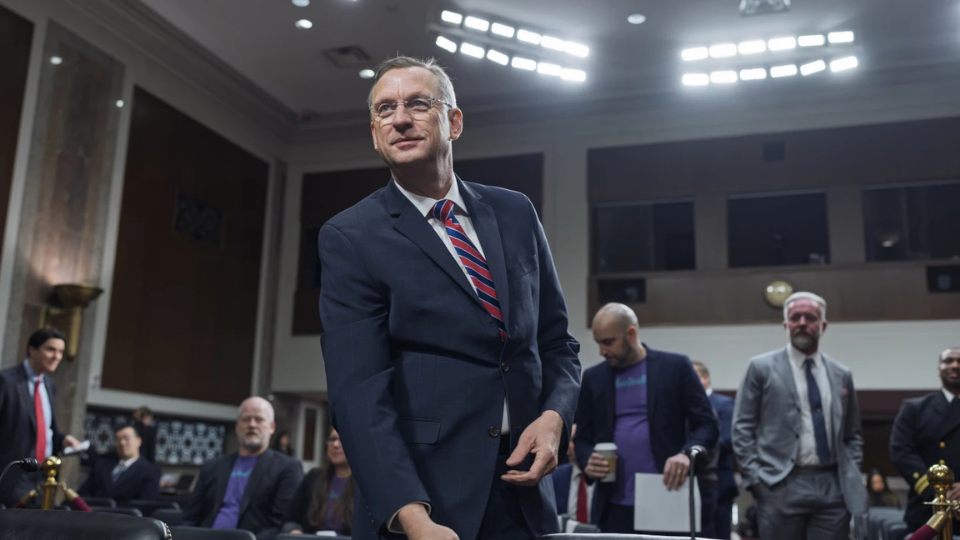
Elliott laid the problems out in detail before a Veterans Affairs subcommittee hearing. The panel’s ruling Republicans called the hearing after the VA’s own Inspector General issued a report highly critical of VA’s management—or mismanagement—of the workforce.
The report and Elliott’s testimony are important for several reasons. One is the shortage of workers they both identify, which in turn harms the care wounded, ailing and hospitalized veterans receive. One example she gave: A new satellite clinic in the Hampton area opened this year. It was supposed to have 550 staffers, including clinicians and nurses. It had 150.
Another is the chaos Trump’s order causes. It strips the VA workers Elliott represented of their collective bargaining agreement and their rights. Faced with no collective bargaining, no worker rights, no protection against bosses’ whims and prejudices and higher pay in the private sector, why would anyone want to work at the VA? Elliott asked.
Elliott pulled no punches. She first zeroed in on a bonus payment plan for the best practitioners, using her own Hampton hospital as an example.
The Inspector General “highlighted several problems with the administration and oversight of this recruitment, retention, and relocation bonus (“RRR bonus ”) program that AFGE agrees with.” Elliott began. The biggest problem, she said, was while VA used the bonuses to recruit and retain clinicians, it lacked any way to measure whether “the correct employees were receiving the benefits and that the process was carried out appropriately.” And those problems have lasted since 2017.
“Unfortunately, the report goes on to note the ‘OIG team found the Veterans Health Administration (VHA) did not take sufficient steps to sustain or enforce the updated VA policies to ensure incentive
Packages were completed appropriately before payments were initiated. Human resources staff acknowledged they did not always adhere to policy.” VHA runs the hospitals and clinics nationwide.
Making things even worse, VA started during Trump’s first term, in 2019, to consolidate all its human resources staff in the central office in D.C., rather than spreading them around the nation in the various hospitals and clinics, where HR personnel could directly see who was an outstanding worker, and who wasn’t.
“During this transition, according to human resources officials, turnover led to a shortage of trained staff to conduct incentive oversight responsibilities,” Elliott said. “AFGE has continuously criticized the HR centralization or modernization the Inspector General is citing, agreeing with the conclusion it led to increased turnover at the VA.” Which is the opposite of the “retention” point of the bonus program.
Since the VA kept no records or disorganized records of who got the bonuses or not, Elliott and the rest of Local 2238 did their own survey of 800 workers and presented the results to the lawmakers.
“Of the nine bargaining unit members [to] self-report, from a variety of professions, four recruitment bonuses, four retention bonuses, and on relocation bonus were awarded,” Elliott testified. “These bonuses were awarded between 2021 and 2025. While AFGE is pleased that at least nine employees received these RRR bonuses, we have no way of knowing if this benefit is being under-, properly, or over-utilized at Hampton Veterans Administration Medical Center compared to the rest of the Veterans Health Administration.
“However, regardless of its relative utilization to other facilities, I can say with decades of experience at this facility that there is significant room for improvement.”
And then came Trump, his VA Secretary, former Rep. Mac Collins, R-Ga. Elliott told the lawmakers the executive order, stripping an estimated one million federal workers of their collective bargaining rights—including the VA workers—only made a bad situation worse.
Existing law trashed by Trump
The existing federal civil service law, which Trump’s executive order trashed, “governs the merit-based system of selecting most federal employees, protects whistleblowers, and provides due process to federal employees who have been unfairly disciplined or terminated,” Elliott explained.
“Continuing to deny large swaths of the VA workforce collective bargaining rights will continue to harm recruitment and retention. As there is a critical shortage of health professionals in this country, why would high-quality candidates want to serve in the VA, when they would retain not only union protections, but better salaries in the private sector?
“This is particularly egregious, as Secretary Collins played favorites when choosing whom to exempt from the EO, not by job description or duties, but by which union represents the employees in question.”
During his first term, though Elliott did not discuss it, Trump pushed intermediate steps to privatize the VA, to put the nation’s largest hospital system in the hands of Wall Street profiteers.
He filled top posts at the VA with corporate denizens. He named a shadow committee of executives who exercised great control over the VA and its sprawling hospital and clinic system.
The avowed aim then of Trump, his White House aides and the shadow orporate committee was to force vets to seek private, more expensive, doctors with less knowledge of the unique battlefield injuries and illnesses veterans suffer. That redirection of care would be a prelude to turning over the VA hospitals and clinics to the private sector. But protests from AFGE and outrage from veterans groups stopped that scheme in its tracks.
Elliott had several suggestions for lawmakers to solve the problems which both AFGE Local 2328 and the agency’s own inspector general identified. One was “rein in the abuse by management” of the section of federal law that lets VA bosses pick and choose and play favorites among the workers. Doing so “would be a critical step to improve recruitment and retention of the VA workforce,” she said.
“While AFGE and other unions are subjected to” Trump’s order, “There is no contract for affected employees to file a grievance under. AFGE urges, particularly after the result of litigation or legislation related” to Trump’s mandate that the panel rewrite the law “to better retain” the workers.
And that includes stopping Trump’s headlong rush to force every one of the 2.2 million federal workers back to their desks, even those who had no desks to go to before the coronavirus pandemic.
“AFGE has long argued for the benefits of allowing telework or remote work for employees who can perform their duties remotely…This is particularly true for clinicians who practice in whole or in large part through telemedicine. Since most telework has been rescinded by this administration, many clinicians had to report to a VA facility, and have been required to interact with patients remotely, often in crowded bullpens, to discuss private matters.
“This has harmed morale and retention of mission-critical and hard-to-recruit clinicians at the VA.
“Ironically, one of the recruitment and retention bonuses AFGE could find was awarded to a former Hampton VAMC employee who for the last three years was a remote mental healthcare provider who was leaving their position due to the end of remote work.
“However, instead of leaving the VA, this employee received a relocation bonus to move to another facility. This has negatively affected the capacity of Hampton and reflects VA’s overly broad approach to telework and telehealth.”
We hope you appreciated this article. At People’s World, we believe news and information should be free and accessible to all, but we need your help. Our journalism is free of corporate influence and paywalls because we are totally reader-supported. Only you, our readers and supporters, make this possible. If you enjoy reading People’s World and the stories we bring you, please support our work by donating or becoming a monthly sustainer today. Thank you!
CONTRIBUTOR